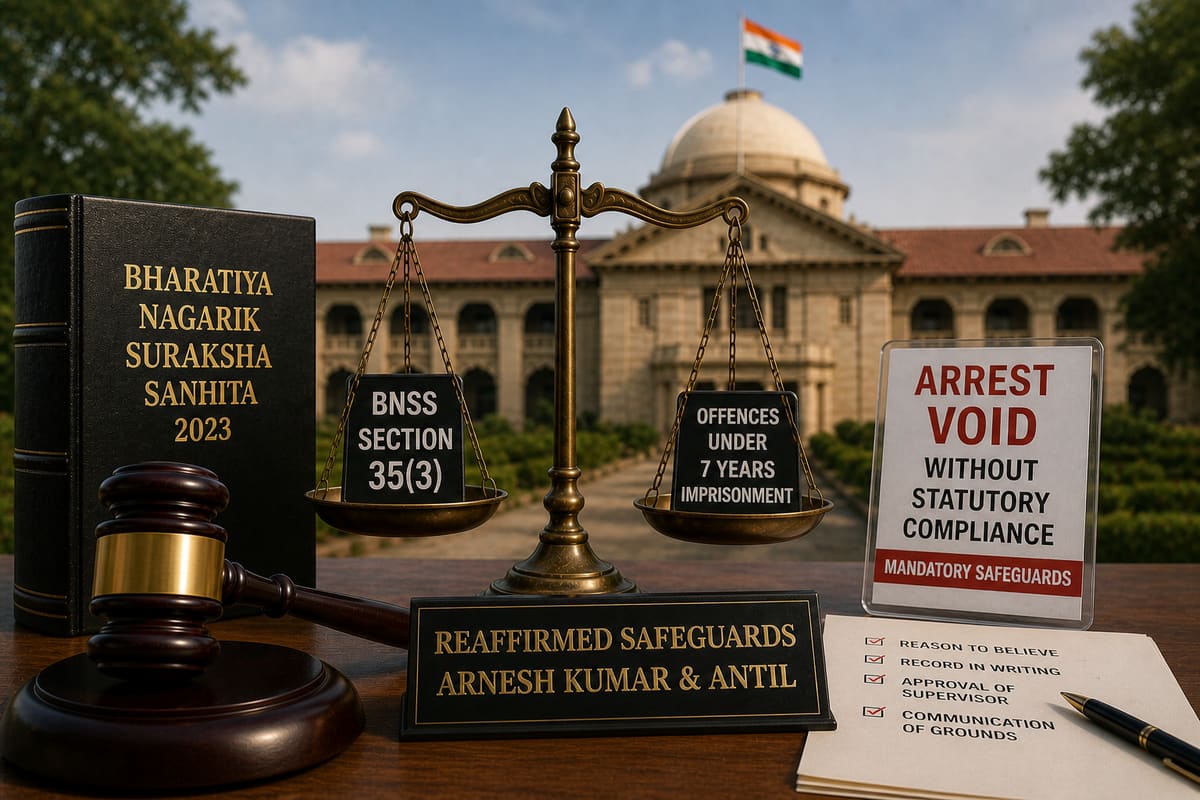
The Telangana High Court has delivered a significant ruling on the procedural requirements for arrest under the Bharatiya Nagarik Suraksha Sanhita, 2023 (BNSS). The Court held that where the prescribed punishment for an offence is below seven years, police must issue notice under Section 35(3) of BNSS before making an arrest. Failure to do so renders the arrest illegal, entitling the accused to bail.
Background & Facts
The Dispute
The petitioner, Ramavath Devichand, was accused of offences under Sections 5(1) read with 6 of the Protection of Children from Sexual Offences Act, 2012 (POCSO Act). The complaint alleged that the petitioner, acquainted with the victim (a 10th class student residing in a hostel), had behaved inappropriately with the victim on multiple occasions. The victim disclosed this to his father, who filed a complaint on 24.01.2026.
Procedural History
The key procedural steps in this case were:
- 24.01.2026: Complaint lodged by the victim’s father
- 26.01.2026: Petitioner arrested and remanded to judicial custody
- 12.03.2026: Criminal Petition filed under Sections 480 and 483 of BNSS seeking bail
The petitioner contended that the arrest was illegal as the police failed to issue notice under Section 35(3) of BNSS, which mandates notice before arrest for offences punishable with imprisonment below seven years.
The Legal Issue
The central question before the Court was:
Whether the arrest of an accused under the POCSO Act without issuing notice under Section 35(3) of BNSS is illegal, thereby entitling the accused to bail?
Arguments Presented
For the Petitioner
The petitioner’s counsel, Sri Akkam Eshwar, argued:
- The punishment for the offence under Section 8 of the POCSO Act is below seven years, making notice under Section 35(3) of BNSS mandatory before arrest
- The police erroneously arrested the petitioner without issuing such notice, rendering the arrest illegal
- The petitioner had been in custody since 26.01.2026, and bail should be granted considering the period of incarceration
For the Respondent
The Additional Public Prosecutor, Sri M. Ramachandra Reddy, opposed the bail application on the following grounds:
- The allegations against the petitioner were grave and serious, involving repeated inappropriate behaviour with a minor
- The investigation was at an initial stage, and releasing the petitioner on bail could lead to intimidation of the victim or witnesses
- The petitioner was not entitled to bail as the offence involved moral turpitude and potential harm to the victim
The Court's Analysis
The Court examined the procedural requirements under BNSS and the nature of the offence. Key observations included:
-
Mandatory Notice Under Section 35(3) of BNSS:
"Since the punishment prescribed is below seven years for the alleged offence, the police instead of issuing notice under Section 35(3) of BNSS, erroneously arrested the petitioner."
The Court emphasised that Section 35(3) of BNSS requires police to issue notice before arresting an accused for offences punishable with imprisonment below seven years. The failure to do so rendered the arrest illegal.
-
Period of Incarceration and Progress of Investigation: The Court noted that the petitioner had been in custody since 26.01.2026 and that ten witnesses had been examined. While the allegations were serious, the Court deemed it appropriate to grant bail considering the period of incarceration and the progress of the investigation.
-
Balancing Investigation and Liberty: The Court acknowledged the State’s concern about potential intimidation of witnesses but held that the illegal arrest and the duration of custody warranted the grant of bail, subject to stringent conditions.
The Verdict
The Court allowed the Criminal Petition and granted bail to the petitioner, subject to the following conditions:
- Execution of a personal bond for Rs. 25,000 with two sureties of the like sum
- Appearance before the concerned Station House Officer (SHO) every Wednesday for eight weeks or until the filing of the charge sheet, whichever is earlier
- Compliance with the conditions stipulated under Section 483(2) of BNSS
What This Means For Similar Cases
Arrest Without Notice Under BNSS Is Illegal
- Practitioners must now argue that for offences punishable with imprisonment below seven years, Section 35(3) of BNSS mandates notice before arrest
- Failure to issue notice renders the arrest illegal, entitling the accused to bail as a matter of right
- Courts are likely to scrutinise arrest procedures more rigorously, especially in cases involving offences with prescribed punishments below seven years
Bail Conditions Can Mitigate Investigative Concerns
- The Court balanced the need for investigation with the liberty of the accused by imposing stringent bail conditions
- Practitioners can argue for bail in similar cases by proposing conditions such as:
- Regular appearance before investigating officers
- Restrictions on travel or communication with witnesses
- Compliance with Section 483(2) of BNSS
POCSO Act Cases Require Strict Procedural Compliance
- Even in cases involving serious allegations under the POCSO Act, procedural compliance under BNSS is non-negotiable
- Courts may grant bail where procedural lapses are established, notwithstanding the gravity of the offence
- Defence counsel should scrutinise arrest procedures in POCSO cases to identify violations of BNSS provisions