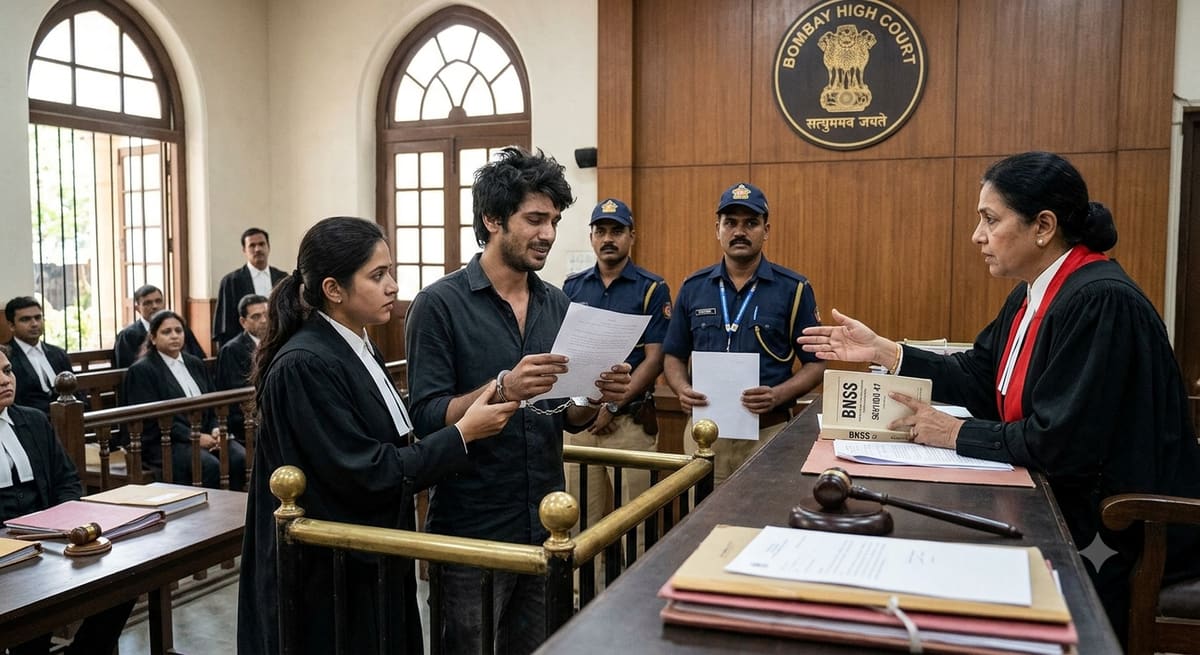
The Bombay High Court has reaffirmed that the failure to communicate grounds of arrest in writing renders an arrest illegal under the Narcotic Drugs and Psychotropic Substances Act, 1985, irrespective of the gravity of the offence. This ruling reinforces the constitutional mandate of procedural fairness and sets a clear precedent for compliance in all custodial cases.
Background & Facts
The Dispute
The applicant, Mahendra Chandra Singh, was arrested on 3rd February 2024 in connection with Crime No. 8 of 2024 registered with the DCB CID, Unit VIII, Andheri, Mumbai. The case involves alleged offences under Sections 8(c), 22(c), and 29 of the Narcotic Drugs and Psychotropic Substances Act, 1985 (NDPS Act). The applicant was taken into custody while already in judicial custody for another unrelated offence.
Key Facts
- The applicant was arrested on 03.02.2024 by officers of the DCB CID, Unit VIII, Mumbai
- No written grounds of arrest were provided to the applicant at the time of arrest or thereafter
- The applicant was not produced before a magistrate within 24 hours as mandated under Section 57 of the CrPC
- The arrest form allegedly recorded that grounds were communicated, but no written document was handed to the applicant
- The applicant has been in custody since 03.02.2024 without formal charges being framed
- The applicant has not been granted any interim relief in the trial court
Procedural History
- 03.02.2024: Arrest of applicant without written grounds of arrest
- 04.02.2024: Production before Magistrate; no written grounds furnished
- 05.02.2024: Remand order passed by Magistrate
- 15.03.2024: Charge sheet filed by DCB CID
- 10.04.2024: Applicant filed application for bail before the Trial Court; rejected on grounds of seriousness of offence
- 20.04.2024: Application for bail filed before Sessions Court; dismissed
- 15.05.2025: Criminal Bail Application No. 3597 of 2025 filed before the Bombay High Court
The Parties' Positions
Applicant’s Position: The arrest is illegal because no written grounds were furnished, violating the mandate laid down in Pankaj Bansal v. Union of India and Ahmed Mansoor v. State. The applicant was not informed of the reasons for his detention in writing, which is a mandatory constitutional requirement.
Respondent’s Position: The State contends that since the applicant was already in custody for another offence, the formal communication of grounds was unnecessary. The State further argues that the arrest form records verbal communication of grounds, and that the Supreme Court’s decision in State of Karnataka v. Sri Darshan permits substantial compliance.
Relief Sought
The applicant seeks immediate release on bail on the sole ground that his arrest was illegal due to non-communication of written grounds of arrest, as required by binding Supreme Court precedents.
The Legal Issue
The central question was whether non-communication of grounds of arrest in writing, as mandated by Pankaj Bansal v. Union of India, renders an arrest illegal under the NDPS Act, even if the arrestee was already in custody for another offence.
Arguments Presented
For the Appellant/Petitioner
Learned counsel for the applicant relied on Pankaj Bansal v. Union of India (2024) 7 SCC 576, which held that written communication of grounds of arrest is mandatory and non-negotiable under Article 22(1) of the Constitution. He further cited Prabir Purkayastha v. State (NCT of Delhi) (2024) 8 SCC 254 and Vihaan Kumar v. State of Haryana to reinforce that procedural compliance is not optional. He emphasized that Ahmed Mansoor v. State (Criminal Appeal No. 4505 of 2025) explicitly overruled any notion of "substantial compliance" and held that failure to provide written grounds invalidates the arrest itself. The applicant’s detention, therefore, was unlawful from inception.
For the Respondent/State
The Additional Public Prosecutor contended that since the applicant was already in judicial custody for a separate offence, the requirement of written grounds was dispensed with under the doctrine of "practical necessity." She relied on State of Karnataka v. Sri Darshan (14.08.2025), arguing that the Supreme Court had recognized that technicalities should not override substantive justice in NDPS cases. She further submitted that the arrest form recorded verbal communication of grounds, which amounted to compliance.
The Court's Analysis
The Court undertook a rigorous analysis of the Supreme Court’s evolving jurisprudence on arrest procedures. It noted that Pankaj Bansal had unequivocally held that the right to be informed of grounds of arrest in writing is not a mere procedural formality but a substantive constitutional safeguard under Article 22(1). The Court observed that Ahmed Mansoor had directly addressed and rejected the State’s reliance on Sri Darshan, clarifying that the latter did not create an exception for NDPS cases or for persons already in custody.
"The failure to communicate grounds of arrest in writing is not a mere technical irregularity; it strikes at the very foundation of the arrest’s legality and renders it void ab initio."
The Court rejected the State’s argument that verbal communication suffices, noting that the arrest form, even if signed, does not constitute a written communication to the arrestee. The Court emphasized that the Constitution requires the arrestee to be informed personally and in writing, not merely recorded by the police. The Court further held that the applicant’s prior custody for another offence does not negate the State’s obligation to comply with Article 22(1). The Court concluded that the arrest was illegal and that the applicant’s continued detention was unlawful.
The Verdict
The applicant succeeded. The Court allowed the bail application and directed the applicant be enlarged on bail upon furnishing a personal bond of Rs. 50,000 with one or two local sureties in the like amount. The applicant is directed to report to the DCB CID, Unit VIII, Andheri, Mumbai once every month until the conclusion of trial, and to attend all hearing dates unless exempted by specific order. Any breach of these conditions shall result in immediate cancellation of bail. The Court clarified that this order is based on prima facie review and does not prejudice the trial court’s final determination.
What This Means For Similar Cases
Written Grounds Are Non-Negotiable
- Practitioners must now challenge any arrest under NDPS Act or other statutes where written grounds are not furnished, regardless of the accused’s prior custody status
- Police records (arrest forms) alone cannot substitute for actual written communication to the arrestee
- Bail applications must be framed around Article 22(1) violations as a standalone ground for release
Pre-Custody Status Does Not Exempt Compliance
- Even if an accused is already in judicial custody for another case, the State must still provide written grounds for each new arrest
- Courts will not accept "practical necessity" as a justification for violating constitutional safeguards
- This ruling applies equally to all offences under the NDPS Act, CrPC, and other statutes requiring arrest
Procedural Violations Trigger Automatic Relief
- Illegal arrest due to non-communication of written grounds is now a sufficient ground for bail, irrespective of the nature of the offence
- Courts are no longer required to weigh the seriousness of the offence when the arrest itself is unlawful
- This creates a powerful tool for defence counsel to secure interim liberty in high-stakes NDPS cases