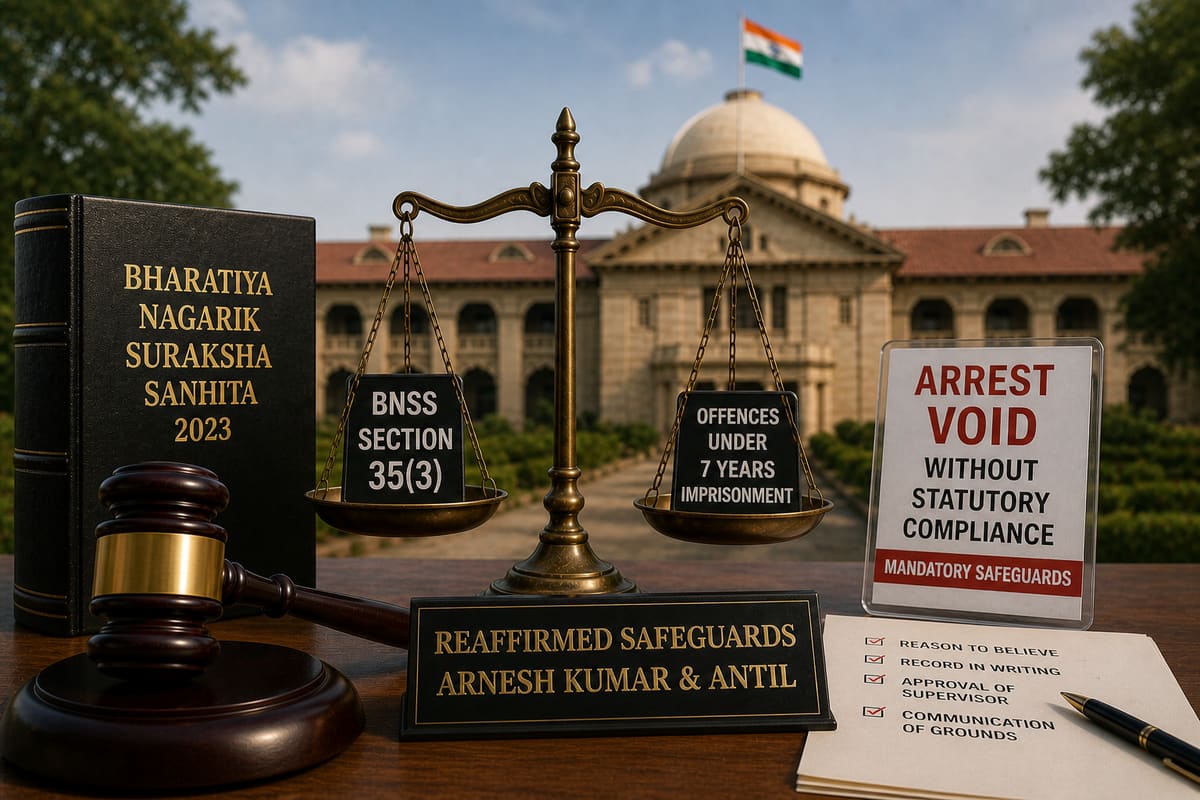
The Uttarakhand High Court has reaffirmed that the procedural safeguards established in Arnesh Kumar v. State of Bihar remain binding even under the new Bharatiya Nagarik Suraksha Sanhita, 2023. In a significant ruling, the Court directed Investigating Officers to issue mandatory notices under Section 35(3) BNSS before resorting to arrest in offences punishable with up to seven years’ imprisonment, reinforcing the principle that arrest is not automatic.
Background & Facts
The Dispute
The petitioners, whose identities are not disclosed in the judgment, were named as accused in FIR No. 0079 of 2026, registered at Police Station Kaliyar Sharif, District Haridwar, on 24.04.2026. The FIR implicates them in multiple offences under the Bharatiya Nagarik Suraksha Sanhita, 2023 (BNSS), including Sections 115(2), 132, 190, 191(2), 191(3), 324(4), 351(2), 351(3), 352, and 79. All these offences carry a maximum punishment of up to seven years.
Key Facts
- The FIR was registered on 24.04.2026 without prior notice to the petitioners.
- No record of any notice under Section 35(3) BNSS was produced by the Investigating Officer.
- The petitioners were not arrested at the time of filing the petition but faced imminent threat of arrest.
- The petitioners are not alleged to have fled, destroyed evidence, or tampered with witnesses.
- The State did not dispute that the offences are non-bailable but punishable with a maximum of seven years.
Procedural History
- 24.04.2026: FIR No. 0079 of 2026 registered at Police Station Kaliyar Sharif, Haridwar.
- 05.05.2026: Writ Petition (WPCRL/781/2026) filed before the Uttarakhand High Court seeking quashing of the FIR and direction to follow due process.
- 05.05.2026: Hearing conducted before Hon’ble Justice Rakesh Thapliyal.
- 05.05.2026: Court disposed of the petition with directions.
The Parties' Positions
For the Petitioners
- Argued that all offences under the FIR are punishable with a maximum sentence of up to seven years.
- Relied on Arnesh Kumar v. State of Bihar (2014) 8 SCC 273 to assert that arrest cannot be the default step.
- Contended that the Investigating Officer is legally bound to issue notice under Section 35(3) BNSS before arrest.
- Stated that no grounds for immediate arrest, such as risk of flight or evidence tampering, were alleged.
For the Respondent/State
- Did not dispute that the offences attract a maximum sentence of up to seven years.
- Acknowledged the applicability of Arnesh Kumar guidelines.
- Did not oppose the prayer for issuance of notice under Section 35(3) BNSS.
- Noted that some petitioners have a history of criminal conduct, but did not provide specific evidence to justify bypassing procedural safeguards.
Relief Sought
The petitioners sought:
- Quashing of FIR No. 0079 of 2026.
- Direction to the Investigating Officer to comply with Arnesh Kumar guidelines.
- Mandatory issuance of notice under Section 35(3) BNSS before any arrest.
The Legal Issue
Whether the Investigating Officer is legally obligated to issue a notice under Section 35(3) of the Bharatiya Nagarik Suraksha Sanhita, 2023 before arresting an accused in offences punishable with up to seven years’ imprisonment, in light of the Supreme Court’s directives in Arnesh Kumar v. State of Bihar.
Arguments Presented
For the Petitioner
The petitioners relied on Arnesh Kumar v. State of Bihar to argue that arrest is a last resort and must be preceded by a notice under the relevant provision. They contended that Section 35(3) BNSS mirrors the intent of Section 41A CrPC, requiring the Investigating Officer to issue a notice requiring the accused to appear before him before resorting to arrest, unless there are compelling reasons to believe the accused will abscond or obstruct justice. The petitioners emphasized that no such exceptional circumstances were pleaded in the FIR or during the hearing.
For the Respondent/State
The State did not contest the applicability of Arnesh Kumar or the requirement under Section 35(3) BNSS. While noting that some petitioners had a prior history of criminal conduct, the State did not present any specific evidence or material to justify immediate arrest. The learned AGA conceded that the offences are punishable with up to seven years and that the procedural safeguards must be followed.
The Court's Analysis
The Court examined the legislative intent behind Section 35(3) BNSS, which mandates that an Investigating Officer shall issue a notice to any person reasonably suspected of committing a cognizable offence punishable with imprisonment of up to seven years, requiring him to appear before the officer. The Court observed that this provision codifies the principles laid down in Arnesh Kumar, which held that arrest must not be mechanical and that the presumption of innocence must be respected.
"The power of arrest is not a tool of harassment but a measure of last resort. The Investigating Officer must satisfy himself that arrest is necessary before exercising it."
The Court noted that the State did not dispute the applicability of Arnesh Kumar or the requirement under Section 35(3) BNSS. It further held that the mere allegation of past criminal conduct, without specific evidence of flight risk or obstruction of investigation, cannot override statutory safeguards. The Court emphasized that procedural compliance is not a technicality but a constitutional imperative under Article 21.
The Court rejected the notion that the enactment of BNSS nullifies prior Supreme Court directives. Instead, it held that Section 35(3) BNSS is the statutory embodiment of the Arnesh Kumar principles and must be strictly followed.
The Verdict
The writ petition was disposed of with the direction that the Investigating Officer shall issue notices to the petitioners under Section 35(3) of the Bharatiya Nagarik Suraksha Sanhita, 2023, before taking any coercive action, including arrest. The Court clarified that if any petitioner is found to be indulging in further criminal activity, the Investigating Officer may take strict action, including arrest, but only after compliance with due process. No arrest shall be made without prior notice under Section 35(3) BNSS, unless exceptional circumstances are recorded in writing.
What This Means For Similar Cases
Notice Under BNSS Section 35(3) Is Mandatory
- Practitioners must now insist on proof of notice issuance in all cases involving offences punishable up to seven years.
- Failure to issue notice under Section 35(3) BNSS renders arrest procedurally invalid and subject to quashing.
- Courts must scrutinize whether the Investigating Officer recorded reasons for bypassing notice.
Past Conduct Alone Cannot Justify Bypassing Procedure
- Allegations of prior criminality, without concrete evidence of flight risk or evidence tampering, are insufficient to justify immediate arrest.
- The burden remains on the State to demonstrate necessity for arrest, not on the accused to prove innocence.
- Courts must apply Arnesh Kumar as a living precedent, even under new criminal codes.
Procedural Compliance Is Non-Negotiable
- The BNSS does not dilute constitutional safeguards; it codifies them.
- Lawyers should file applications under Section 35(3) BNSS proactively in anticipatory bail or quashing petitions.
- Investigating Officers must maintain a log of notices issued and responses received, to be produced before courts upon demand.