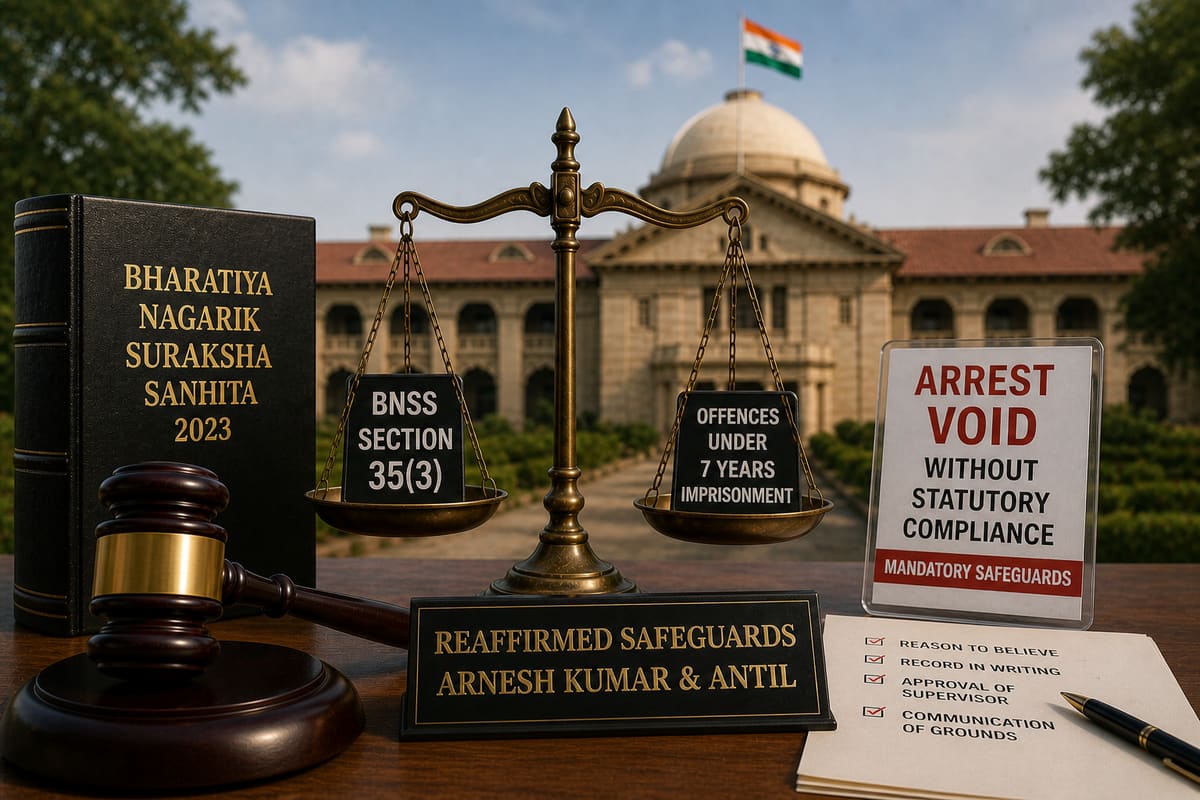
The Allahabad High Court has delivered a decisive affirmation of procedural safeguards in preventive detention cases under the Health Security Se National Security Cess Act, 2025, holding that arrest without adherence to statutory and circular mandates renders detention illegal and violative of fundamental rights. This judgment reinforces the constitutional imperative that liberty cannot be curtailed on the basis of post-hoc or non-compliant documentation.
Background & Facts
The Dispute
The petitioner, Nitin Rajesh, was arrested on 24.04.2026 by officials of the Central Goods and Service Tax Commissionerate under Sections 18(1)(a), 18(1)(c), and 19(1)(a) of the Health Security Se National Security Cess Act, 2025 (HSSNSC Act). The arrest was followed by a remand order dated 25.04.2026 passed by the Additional Chief Judicial Magistrate-7, Meerut. The petitioner challenged the legality of his arrest, detention, and remand, alleging multiple procedural violations that rendered the entire process unconstitutional.
Key Facts
- The petitioner was taken into custody on 24.04.2026 without any formal notice or explanation of grounds.
- An arrest memo was prepared on 25.04.2026 at 04:10 p.m. by Superintendent Sacchidanand Yadav, who is not the Commissioner as required under Section 26 of the HSSNSC Act.
- The arrest memo claimed that the "reasons to believe" were annexed, but no such annexure was physically attached.
- The grounds of arrest, as later produced, were dated 25.04.2026 at 04:16 p.m. - six minutes after the arrest memo was signed.
- The petitioner was compelled to sign documents acknowledging receipt of the arrest memo, jama talashi, and grounds of arrest, all at 04:10 p.m., despite the documents being generated afterward.
- The jama talashi lacked the signature, name, and designation of the official who prepared it.
- The grounds of arrest, as submitted in the counter affidavit, bore no signature of any authorized officer.
- The petitioner’s counsel received copies of the medical report and grounds of arrest only on 25.04.2026 at 05:00 p.m., after the remand hearing.
Procedural History
- 24.04.2026: Petitioner taken into custody without formal arrest or explanation.
- 25.04.2026, 04:10 p.m.: Arrest memo prepared by Superintendent Yadav; petitioner forced to sign acknowledgment.
- 25.04.2026, 04:16 p.m.: DIN generated for grounds of arrest - six minutes after arrest memo.
- 25.04.2026: Remand application filed before Additional Chief Judicial Magistrate-7, Meerut.
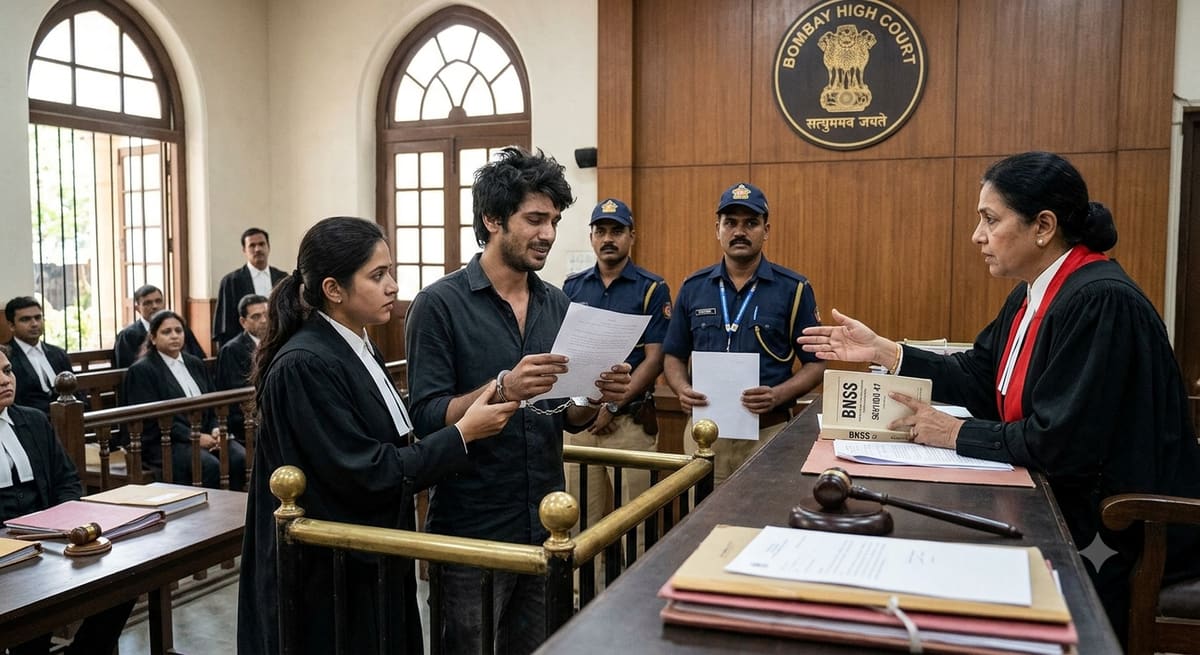
- 25.04.2026: Remand order passed without any recital that grounds of arrest were explained or provided to the petitioner.
- 26.04.2026: Petitioner’s counsel received copies of grounds of arrest and medical report.
- 06.05.2026: Habeas Corpus Writ Petition No. 684 of 2026 filed before the Allahabad High Court.
- 26.05.2026: Case reserved.
- 29.05.2026: Judgment delivered.
The Parties' Positions
For the Petitioner: The arrest was procedurally invalid because:
- The "reasons to believe" were not framed by the Commissioner as mandated by Section 26 of the HSSNSC Act.
- The grounds of arrest were not annexed to the arrest memo as required by Circular dated 13.01.2025.
- The timing of the DIN and signature collection proved fabrication after the fact.
- The jama talashi was non-compliant and unsigned.
- The remand court failed to verify whether the arrest was based on credible evidence or mere suspicion, as required by Satendra Kumar Antil v. CBI.
For the Respondent: No specific reply was filed addressing the factual allegations. The counter affidavit merely stated general compliance without rebutting the specific claims regarding timing, annexation, or authority.
Relief Sought
The petitioner sought:
- Immediate release from unlawful detention.
- Quashing of the remand order dated 25.04.2026.
- Declaration that the arrest, detention, and remand were illegal and violative of Articles 21 and 22.
- Costs of the petition.
The Legal Issue
The central question was whether an arrest under the HSSNSC Act, 2025, is lawful when the "reasons to believe" are not framed by the Commissioner, the grounds of arrest are not annexed to the arrest memo as per the mandatory circular, and the documents are back-dated or generated after the arrest.
Arguments Presented
For the Petitioner
Learned Senior Counsel relied on Satendra Kumar Antil v. CBI (2026 SCC OnLine SC 162) to argue that arrest must be based on objective, contemporaneous grounds and not as a tool for investigation. He cited Jai Kumar Agarwal v. Directorate General of GST Intelligence (2026) to establish that Circular 13.01.2025 mandates annexation of grounds of arrest to the arrest memo. He further contended that the failure to produce signed grounds of arrest, the timing discrepancy, and the absence of Commissioner’s authorization rendered the arrest a nullity. The petitioner’s right to be informed of grounds under Article 22(1) was violated, and the remand court’s failure to scrutinize the legality of arrest amounted to abdication of judicial duty.
For the Respondent
The respondent filed a counter affidavit but did not address any of the specific factual allegations. No explanation was provided for why the Commissioner did not frame the reasons to believe, why the grounds were not annexed, why the jama talashi was unsigned, or why the DIN was generated after the arrest memo. The court noted the complete absence of rebuttal as a critical failure.
The Court's Analysis
The Court conducted a rigorous analysis of procedural compliance under the HSSNSC Act, 2025, and the binding circular dated 13.01.2025. It emphasized that the right to liberty under Article 21 is not absolute but is protected by strict procedural safeguards, especially in cases involving preventive detention.
"The arrest memo cannot be a mere formality. The grounds of arrest must be contemporaneous, authored by the competent authority, and physically annexed at the time of arrest. To permit post-hoc creation of grounds is to invite abuse and render constitutional protections illusory."
The Court noted that Section 26 of the HSSNSC Act explicitly requires the Commissioner to frame the "reasons to believe". The fact that a Superintendent, not the Commissioner, recorded these reasons was a fatal jurisdictional defect. The Court further held that the circular dated 13.01.2025, issued under the Act, was binding and its violation rendered the arrest illegal.
The Court also relied on Jai Kumar Agarwal, where this very bench had held that failure to annex grounds of arrest to the arrest memo invalidates the remand. The timing discrepancy - DIN generated at 04:16 p.m. after the arrest memo at 04:10 p.m. - was deemed conclusive evidence of fabrication. The Court observed:
"The remand court did not record any satisfaction that the grounds were explained to the petitioner before arrest, nor did it examine whether the reasons to believe were based on credible evidence. This omission is fatal."
The unsigned jama talashi and the delayed delivery of documents to counsel further confirmed a pattern of procedural disregard. The Court concluded that the respondent’s silence in the face of specific allegations amounted to an admission of non-compliance.
The Verdict
The writ petition is allowed. The arrest, detention, and remand of the petitioner are declared illegal and void ab initio. The petitioner is directed to be released forthwith. The remand order dated 25.04.2026 is quashed. The respondents are barred from relying on the current proceedings. However, the respondents are at liberty to initiate fresh proceedings against the petitioner strictly in accordance with the HSSNSC Act, 2025, and Circular 13.01.2025, ensuring full compliance with procedural safeguards.
What This Means For Similar Cases
Procedural Compliance Is Non-Negotiable
- Practitioners must insist on verification of the arresting officer’s authority under the statute - only the Commissioner may frame "reasons to believe" under the HSSNSC Act.
- Any arrest memo without an annexed, signed copy of grounds of arrest is void, regardless of the nature of the offence.
- Courts must actively scrutinize remand applications for compliance with circulars and statutory mandates, not merely rubber-stamp them.
Timing and Documentation Are Critical Evidence
- If the DIN or document timestamp post-dates the arrest memo, the entire arrest is suspect and must be challenged as fabricated.
- Signed jama talashi and contemporaneous delivery of grounds are mandatory; failure to produce them at the time of arrest invalidates detention.
- In habeas corpus petitions, the burden shifts to the state to prove compliance; silence is not an answer.
Judicial Scrutiny of Remand Orders Must Be Rigorous
- Remand courts cannot rely on the state’s assertions; they must record explicit satisfaction that grounds were explained and annexed.
- The Satendra Kumar Antil principle applies: arrest must not be used as a tool for investigation. Courts must ask: "Is there credible evidence, or is this suspicion disguised as arrest?"