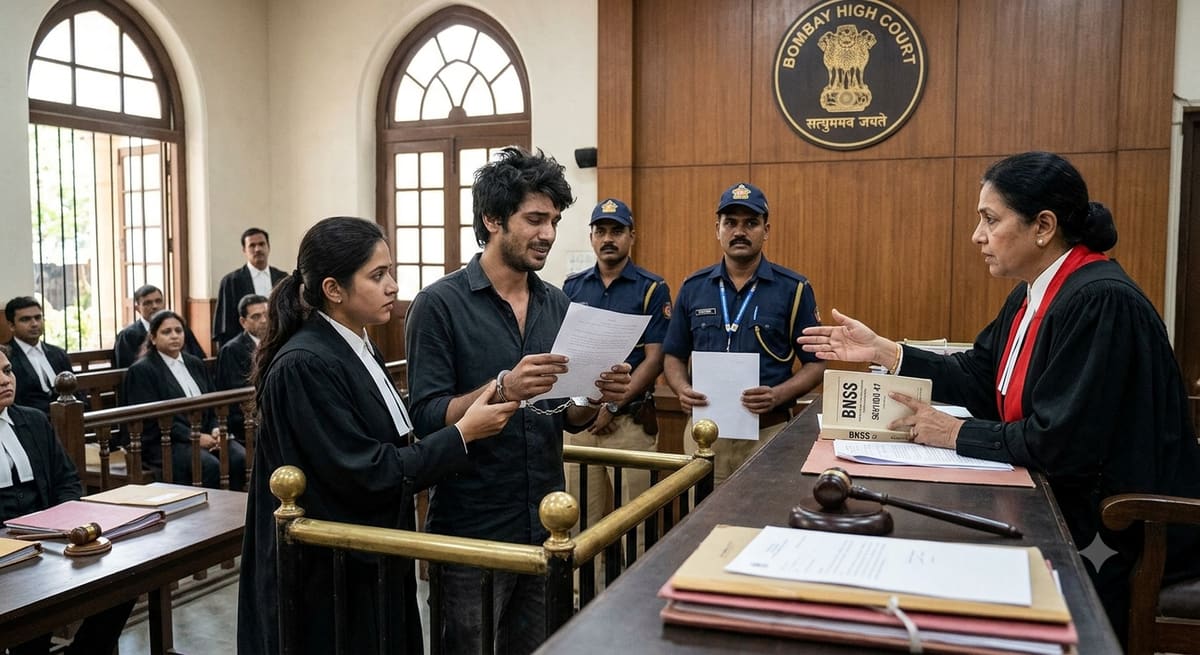
The Chhattisgarh High Court set aside the judicial and police custody orders against Jitesh Anand, declaring his arrest and subsequent detention illegal for violating Article 22(2) of the Constitution and the procedural safeguards of the Bharatiya Nagarik Suraksha Sanhita, 2023 (BNSS).
Background & Facts
The Dispute
The petitioner, Jitesh Anand, a 28-year-old resident of Rohtak, Haryana, challenged the legality of his arrest and detention in FIR No. 3/2025 registered on 22.07.2025 for alleged cyber-fraud offences under Sections 318(4), 3(5) of the BNSS and Section 66D of the IT (Amendment) Act, 2008.
Key Facts
- 22.07.2025: FIR No. 3/2025 lodged at Cyber Police Station, Surguja Range, Ambikapur.
- 28.06.2026: Petitioner picked up from his residence in Rohtak by Chhattisgarh police officials.
- 28.06.2026 (evening): Transported to Delhi and held at Chhattisgarh Bhawan.
- 29.06.2026 (12:00-12:30 p.m.): Departed Delhi in police vehicle CGG 15 EG 9706.
- 29.06.2026 (afternoon): Petitioner’s brother and counsel repeatedly contacted police officials for his whereabouts; no satisfactory response received.
- 30.06.2026 (4:50 p.m.): Produced before Judicial Magistrate First Class, Ambikapur; remanded to judicial custody.
- 03.07.2026: Magistrate granted two-day police custody remand.
- 29.06.2026: Notice under Section 35(3) BNSS served, directing appearance on 05.07.2026.
- 30.06.2026 (10:55 a.m.): Formal arrest recorded at Ambikapur police station; grounds of arrest supplied thereafter.
- 03.08.2026: High Court hearing of the writ petition.
- 03.08.2026: High Court order quashing the custody orders and directing release on bail.
Procedural History
- 22.07.2025: FIR lodged.
- 28.06.2026: Petitioner arrested and taken across states without transit remand.
- 30.06.2026: Judicial custody order dated 30.06.2026.
- 03.07.2026: Police custody order dated 03.07.2026.
- 29.06.2026: Writ petition filed under Article 226 of the Constitution and Section 528 BNSS.
- 03.08.2026: High Court delivered its judgment.
Parties' Positions
- Petitioner: Argues that his liberty was curtailed on 28.06.2026, no transit remand was obtained, and he was not informed of grounds of arrest, rendering the arrest and subsequent remand illegal.
- State (Respondents 1-4): Contends that the petitioner voluntarily accompanied police after being served a Section 35(3) notice, that all statutory safeguards were complied with, and that the arrest on 30.06.2026 was lawful.
Relief Sought
- Quash the orders dated 30.06.2026 and 03.07.2026.
- Declare the arrest and detention illegal and unconstitutional.
- Direct immediate release on bail with a personal bond of Rs.5,00,000 and two sureties of equal amount.
- Direct surrender of passport and compliance with investigation requirements.
The Legal Issue
Whether the petitioner’s arrest on 30.06.2026 and the subsequent judicial and police custody orders are valid when the liberty was first curtailed on 28.06.2026 without a transit remand and without timely communication of the grounds of arrest, in breach of Article 22(2) of the Constitution and Section 187 of the BNSS, 2023.
Arguments Presented
For the Petitioner
- The petitioner’s liberty was effectively restrained on 28.06.2026; therefore, Article 22(2) and Section 187 BNSS required production before the nearest magistrate within 24 hours or a transit remand, which was absent.
- The grounds of arrest were not communicated at the time of restraint, violating Section 47 BNSS and the Supreme Court’s pronouncements in Vihaan Kumar v. State of Haryana and Prabir Purkayastha v. State (NCT of Delhi).
- The alleged “voluntary” accompaniment is untenable because the petitioner was already under police control; any endorsement on the notice cannot establish freedom of choice.
For the Respondent/State
- The petitioner signed the Section 35(3) notice on 29.06.2026, indicating willingness to cooperate, thereby rendering the travel voluntary.
- All procedural safeguards, including issuance of grounds of arrest and telephonic intimation to the brother, were complied with as per BNSS provisions.
- The seriousness of the cyber-fraud investigation justifies the police’s actions, and the magistrate’s remand orders were based on a complete documentary record.
The Court's Analysis
The Court first examined the constitutional guarantee under Article 22(2) that a person arrested must be produced before the nearest magistrate within twenty-four hours, excluding travel time. It held that the moment a person’s liberty is substantially curtailed - here, the night of 28.06.2026 when the petitioner was taken from his home - the protection attaches. The Court rejected the State’s contention that the petitioner’s signing of the Section 35(3) notice rendered his travel “voluntary,” emphasizing that the petitioner was already in police custody and therefore could not exercise free choice.
"The expression ‘arrest’ occurring in Article 22(2) cannot be construed in a narrow or technical sense. The constitutional protection becomes operative from the point of time when an individual's liberty is substantially curtailed and he is placed under the control of the police."
The Court then turned to the statutory framework of the BNSS. Section 187 BNSS mirrors Article 22(2) and mandates a transit remand when a person is moved across state boundaries while in police custody. No such remand was obtained; the petitioner was transported from Haryana to Delhi and then to Chhattisgarh without judicial authorization. The Court cited Mihir Rajesh Shah and Vihaan Kumar to underscore that the mere issuance of a notice under Section 35(3) does not dispense with the requirement of a transit remand when the individual is already restrained.
Regarding the communication of grounds of arrest, the Court noted that the petitioner was not furnished with a written notice at the moment his liberty was first curtailed. The later provision of grounds on 30.06.2026, after a 24-hour period, violated Section 47 BNSS and the Supreme Court’s ratio in Prabir Purkayastha that any infringement of Article 22(1) vitiates the arrest process.
The Court further observed that the magistrate’s remand orders could not cure the illegality of the initial arrest. As per Manubhai Ratilal Patel, a magistrate must apply his mind to the legality of the arrest before authorising remand; a mechanically granted remand cannot validate an unlawful detention.
Consequently, the Court concluded that the arrest on 28.06.2026 was illegal, the subsequent custody orders were unsustainable, and the petitioner was entitled to release.
The Verdict
The High Court allowed the writ petition. It quashed the judicial custody order dated 30.06.2026 and the police custody order dated 03.07.2026. The petitioner was ordered to be released on bail upon furnishing a personal bond of Rs.5,00,000 with two sureties of equal amount. He must surrender his passport, appear before the investigating officer and the trial court as required, and cooperate with the investigation. No costs were awarded.
What This Means For Similar Cases
Transit Remand Is Mandatory When Liberty Is Curtailed
- Police must obtain a transit remand from the nearest magistrate before moving an arrested person across state borders, even if a Section 35(3) notice has been served.
- Failure to secure such remand renders any subsequent custody orders void.
Communication of Grounds of Arrest Must Be Immediate
- Grounds of arrest must be communicated at the time of restraint, not after a delay.
- Non-compliance with Section 47 BNSS vitiates the arrest and any later remand.
Judicial Remand Cannot Cure an Illegal Arrest
- A magistrate’s remand order is contingent on the legality of the arrest; it cannot legitimize an unlawful detention.
- Courts will scrutinise the procedural history before granting remand, especially in inter-state operations.
Practical Takeaways for Practitioners
- Verify that a transit remand has been obtained before any inter-state transfer of a detainee.
- Insist on immediate written communication of arrest grounds; if omitted, file a writ under Article 226.
- Challenge remand orders that ignore the legality of the initial arrest; cite Manubhai Ratilal Patel and Vihaan Kumar.