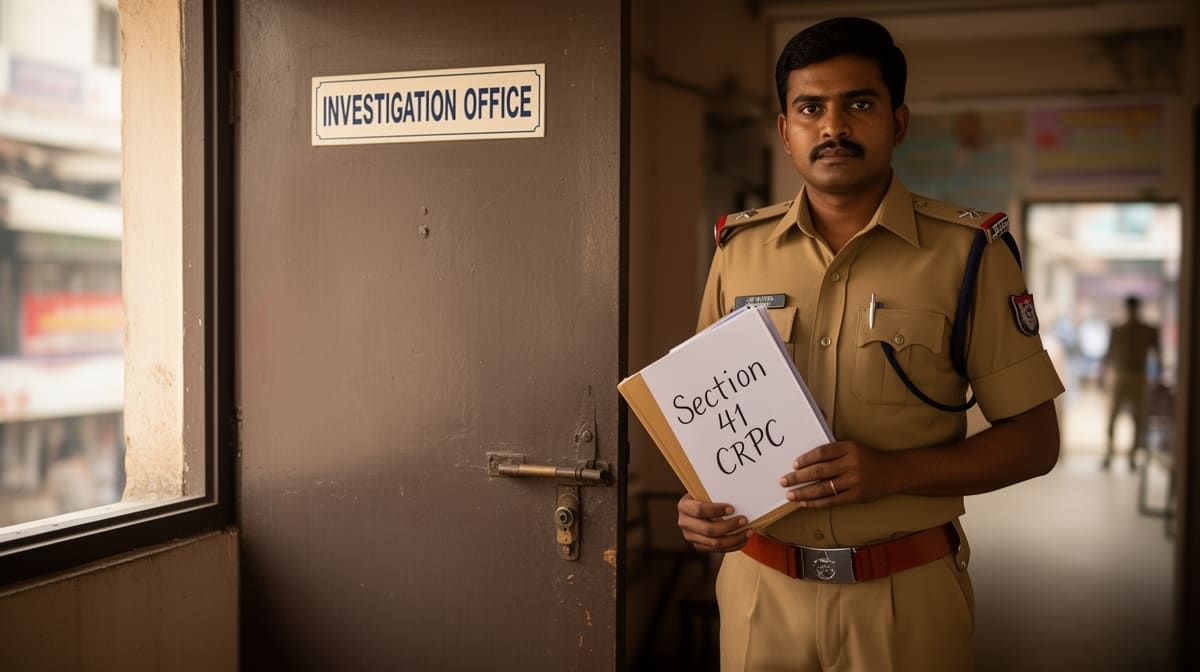
The Madhya Pradesh High Court has reaffirmed that procedural safeguards under Section 41 of the CrPC are mandatory even in serious cyber fraud cases, rejecting automatic arrest based solely on financial involvement. The judgment underscores that personal liberty cannot be compromised without strict adherence to statutory preconditions, regardless of the alleged magnitude of the offence.
Background & Facts
The Dispute
The applicant, Naseer Ahmad Sheikh, a government contractor managing sanitation services for medical institutions in Srinagar with over 350 employees, was arrested on 3 February 2026 in connection with a cyber fraud case involving Rs. 2.27 crore. The FIR, registered under Section 318(4) and Section 3(5) of the Bhartiya Nagrik Suraksha Sanhita, 2023 (BNS), and Section 66D of the IT Act, alleged that his bank account was used to process Rs. 45 lakh in fraudulent transactions. The applicant claims he was unaware of the illicit nature of the transactions and was misled by a friend.
Procedural History
- January 2025: FIR registered at Crime Branch, Jabalpur, against multiple accused across states
- February 2026: Applicant arrested without prior notice under Section 41 or 41(A) CrPC
- March 2026: Application filed under Section 483 BNSS for regular bail
- No charge sheet filed as of the hearing date; investigation ongoing
Relief Sought
The applicant sought release on bail, emphasizing his clean record, stable employment, and willingness to comply with stringent conditions. He argued that his involvement was passive and lacked mens rea, and that prolonged detention without trial violated his right to personal liberty.
The Legal Issue
The central question was whether Section 41 of the CrPC permits arrest in non-bailable offences without first satisfying the conditions laid down in Arnesh Kumar v. State of Bihar and Satender Kumar Antil v. CBI, particularly where the accused has no criminal antecedents and the investigation is incomplete.
Arguments Presented
For the Petitioner
Counsel relied on Arnesh Kumar v. State of Bihar and Satender Kumar Antil v. CBI to argue that arrest is not automatic even for offences punishable with up to seven years’ imprisonment. He contended that the investigating officer failed to record reasons for arrest under Section 41(1) CrPC, ignored the requirement to consider alternatives to arrest under Section 41(1)(b), and did not issue a notice under Section 41(A). He emphasized the applicant’s non-flight risk, employment stability, and absence of prior convictions.
For the Respondent/State
The State, through the Investigating Officer, conceded that no notice was issued under Section 41 or 41(A) CrPC. However, it argued that the scale of the fraud (Rs. 2.27 crore), the interstate nature of the accused, and the risk of evidence tampering justified immediate arrest. It submitted that the applicant’s account was used to transfer Rs. 45 lakh, with Rs. 8.5 lakh further routed to another accused, indicating active participation.
The Court's Analysis
The Court conducted a rigorous review of the procedural record and found a clear violation of the mandatory safeguards established in Arnesh Kumar and Satender Kumar Antil. It held that the absence of a recorded application of mind under Section 41 CrPC rendered the arrest procedurally defective, irrespective of the seriousness of the alleged offence.
"The fact that the accused is alleged to have been involved in a transaction of Rs. 45 lakh does not, by itself, justify bypassing the statutory preconditions for arrest. Personal liberty is not a concession but a constitutional right, and its curtailment must be justified by compliance with law, not merely by the quantum of alleged loss."
The Court distinguished between mere financial involvement and active criminal intent, noting that the applicant’s role appeared limited to permitting use of his bank account without evidence of knowledge or participation in the fraud’s design. It further observed that the investigation was still ongoing, with no charge sheet filed, and that the accused had no history of flight or tampering.
The Court emphasized that the Arnesh Kumar directive is not discretionary but mandatory, and its non-compliance cannot be excused by post-hoc justifications. It also noted that the applicant’s employment and social ties in Srinagar, coupled with his willingness to deposit a substantial sum and surrender his passport, demonstrated low flight risk.
The Verdict
The applicant won. The Court granted bail on stringent conditions, holding that non-compliance with Section 41 CrPC invalidates automatic arrest, even in high-value cyber fraud cases. The Court directed the trial court to examine the procedural lapse and report to higher authorities.
What This Means For Similar Cases
Arrest Is Not Automatic, Even in Cyber Fraud
- Practitioners must now challenge arrests in all non-bailable offences where Section 41 CrPC conditions were not met
- Bail applications should cite Arnesh Kumar and Satender Kumar Antil as binding precedent, regardless of the alleged sum involved
- Investigating agencies must record reasons for arrest in writing before detention
Procedural Lapses Trigger Judicial Scrutiny
- Courts will now routinely examine compliance with Section 41 CrPC during bail hearings
- Failure to issue notice under Section 41(A) or record satisfaction of conditions may lead to adverse observations against police
- Trial courts are now directed to report non-compliance to higher authorities, opening avenues for departmental action
Bail Conditions Must Reflect Risk, Not Punishment
- Courts may impose financial deposits, passport surrender, and monthly police reporting as reasonable conditions
- Conditions should be tailored to ensure appearance, not to penalize the accused
- The Court’s refusal to prejudge the merits reinforces that bail is not an admission of guilt