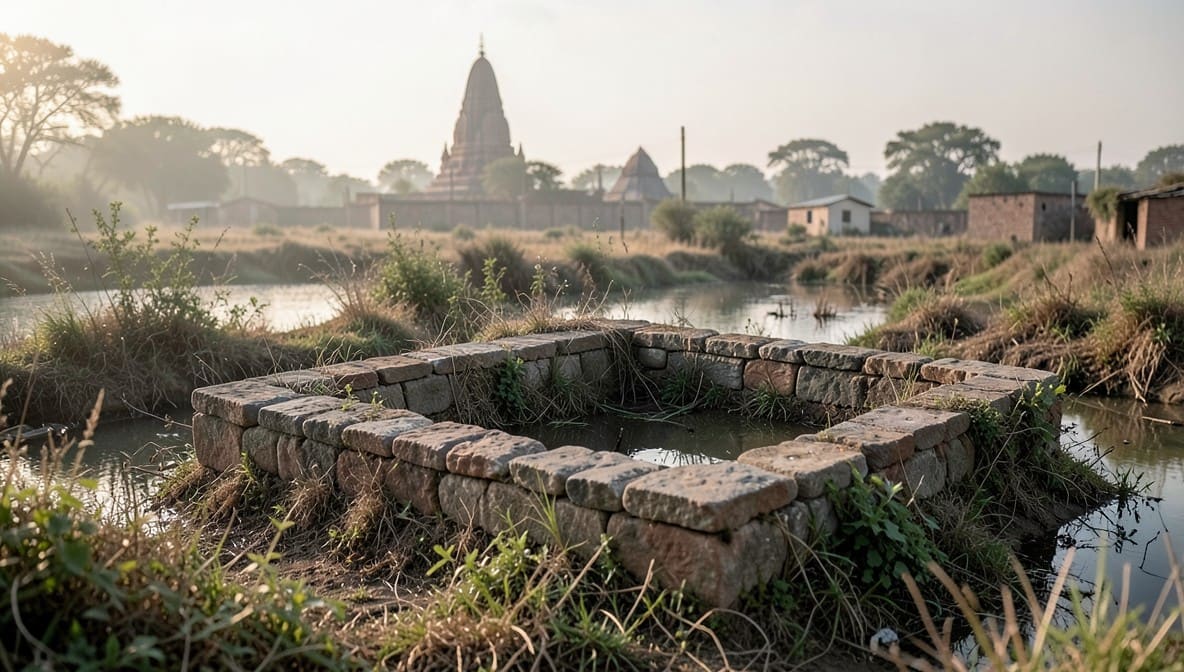
The Madurai Bench of the Madras High Court has reaffirmed the constitutional obligation to protect waterbodies from illegal encroachment, issuing clear directives to prevent religious activities on unlawfully constructed foundations. This judgment reinforces the principle that cultural or religious claims cannot override statutory and judicial mandates to preserve ecological resources.
Background & Facts
The Dispute
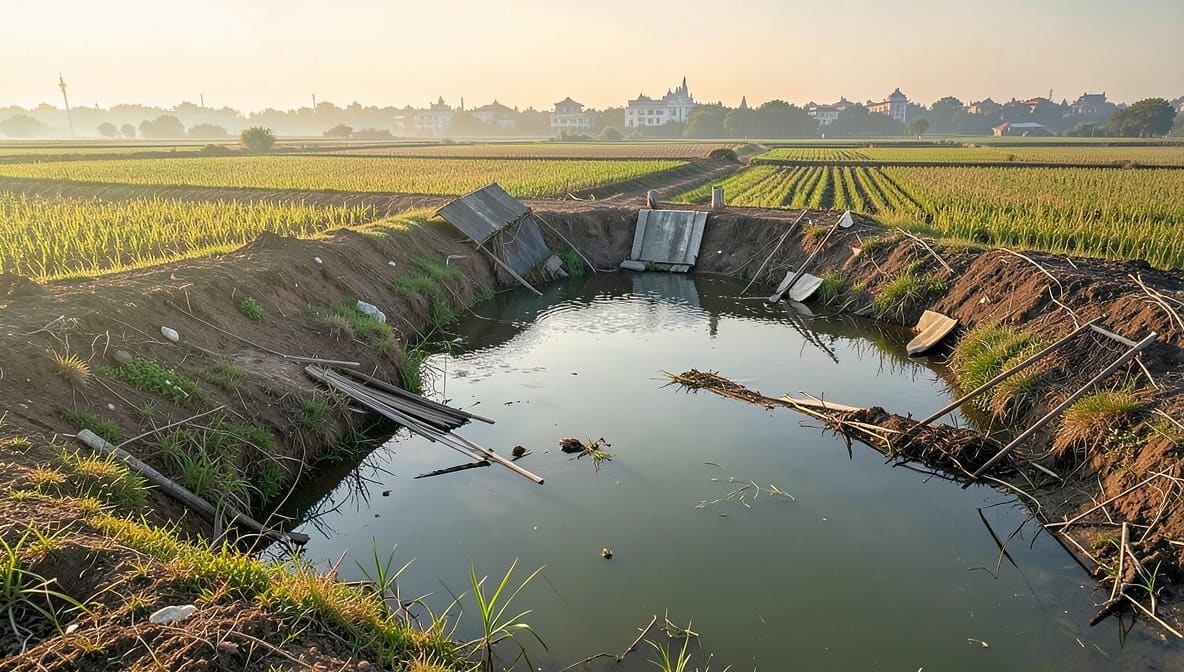
The petitioner sought to prevent the respondents from constructing temporary sheds, installing idols, or conducting festivals on an encroached portion of a waterbody located in Survey No.71/1, Ponkulam Village, Ramanathapuram District. The encroachment, measuring 1 acre and 26 cents, was allegedly built over an unfinished foundation in the middle of a tank, which is legally classified as a waterbody under environmental and revenue laws.
Key Facts
- The petitioner had previously filed W.P.(MD) No.12839 of 2023 seeking removal of the encroachment.
- On 03.01.2025, this Court ordered that no further construction be permitted and directed the dismantling and removal of the existing foundation to restore the original status quo.
- Respondents 11 and 12 (B. Veerasekaran and B. Singaravelu) failed to comply with the 03.01.2025 order.
- In violation of the Court’s directive, respondents 11 and 12 initiated steps to install idols and planned to conduct a temple festival on 30.05.2026.
- The petitioner lodged complaints with respondents 8 to 10 (police authorities), but no effective action was taken.
- A contempt petition, Cont.P.(MD) No.536 of 2026, was filed seeking enforcement of the 03.01.2025 order and is listed for hearing on 04.06.2026.
Procedural History
- 03.01.2025: Madras High Court, Madurai Bench, passed order in W.P.(MD) No.12839 of 2023 directing removal of encroachment and restoration of status quo.
- Between 03.01.2025 and 27.05.2026: Respondents 11 and 12 failed to dismantle the foundation and began preparations for idol installation.
- 2026: Petitioner filed Cont.P.(MD) No.536 of 2026 for enforcement of the 03.01.2025 order.
- 27.05.2026: Present writ petition (W.P.(MD) No.14359 of 2026) filed under Article 226 seeking immediate restraint on festival and construction.
- 27.05.2026: Connected M.P. No.10791 of 2026 filed for interim relief.
The Parties' Positions
The petitioner contended that the encroachment violated environmental norms, judicial orders, and the public trust doctrine. The respondents, particularly respondents 11 and 12, sought to legitimize the encroachment by conducting religious rituals, thereby creating a de facto religious site to deter removal.
Relief Sought
The petitioner sought a writ of mandamus directing respondents 1 to 10 to restrain respondents 11 and 12 from:
- Installing idols or constructing any temporary shed on the encroached portion
- Conducting any festival or pooja on the foundation on 30.05.2026 or any other date
- Permitting any activity that would make removal of the encroachment difficult or impossible
The Legal Issue
The central question was whether the Court could issue a mandamus to prevent religious activities on an encroached waterbody in violation of a prior judicial order, and whether such activities could be permitted under the guise of religious practice.
Arguments Presented
For the Petitioner
The petitioner’s counsel argued that waterbodies are protected under Article 21 (right to environment) and the public trust doctrine. The 03.01.2025 order was binding and had not been complied with. Allowing idol installation would render the Court’s order nugatory and set a dangerous precedent permitting religious encroachment to override judicial mandates.
For the Respondent
The State counsel on behalf of respondents 1 to 5 and 8 to 10 conceded that the 03.01.2025 order remained unimplemented and assured compliance. They submitted that no idols would be installed and that only prayers in the existing old structure would be permitted, pending removal of the foundation. The police respondents confirmed that an inquiry (C.S.R. No.58 of 2026) had been initiated and respondents 11 and 12 had failed to appear.
The Court's Analysis
The Court emphasized that judicial orders are not advisory but binding, and their non-compliance undermines the rule of law. The encroachment on a waterbody is not merely a civil dispute but an environmental violation with public consequences. The Court noted that while religious sentiments are entitled to respect, they cannot be used as a shield to defy court orders.
"The foundation laid on the waterbody is not a place of worship but an illegal structure subject to removal. Permitting prayers or poojas on it would amount to condoning the encroachment and nullifying this Court’s earlier direction."
The Court accepted the undertaking given by the State counsel that the foundation would be removed by 02.06.2026 and that no idols would be installed. However, it clarified that even prayers must be confined to the pre-existing, non-encroached structure. The Court distinguished between permissible religious practice and the legitimization of illegal construction through ritual activity.
The Court also underscored the duty of revenue and police authorities to enforce judicial orders, noting that inaction by respondents 8 to 10 constituted dereliction of statutory duty.
The Verdict
The writ petition is disposed of. Respondents 1 to 10 are directed to ensure strict compliance with the order dated 03.01.2025 in W.P.(MD) No.12839 of 2023. Respondents 11 and 12 are permitted to offer prayers only in the old structure, and shall not install any idols, conduct any poojas, or perform any rituals on the encroached foundation. The foundation shall be removed by 02.06.2026. No costs are awarded. The connected miscellaneous petition is closed.
What This Means For Similar Cases
Religious Practices Cannot Legitimize Judicial Non-Compliance
- Practitioners must argue that any attempt to sanctify illegal structures through religious rituals constitutes an abuse of process and violates the public trust doctrine.
- Courts will not permit de facto conversion of encroached land into religious sites to evade demolition orders.
Enforcement of Environmental Orders Is Non-Negotiable
- Revenue and police authorities have a mandatory duty to enforce court orders protecting waterbodies.
- Failure to act may attract contempt proceedings or writs of mandamus against public officials.
Status Quo Must Be Maintained Pending Removal
- Even interim permissions must be strictly limited to pre-existing, lawful structures.
- Any activity on encroached land - regardless of religious character - is prohibited until the structure is lawfully removed.
Judicial Orders Are Binding Until Set Aside
- A pending contempt petition does not suspend the enforceability of the original order.
- Parties cannot delay compliance by initiating new rituals or festivals.
The Public Trust Doctrine Applies to Urban and Rural Waterbodies
- This judgment reinforces that waterbodies, whether in cities or villages, are held in public trust and cannot be alienated or encroached upon for private or religious use.
No Costs Awarded
- The Court’s refusal to award costs signals that compliance was achieved through undertaking, not litigation pressure, but does not diminish the binding nature of the order.