The Madras High Court has reaffirmed the state’s duty to protect government poramboke land from illegal encroachment by directing immediate enforcement action against unauthorized constructions. This order underscores the non-negotiable obligation of revenue authorities to act decisively when public land is unlawfully occupied, even in the absence of prior adjudication.
Background & Facts
The Dispute
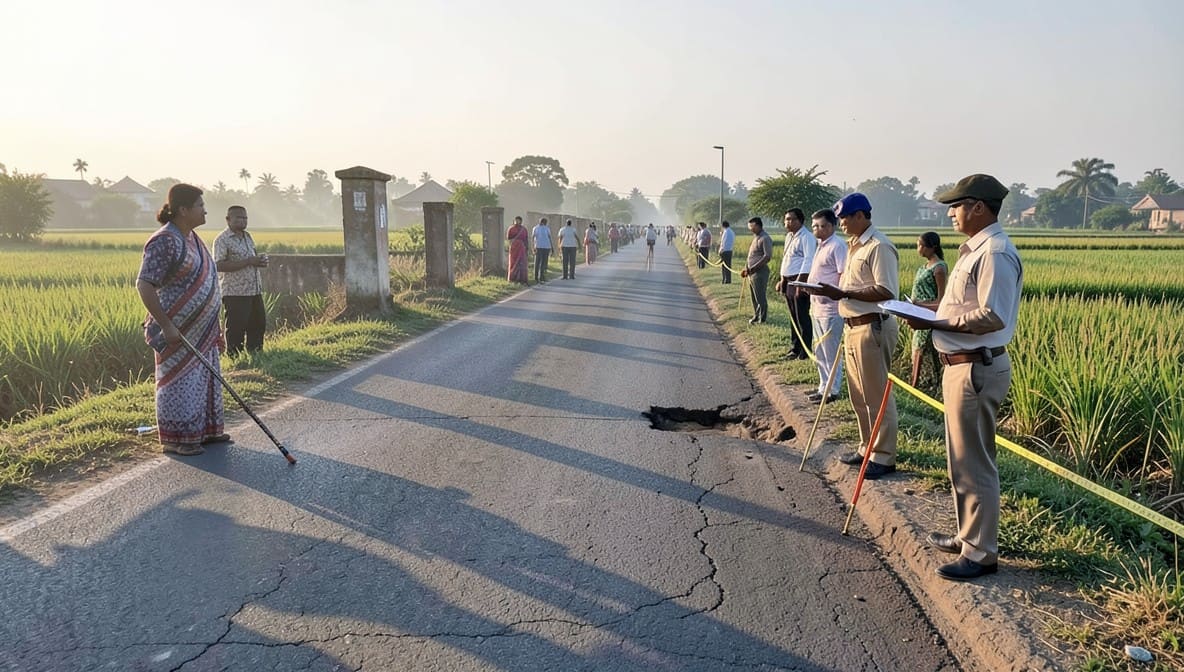
The petitioner, M. Perumal, seeks the removal of illegal structures erected by respondents 9 to 18 on Survey Nos. 292/36 and 292/40 in Semmiyamangalam Village, Polur Taluk, Thiruvannamalai District. These survey numbers are classified as government poramboke land, intended for public use, including as a pathway. The encroachments allegedly obstruct public access and violate land use regulations.
Key Facts
- Survey No. 292/40 is designated as government poramboke land meant for use as a pathway
- Respondents 9 to 18 have constructed buildings and structures on the said land without any legal authority
- The 3rd Respondent, Thasildar, Polur Taluk, issued a notice on 26/06/2025 directing removal of encroachments
- The 4th Respondent, Block Development Officer, initiated proceedings under Na.Ka. No. 1234/2024/va.A3 dated 22/08/2025
- No demolition or enforcement action has been carried out despite these notices
- The petitioner has not sought compensation or damages, but only restoration of the land to its original public use
Procedural History
- 26/06/2025: Notice issued by the 3rd Respondent (Thasildar) directing removal of encroachments
- 22/08/2025: Proceedings initiated by the 4th Respondent (Block Development Officer) under Na.Ka. No. 1234/2024/va.A3
- No further action taken by any revenue authority despite issuance of notices
- 2025: Writ Petition No. 50333 of 2025 filed before the Madras High Court seeking mandamus
- 27/04/2026: Judgment delivered by the Division Bench
The Parties' Positions
Petitioner’s Position: The encroachments on poramboke land are illegal and must be removed immediately. The notices issued by the Thasildar and Block Development Officer are sufficient to trigger enforcement. The state has failed in its statutory duty to protect public land.
Respondents’ Position: The respondents did not file a written reply. The state respondents (1 to 8) did not contest the factual allegations, and the private respondents (9 to 18) did not appear or contest the petition.
Relief Sought
The petitioner seeks:
- Direct removal of structures on Survey Nos. 292/36 and 292/40
- Restoration of Survey No. 292/40 as a public pathway
- Enforcement of notices dated 26/06/2025 and 22/08/2025
- A timeline for completion of demolition and restoration
The Legal Issue
The central question was whether the High Court can issue a writ of mandamus to compel revenue authorities to enforce removal of encroachments on poramboke land when statutory notices have been issued but no action taken.
Arguments Presented
For the Petitioner
The petitioner’s counsel argued that poramboke land is held in trust by the state for public purposes, and its encroachment is a violation of public trust and statutory duty under the Tamil Nadu Land Reforms Act and relevant revenue rules. The issuance of notices under Section 104 of the Tamil Nadu Land Revenue Code constitutes sufficient notice to trigger enforcement. Delay in action amounts to abdication of duty, warranting judicial intervention under Article 226 of the Constitution.
For the Respondent
No arguments were presented by the respondents. The state respondents did not file any counter-affidavit or opposition, and the private encroachers did not appear before the court.
The Court's Analysis
The Court observed that the existence of encroachments on poramboke land is not in dispute. The notices issued by the Thasildar and the Block Development Officer demonstrate that the authorities are aware of the illegality. The failure to act despite these notices constitutes a clear dereliction of statutory duty.
"The state cannot remain a silent spectator when public land is unlawfully occupied. Notices alone are not compliance; enforcement is the obligation."
The Court emphasized that mandamus lies to compel performance of a public duty, especially where the rights of the public are affected. The petitioner, as a resident of the village, has a legitimate interest in the preservation of public pathways. The Court further noted that the respondents have not raised any defense, nor have they contested the factual assertions in the petition.
The Court also clarified that while enforcement must proceed, it must be carried out in accordance with due process. The competent authority must afford a reasonable opportunity to the alleged encroachers before demolition, as required under principles of natural justice and statutory procedure.
The Verdict
The writ petition is disposed of with directions. The respondents 1 to 4 are directed to proceed with the removal of encroachments on Survey Nos. 292/36 and 292/40 in accordance with the notices dated 26/06/2025 and 22/08/2025. The competent authority shall afford a reasonable opportunity to respondents 9 to 18 before demolition. The entire enforcement process, including demolition and restoration of Survey No. 292/40 as a pathway, shall be completed within twelve weeks from the date of receipt of a copy of this order. No costs are awarded.
What This Means For Similar Cases
Enforcement of Notices Is Not Optional
- Practitioners must now treat issuance of revenue notices under Sections 104 or 105 of the Tamil Nadu Land Revenue Code as triggering a mandatory duty to act
- Failure to act within a reasonable time invites writ jurisdiction under Article 226
- Courts will not tolerate bureaucratic inertia in protecting poramboke land
Due Process Must Precede Demolition
- Even in clear cases of encroachment, authorities must follow procedural safeguards
- Affording opportunity to the alleged encroacher is not a formality - it is a constitutional requirement
- Any demolition without hearing may be set aside in subsequent litigation
Public Interest Trumps Private Occupation
- Ownership claims over poramboke land are legally invalid regardless of duration of possession
- Long-standing occupation does not confer title or right to retain encroached land
- Restoration of public land is a non-discretionary duty of revenue authorities