Tribunals and Commissions judgments

1767 Tribunals and Commissions judgments explained in plain English: what was decided, the law applied and why it matters. Page 11 of 74.

Section 37 IT Act | Margin Penalties for Commodity Trading Shortfalls Are Compensatory, Not Prohibited Expenditure : ITAT Jaipur
Case Law Analysis
|Income Tax Appellate Tribunal

Section 37 IT Act | Margin Penalties for Commodity Trading Shortfalls Are Compensatory, Not Prohibited Expenditure : ITAT Jaipur

ITAT Jaipur holds that margin penalties levied by NCDEX for shortfalls in commodity trading are compensatory in nature and not prohibited under Section 37 of the Income Tax Act. The ruling deletes the 10% ad hoc disallowance under Section 36(1)(iii), setting a precedent for the tax treatment of such penalties in business expenditure claims.

Service Tax Exemption for Non-AC Restaurants with Common Kitchen | CESTAT Clarifies Demarcation Requirement Under Finance Act 1994 : CESTAT Chennai
Case Law Analysis
|Custom, Excise & Service Tax Tribunal

Service Tax Exemption for Non-AC Restaurants with Common Kitchen | CESTAT Clarifies Demarcation Requirement Under Finance Act 1994 : CESTAT Chennai

CESTAT Chennai rules that non-air-conditioned restaurant services sourced from a common kitchen are exempt from service tax if clearly demarcated from AC sections. The ruling underscores strict compliance with Notification No. 03/2013-ST, impacting restaurant operators with mixed seating arrangements.

Section 124 Customs Act | Right to Cross-Examination & Corroboration of Retracted Statements Mandatory for Confiscation : CESTAT Allahabad
Case Law Analysis
|Custom, Excise & Service Tax Tribunal

Section 124 Customs Act | Right to Cross-Examination & Corroboration of Retracted Statements Mandatory for Confiscation : CESTAT Allahabad

CESTAT Allahabad rules that confiscation and penalties under the Customs Act cannot stand without affording the accused the right to cross-examine witnesses and corroborating retracted statements. The tribunal sets aside orders imposing ₹61.9 lakh duty drawback recovery and penalties, reinforcing natural justice in adjudication proceedings.

Section 11A Central Excise Act | Clandestine Removal Demand Rejected Without Corroborative Evidence: CESTAT Kolkata
|Custom, Excise & Service Tax Tribunal

Section 11A Central Excise Act | Clandestine Removal Demand Rejected Without Corroborative Evidence: CESTAT Kolkata

CESTAT Kolkata has ruled that revenue authorities cannot sustain excise duty demands for clandestine removal without tangible, corroborative evidence-reinforcing that mere suspicion or intelligence reports are insufficient under Section 11A. This sets a critical precedent for manufacturers facing speculative assessments, shifting the burden firmly onto the tax department to prove intent and action with concrete proof.

Operational Debt Under IBC | Advance Payment Under Consortium Agreement Constitutes Operational Debt: NCLAT
Case Law Analysis
|National Company Law Appellate Tribunal

Operational Debt Under IBC | Advance Payment Under Consortium Agreement Constitutes Operational Debt: NCLAT

The NCLAT has ruled that advance payments made under a consortium agreement for goods supply qualify as operational debt under Section 5(21) of the IBC, even when payment obligations are structured between consortium members rather than directly with a corporate debtor. This expands the scope of operational creditors in complex supply chains and clarifies that inter-se financial arrangements do not negate the existence of a debt arising from a transaction in the ordinary course of business.

Advance Authorisation | Confiscation Invalid Without Mens Rea for Procedural Lapses: CESTAT Kolkata
|Custom, Excise & Service Tax Tribunal

Advance Authorisation | Confiscation Invalid Without Mens Rea for Procedural Lapses: CESTAT Kolkata

CESTAT Kolkata rules that minor procedural breaches under the Advance Authorisation Scheme cannot justify confiscation of gold and jewellery unless there is intentional fraud or dishonest intent. This reinforces that administrative errors, absent mens rea, are curable and not punishable by asset seizure - a critical safeguard for exporters and jewellery traders facing rigid customs enforcement.

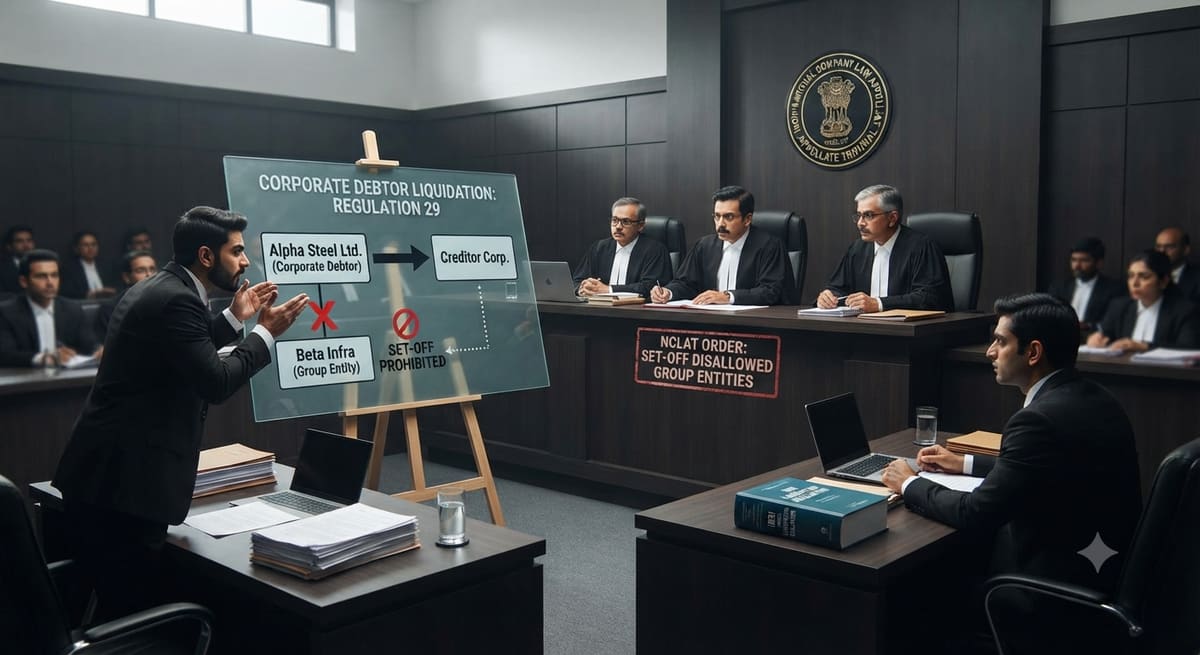
Regulation 29, IBBI Liquidation Regulations | Set-off Permitted Only Between Corporate Debtor and Creditor, Not Across Group Entities : NCLAT
Case Law Analysis
|National Company Law Appellate Tribunal

Regulation 29, IBBI Liquidation Regulations | Set-off Permitted Only Between Corporate Debtor and Creditor, Not Across Group Entities : NCLAT

The NCLAT has clarified that Regulation 29 of the IBBI Liquidation Regulations does not permit set-off claims between a corporate debtor and a creditor through affiliated group entities, upholding the doctrine of corporate separateness. This ruling directly impacts how operational creditors and liquidators assess mutual obligations in insolvency proceedings, preventing cross-entity netting that could distort the waterfall of claims under the IBC.

Cenvat Credit Rules, 2004 | Credit Permitted for Reverse Charge on Imported Services Before July 2012: CESTAT
Case Law Analysis
|Custom, Excise & Service Tax Tribunal

Cenvat Credit Rules, 2004 | Credit Permitted for Reverse Charge on Imported Services Before July 2012: CESTAT

CESTAT has ruled that taxpayers could lawfully utilize Cenvat credit to discharge service tax liability under the reverse charge mechanism for imported services prior to July 2012, overturning departmental demands and clarifying a critical ambiguity in pre-GST compliance. This decision protects businesses that relied on existing rules and sets a precedent for retrospective interpretation of credit utilization in indirect tax regimes.

Possession of Exotic Birds Not Smuggling Without Proof of Illegal Import | Burden of Proof Lies with Revenue: CESTAT Kolkata
Case Law Analysis
|Custom, Excise & Service Tax Tribunal

Possession of Exotic Birds Not Smuggling Without Proof of Illegal Import | Burden of Proof Lies with Revenue: CESTAT Kolkata

CESTAT Kolkata rules that merely possessing exotic birds within India does not amount to smuggling under the Customs Act unless the Revenue proves they were illegally imported. This shifts the legal burden squarely onto the Department, protecting bird owners from presumption-based penalties and clarifying the limits of customs enforcement in wildlife cases.

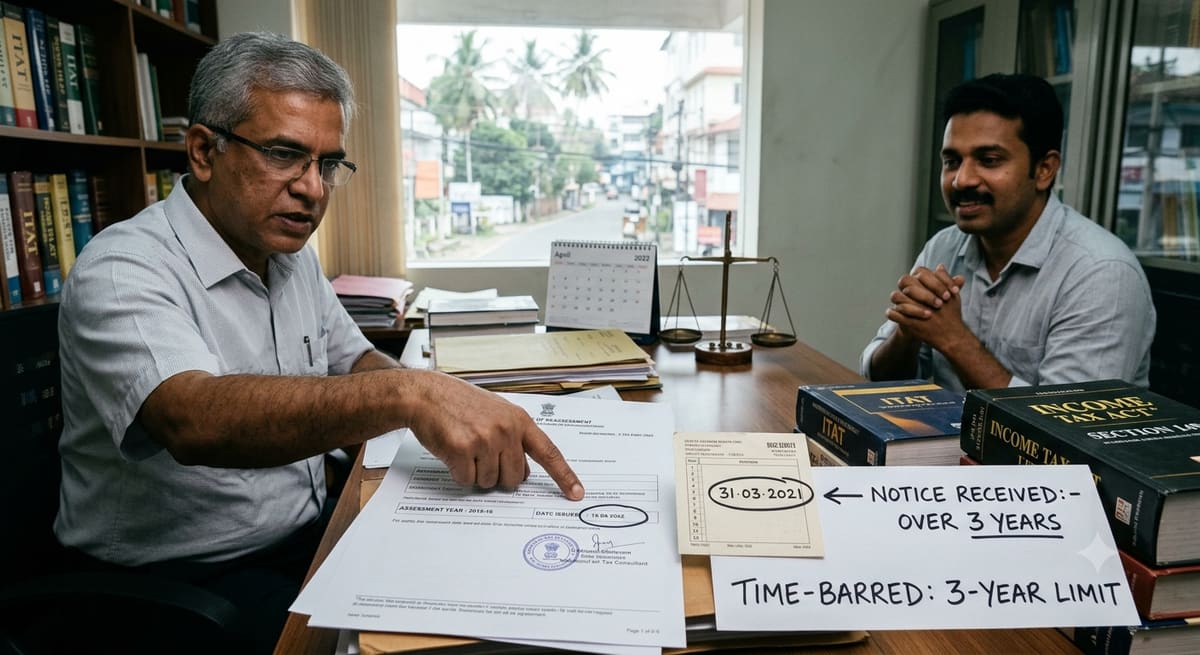
Section 149(1) First Proviso | Reassessment Notice Issued After 31.03.2022 for AY 2015-16 Barred by 3-Year Limit: ITAT Cochin
Case Law Analysis
|Income Tax Appellate Tribunal

Section 149(1) First Proviso | Reassessment Notice Issued After 31.03.2022 for AY 2015-16 Barred by 3-Year Limit: ITAT Cochin

ITAT Cochin has ruled that a reassessment notice issued on 06.05.2022 for AY 2015-16 is time-barred because the income escaped assessment did not exceed ₹50 lakh, triggering the three-year limitation under Section 149(1). This reinforces that post-2022 notices for pre-2019 assessments cannot be revived unless the monetary threshold is crossed, protecting taxpayers from arbitrary reopening.

Section 35(1)(ii) IT Act | Weighted Deduction for Scientific Research Permitted Against Other Heads of Income When Business Income Is Insufficient : ITAT Kolkata
Case Law Analysis
|Income Tax Appellate Tribunal

Section 35(1)(ii) IT Act | Weighted Deduction for Scientific Research Permitted Against Other Heads of Income When Business Income Is Insufficient : ITAT Kolkata

The ITAT Kolkata has ruled that a taxpayer claiming weighted deduction under Section 35(1)(ii) for scientific research may offset the full Rs. 1.57 crore claim against income from other sources if business income is inadequate to absorb the deduction. This clarifies that the deduction is not capped by business profits, significantly benefiting R&D investors with diversified income streams and aligning with the legislative intent to incentivize innovation.

Section 271AAC(1) & 272A(1)(d) NI Act | Penalty Invalid If Underlying Unexplained Income Addition Is Deleted on Appeal : ITAT Jaipur
Case Law Analysis
|Income Tax Appellate Tribunal

Section 271AAC(1) & 272A(1)(d) NI Act | Penalty Invalid If Underlying Unexplained Income Addition Is Deleted on Appeal : ITAT Jaipur

When an appellate authority deletes an addition of unexplained income under Section 69A, penalties imposed under Sections 271AAC(1) and 272A(1)(d) automatically lapse - the penalty cannot stand without its foundational tax liability. This ruling protects cooperative societies and other assessees from punitive measures rooted in nullified assessments, reinforcing that penalties are consequential, not independent, under the Income Tax Act.

Cenvat Credit Rules, 2004 | Insurance, Travel, Telecom & Accommodation Services for Export-Oriented IT Services Qualify as Input Services : CESTAT Chennai
Case Law Analysis
|Custom, Excise & Service Tax Tribunal

Cenvat Credit Rules, 2004 | Insurance, Travel, Telecom & Accommodation Services for Export-Oriented IT Services Qualify as Input Services : CESTAT Chennai

CESTAT Chennai rules that ancillary services like air travel, cab rentals, telecom, insurance, and accommodation directly supporting export of IT services qualify as eligible input services under Rule 2(r) of the Cenvat Credit Rules, 2004. This expands the scope of claimable credits for IT exporters, removing arbitrary disallowances based on perceived lack of direct nexus and aligning with the intent of export promotion under service tax law.

Section 11 Income Tax Act | Exemption Denial Limited to Diverted Amounts Only - No Full Disallowance for Transactions with Specified Concerns : ITAT Delhi
Case Law Analysis
|Income Tax Appellate Tribunal

Section 11 Income Tax Act | Exemption Denial Limited to Diverted Amounts Only - No Full Disallowance for Transactions with Specified Concerns : ITAT Delhi

The ITAT Delhi has ruled that a charitable trust’s exemption under Section 11 cannot be entirely revoked merely due to transactions with specified concerns; the disallowance must be confined strictly to the actual diverted funds. This clarifies a critical safeguard for trusts, ensuring proportionality in tax scrutiny and preventing punitive overreach under Section 13.

Section 249(3) Income Tax Act | 175-Day Delay in Appeal Condoned on Substantial Justice Over Technicality : ITAT Delhi
Case Law Analysis
|Income Tax Appellate Tribunal

Section 249(3) Income Tax Act | 175-Day Delay in Appeal Condoned on Substantial Justice Over Technicality : ITAT Delhi

ITAT Delhi has ruled that a 175-day delay in filing an income tax appeal must be condoned when the delay stems from genuine hardship, affirming that procedural rigidity cannot override the core principle of substantial justice. This reinforces that appellate authorities must interpret condonation provisions liberally to ensure access to justice for taxpayers, especially where no prejudice is shown to the revenue.

Section 80P(2)(d) IT Act | Interest from Cooperative Banks Eligible for Deduction by Primary Credit Societies : ITAT Pune
Case Law Analysis
|Income Tax Appellate Tribunal

Section 80P(2)(d) IT Act | Interest from Cooperative Banks Eligible for Deduction by Primary Credit Societies : ITAT Pune

Primary credit cooperative societies can claim tax deductions under Section 80P(2)(d) for interest earned on deposits with other cooperative banks, affirming that such income qualifies as business income derived from cooperative activities. This ruling reinforces the scope of cooperative-specific tax benefits and provides clarity for thousands of rural financial institutions across India.

Section 112 Customs Act | Constructive Possession of Smuggled Goods Triggers Penalty Even Without Ownership: CESTAT Kolkata
|Custom, Excise & Service Tax Tribunal

Section 112 Customs Act | Constructive Possession of Smuggled Goods Triggers Penalty Even Without Ownership: CESTAT Kolkata

CESTAT Kolkata holds that mere control over premises where smuggled gold is found, coupled with inability to prove lawful possession, suffices to impose penalty under Section 112 - shifting the burden to the possessor to explain lawful origin. This clarifies that statutory liability under customs law extends beyond ownership to de facto control, impacting warehouse operators, agents, and third-party custodians.

Section 145(3) IT Act | Statistical Deviations Alone Cannot Justify Rejection of Audited Books : ITAT Jaipur
Case Law Analysis
|Income Tax Appellate Tribunal

Section 145(3) IT Act | Statistical Deviations Alone Cannot Justify Rejection of Audited Books : ITAT Jaipur

The ITAT Jaipur deleted a Rs. 40.82 lakh addition for unexplained cash deposits, ruling that mere deviations in cash sales or bank deposits-even amid demonetization-are insufficient to reject duly audited books of accounts. This reinforces that tax authorities must identify specific, material defects in accounting records, not rely on speculative patterns, protecting compliant businesses from arbitrary assessments.

Section 123 Customs Act 1962 | Reasonable Belief Required to Trigger Presumption of Smuggling in Gold Seizures : CESTAT Kolkata
Case Law Analysis
|Custom, Excise & Service Tax Tribunal

Section 123 Customs Act 1962 | Reasonable Belief Required to Trigger Presumption of Smuggling in Gold Seizures : CESTAT Kolkata

CESTAT Kolkata rules that mere possession of unmarked gold, without any corroborating intelligence or border-crossing context, cannot invoke the Section 123 presumption of smuggling. The burden remains squarely on the Revenue to prove intent and illicit movement, reinforcing procedural safeguards for travelers and traders against speculative seizures.

Section 112(a)(i) Customs Act | Penalty Requires Direct Link to Goods Rendered Confiscable Under Section 111, Not Just CBLR Breach : CESTAT Chandigarh
Case Law Analysis
|Custom, Excise & Service Tax Tribunal

Section 112(a)(i) Customs Act | Penalty Requires Direct Link to Goods Rendered Confiscable Under Section 111, Not Just CBLR Breach : CESTAT Chandigarh

CESTAT Chandigarh has ruled that penalties under Section 112(a)(i) of the Customs Act cannot be imposed solely for violations of Customs Broker Liability Rules unless the act or omission directly renders the goods liable for confiscation under Section 111. This decision shields customs brokers from punitive action for procedural lapses that do not facilitate smuggling or concealment of prohibited goods, reinforcing the principle that penalty must flow from substantive harm, not technical non-compliance.

Section 153C Income Tax Act | Assessment Invalid Without Incriminating Material Belonging to Assessee Found During Third-Party Search : ITAT Delhi
Case Law Analysis
|Income Tax Appellate Tribunal

Section 153C Income Tax Act | Assessment Invalid Without Incriminating Material Belonging to Assessee Found During Third-Party Search : ITAT Delhi

The ITAT Delhi has ruled that an assessment under Section 153C cannot stand unless incriminating material directly belonging to the assessee is discovered during a search of a third party. This clarifies a critical jurisdictional limit on the tax department’s power to reassess unrelated taxpayers, reinforcing natural justice and statutory compliance in income tax proceedings.

POPS Rules | Direct Contract with Overseas Principal Excludes Intermediary Status, Entitles Cenvat Credit: CESTAT Chandigarh
Case Law Analysis
|Custom, Excise & Service Tax Tribunal

POPS Rules | Direct Contract with Overseas Principal Excludes Intermediary Status, Entitles Cenvat Credit: CESTAT Chandigarh

CESTAT Chandigarh rules that Genpact Services LLC, providing BPO services directly to an overseas principal under a single contract, does not qualify as an 'intermediary' under the Place of Provision of Services Rules. The ruling entitles the appellant to Cenvat credit refunds worth ₹14.55 crore, setting a precedent for service exporters with direct overseas contracts.

Section 147 Income Tax Act | Reassessment Invalid Without Recorded Reasons & Section 151 Approval: ITAT Delhi Reduces Addition from Rs. 35 Lakh to Rs. 3 Lakh
Case Law Analysis
|Income Tax Appellate Tribunal

Section 147 Income Tax Act | Reassessment Invalid Without Recorded Reasons & Section 151 Approval: ITAT Delhi Reduces Addition from Rs. 35 Lakh to Rs. 3 Lakh

The ITAT Delhi set aside a Rs. 35 lakh addition for unexplained cash deposits during demonetization because the reassessment under Section 147 lacked mandatory reasons and failed to secure prior approval under Section 151. Only Rs. 3 lakh was upheld after scrutiny, reinforcing that procedural compliance is non-negotiable in reassessments - a critical safeguard for taxpayers facing post-demonetization scrutiny.

Section 111(l) & 114A Customs Act | Marginal Measurement Discrepancy Without Mens Rea Cannot Sustain Redemption Fine & Penalty : CESTAT Mumbai
|Custom, Excise & Service Tax Tribunal

Section 111(l) & 114A Customs Act | Marginal Measurement Discrepancy Without Mens Rea Cannot Sustain Redemption Fine & Penalty : CESTAT Mumbai

CESTAT Mumbai quashes redemption fine and penalty under Sections 111(l), 111(m), and 114A of the Customs Act, ruling that a 13% excess in declared surface area-attributable to measurement methodology-does not constitute deliberate misdeclaration. The Tribunal emphasized that penalties require proof of mens rea, offering relief to importers facing disproportionate liabilities for minor discrepancies.