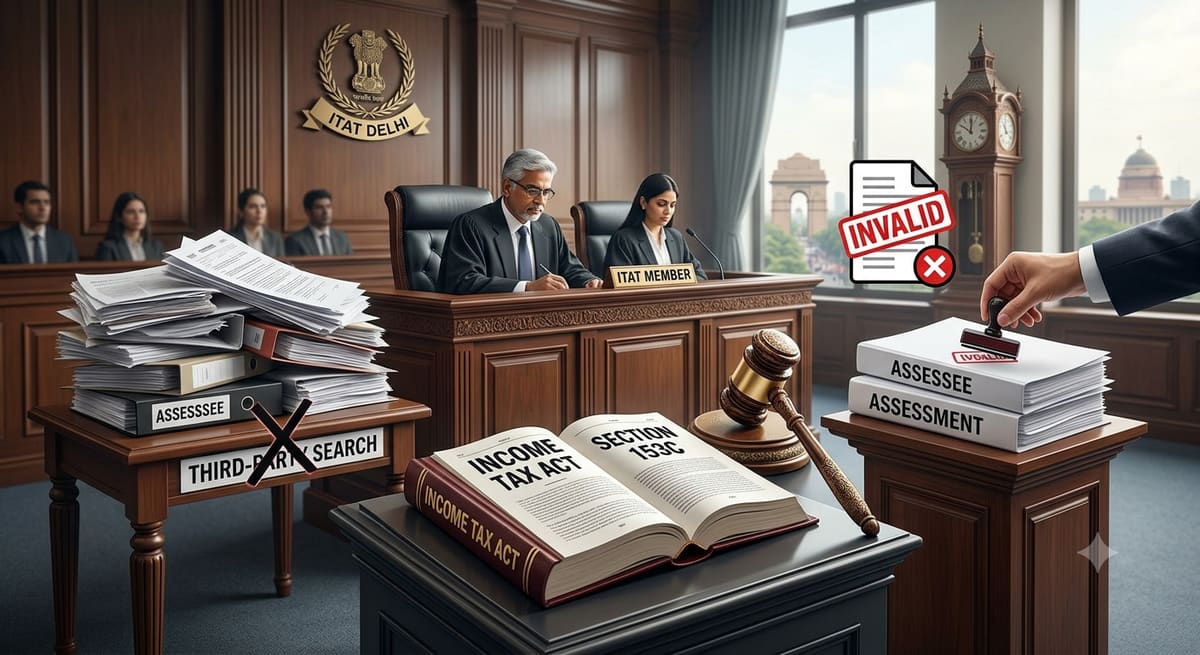
The Income Tax Appellate Tribunal, Delhi Bench, has delivered a significant ruling on the jurisdictional requirements under Section 153C of the Income Tax Act, 1961. The Tribunal held that proceedings initiated under this section are invalid in the absence of incriminating material belonging to the assessee found during a search of a third party. This judgment reinforces the principle that jurisdiction under Section 153C cannot be assumed without concrete evidence linking the assessee to the seized material.
Background & Facts
The Dispute
The appellant, Jitender Parmar, an individual deriving income from business and house property, filed his original return of income for Assessment Year (A.Y.) 2020-21 on 04.01.2021, declaring an income of Rs. 7,01,030. A search and seizure operation under Section 132 of the Act was conducted on 06.01.2021 in the case of the Hans Group. During the search, various documents, digital data, and incriminating material were seized from the premises of individuals and entities associated with the Hans Group.
Key Facts
Upon perusal of the seized documents, the Assessing Officer (AO) of the searched person found information purportedly relating to the appellant.
The AO of the searched person drew a satisfaction note on 30.06.2022 and handed over the relevant seized document to the AO of the appellant to initiate proceedings under Section 153C read with Section 153A of the Act.
The AO of the appellant recorded his satisfaction note under Section 153C on 30.06.2022 and issued a notice under the same section requiring the appellant to furnish a return of income for A.Y. 2020-21.
The AO made an addition of Rs. 40,00,000 under Section 69 read with Section 115BBE of the Act, treating the amount as an unexplained investment in a property situated at 78, Shankar Vihar, Delhi-110092.
Procedural History
04.01.2021: Appellant filed original return of income for A.Y. 2020-21.
06.01.2021: Search and seizure operation conducted in the case of Hans Group.
30.06.2022: Satisfaction note drawn by AO of searched person; notice issued under Section 153C to the appellant.
19.03.2024: Assessment order passed under Section 144 read with Section 153C of the Act.
24.10.2025: Commissioner of Income Tax (Appeals) [CIT(A)] confirmed the addition.
07.04.2026: Appeal heard by ITAT Delhi.
01.07.2026: ITAT pronounced order allowing the appeal.
The Parties' Positions
For the Appellant
The appellant contended that:
The assessment order under Section 144 read with Section 153C was invalid as no incriminating material belonging to the appellant was found during the search.
The proceedings under Section 153C were initiated without valid jurisdiction, as the satisfaction note did not link the seized material to any specific assessment year.
The satisfaction note lacked a Document Identification Number (DIN), rendering it invalid as per CBDT Circular No. 19/2019.
The addition of Rs. 40,00,000 was made without corroborative evidence and in violation of the principles of natural justice, as the appellant was not provided an opportunity to cross-examine the evidence.
The payment of Rs. 40,00,000 was made through banking channels as a security deposit for a proposed property transaction, which was subsequently refunded in full through the same channels upon cancellation of the deal.
For the Respondent
The Department relied on the orders of the AO and CIT(A), contending that:
The seized document (an agreement to sell found on the mobile phone of a third party) constituted sufficient incriminating material to initiate proceedings under Section 153C.
The addition under Section 69 was justified as the appellant failed to explain the source of the investment.
The procedural requirements under Section 153C were complied with, and the satisfaction note was validly recorded.
Relief Sought
The appellant sought:
Quashing of the assessment order dated 19.03.2024 and the CIT(A) order dated 24.10.2025.
Deletion of the addition of Rs. 40,00,000 made under Section 69 of the Act.
A direction to the Department to consider the appellant's explanation and documentary evidence regarding the banking transactions.
The Legal Issue
The central legal questions before the Tribunal were:
Whether proceedings under Section 153C of the Income Tax Act can be validly initiated in the absence of incriminating material belonging to the assessee found during the search of a third party?
Whether the satisfaction note recorded by the AO of the searched person and the AO of the assessee was valid, given the lack of specificity regarding the assessment year and the absence of a DIN?
Whether the addition of Rs. 40,00,000 under Section 69 was sustainable in law, given that the transaction was fully recorded through banking channels and subsequently refunded?
Arguments Presented
For the Appellant
Jurisdictional Validity: The appellant argued that Section 153C mandates the finding of incriminating material belonging to the assessee during the search. Since no such material was found, the proceedings were without jurisdiction.
Satisfaction Note Defects: The satisfaction note was defective as it did not specify the assessment year to which the seized material pertained and lacked a DIN, violating CBDT Circular No. 19/2019.
Natural Justice: The addition was made without providing the appellant an opportunity to cross-examine the evidence, violating the principles of natural justice.
Banking Transactions: The appellant submitted detailed evidence of banking transactions showing that Rs. 40,00,000 was paid as a security deposit and subsequently refunded in full. The AO, in the remand report, acknowledged that no immovable property was registered in the appellant's name and that the payments were made through banking channels.
For the Respondent
Incriminating Material: The Department contended that the agreement to sell found on the mobile phone of a third party constituted incriminating material sufficient to initiate proceedings under Section 153C.
Addition Justification: The addition under Section 69 was justified as the appellant failed to explain the source of the investment, and the seized document was sufficient evidence of the transaction.
Procedural Compliance: The Department argued that the procedural requirements under Section 153C were complied with, and the satisfaction note was validly recorded.
The Court's Analysis
The Tribunal conducted a detailed analysis of the jurisdictional requirements under Section 153C and the validity of the addition made under Section 69 of the Act.
Jurisdiction Under Section 153C
The Tribunal observed that Section 153C can only be invoked if incriminating material belonging to the assessee is found during the search of a third party. The provision is not a roving inquiry and requires a direct nexus between the seized material and the assessee. The Tribunal noted:
"We find that in the present case, the AO himself, during the remand proceedings, has verified from the office of the Sub-Registrar that no immovable property was registered in the name of the assessee during the relevant year and has further observed that the payments were made through banking channels and could be in the nature of a security or guarantee, which were subsequently refunded upon cancellation of the deal."
The Tribunal held that the foundation for invoking Section 153C was absent, as no incriminating material belonging to the appellant was found during the search. The satisfaction note was also defective as it did not specify the assessment year and lacked a DIN, rendering the proceedings invalid.
Validity of Addition Under Section 69
The Tribunal examined the addition of Rs. 40,00,000 under Section 69 read with Section 115BBE of the Act. The appellant had submitted detailed evidence of banking transactions showing that the amount was paid as a security deposit and subsequently refunded in full. The AO, in the remand report, acknowledged that no immovable property was registered in the appellant's name and that the payments were made through banking channels.
The Tribunal noted:
"We also note that the assessee furnished documentary evidences for the payment made through banking channel and the AO or the CIT(A) could not bring out any corroborative material or evidence to show that any payment were made in cash. In such factual matrix of the instant case, we are of the considered view that once these facts stand admitted, the very foundation for invoking section 69 of the Act ceases to exist, as there is neither any investment nor any unexplained source of funds."
The Tribunal further observed that the AO made no independent enquiry or verification from the seller or custodian of the property and failed to collect any adverse material to rebut the appellant's claim. The addition was thus unsustainable in law.
The Verdict
The Tribunal allowed the appeal and deleted the addition of Rs. 40,00,000 made under Section 69 of the Act. The Tribunal held that:
The proceedings under Section 153C were invalid as no incriminating material belonging to the appellant was found during the search.
The satisfaction note was defective as it lacked specificity regarding the assessment year and did not comply with CBDT Circular No. 19/2019.
The addition under Section 69 was unsustainable as the transaction was fully recorded through banking channels and subsequently refunded, with no evidence of cash payment.
What This Means For Similar Cases
Jurisdictional Requirements Under Section 153C Are Strict
Incriminating Material Mandatory: Practitioners must emphasize that Section 153C proceedings cannot be initiated without incriminating material belonging to the assessee found during the search. A mere suspicion or indirect link to the assessee is insufficient.
Satisfaction Note Specificity: The satisfaction note must clearly specify the assessment year to which the seized material pertains. A collective satisfaction note for multiple assessment years, as in this case, is invalid.
DIN Compliance: The satisfaction note must comply with CBDT Circular No. 19/2019 and include a valid Document Identification Number (DIN). Non-compliance renders the note invalid.
Documentary Evidence Prevails Over Presumptions
Banking Transactions: Where transactions are recorded through banking channels, additions under Section 69 cannot be sustained merely on the basis of presumptions or dumb documents. The Department must bring cogent evidence to rebut the assessee's explanation.
Remand Report Findings: If the AO, during remand proceedings, verifies the assessee's claims (e.g., no property registration, banking transactions), the CIT(A) cannot disregard these findings without contrary evidence.
Natural Justice: The Department must provide the assessee an opportunity to cross-examine evidence relied upon for additions. Violations of natural justice can vitiate the assessment.
Procedural Compliance Is Non-Negotiable
Independent Verification: The AO must conduct independent verification from relevant parties (e.g., sellers, custodians) before making additions. Reliance on seized documents without verification is insufficient.
Remand Proceedings: The CIT(A) must consider the AO's remand report findings and cannot confirm additions without addressing these findings or bringing contrary material on record.