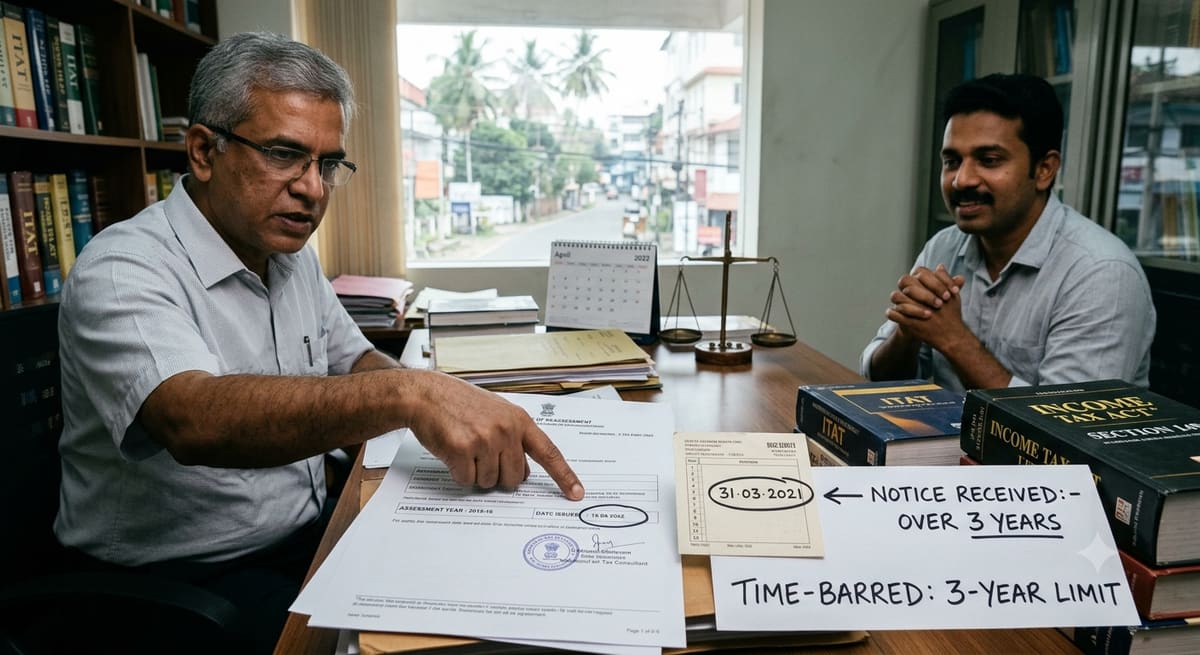
The Income Tax Appellate Tribunal, Cochin Bench, has held that a reassessment notice issued under Section 148 of the Income Tax Act for Assessment Year 2015-16 on 06.05.2022 is void ab initio, as it was issued after the statutory limitation period expired on 31.03.2022. This decision reaffirms the binding effect of the first proviso to Section 149(1), which bars reopening of assessments for pre-2021 years if the old regime’s limitation had already lapsed.
Background & Facts
The Dispute
The dispute arose from the Income Tax Department’s attempt to reopen the assessment of the assessee, Binu Joy Kondody, for Assessment Year 2015-16 based on cash deposits exceeding Rs. 50 lakhs during Financial Year 2014-15. The assessee, who claimed to be a Non-Resident until September 2014, contended that the funds deposited were from NRE account proceeds and not taxable income. The Assessing Officer (AO) initiated reassessment proceedings under Section 148 on 06.05.2022, adding Rs. 16,67,740 as unexplained investment under Section 69 read with Section 115BBE, and Rs. 1,15,186 as interest income, resulting in a total assessed income of Rs. 17,82,926.
Key Facts
The assessee did not file a return of income for AY 2015-16.
Cash deposits in bank accounts during FY 2014-15 exceeded Rs. 50 lakhs.
The assessee claimed Non-Resident status until September 2014 and that funds were from NRE account closures for personal expenses.
The AO did not accept the explanation and made additions without requiring documentary proof.
The total income addition of Rs. 17,82,926 was below the Rs. 50 lakh threshold required for invoking the extended 10-year limitation under the amended Section 149(1)(b).
Procedural History
31.03.2016: End of Assessment Year 2015-16.
31.03.2022: Last date for issuing notice under Section 148 under the pre-Finance Act 2021 regime (six-year limitation).
28.03.2022: Show cause notice (SCN) issued under Section 148A(b) granting 9 days to respond.
06.04.2022: Deadline for response to SCN.
06.05.2022: Order under Section 148A(d) passed; notice under Section 148 issued on the same date.
14.02.2024: AO passed reassessment order under Section 147 read with Section 144.
14.10.2025: CIT(A)/NFAC dismissed the appeal, upholding the reassessment.
12.06.2026: Hearing before ITAT Cochin.
02.07.2026: ITAT pronounced judgment.
The Parties' Positions
For the Appellant (Assessee):
The notice under Section 148 was issued on 06.05.2022, after the expiry of the six-year limitation period under the old regime (31.03.2022).
The first proviso to Section 149(1) explicitly bars issuance of notices for assessment years beginning on or before 01.04.2021 if the old limitation had expired.
The procedural compliance under Section 148A cannot cure a jurisdictional defect arising from a time-barred notice.
The additions were below Rs. 50 lakhs, making the extended 10-year period inapplicable.
For the Respondent (Revenue):
The SCN under Section 148A(b) was issued on 28.03.2022, within the limitation period.
The time taken for the Section 148A proceedings (9 days for reply + 7 days extension under 4th proviso) should be excluded, making the Section 148 notice timely.
The notice was issued after completion of mandatory Section 148A procedures, which are integral to the reassessment process.
Relief Sought
The assessee sought quashing of the reassessment order dated 14.02.2024, cancellation of the notice under Section 148 dated 06.05.2022, and setting aside of the CIT(A) order dated 14.10.2025. The stay application (SA No. 3/Coch/2026) sought stay of the disputed demand of Rs. 15,92,309.
The Legal Issue
The central question was whether a notice issued under Section 148 of the Income Tax Act for Assessment Year 2015-16 on 06.05.2022 is valid, when the limitation period under the pre-amendment Section 149(1)(b) expired on 31.03.2022, and the first proviso to the amended Section 149(1) explicitly bars such notices if they could not have been issued under the old regime.
Arguments Presented
For the Appellant
The appellant relied on the Supreme Court’s judgment in Union of India v. Rajeev Bansal (2024) 469 ITR 46, which held that the first proviso to Section 149(1) acts as a statutory gatekeeper: if the notice could not have been issued under the old regime’s six-year limit, it cannot be revived under the new regime, regardless of procedural compliance under Section 148A. The appellant emphasized that the monetary addition (Rs. 17.82 lakh) was below Rs. 50 lakh, making the extended 10-year period inapplicable. The exclusion of time under the 3rd and 4th provisos to Section 149(1) cannot override the jurisdictional bar imposed by the first proviso. The Karnataka High Court in Mohammed Yaseen v. ITO [2025] 175 taxmann.com 280 and Bombay High Court in Godrej Industries Ltd. [2024] 160 taxmann.com 13 were cited to reinforce that the date of issuance of the Section 148 notice, not the SCN, is decisive.
For the Respondent
The Revenue contended that the Section 148A proceedings were initiated within the limitation period (SCN issued on 28.03.2022) and that the time taken for the assessee’s response (9 days) and the mandatory 7-day extension under the 4th proviso should be excluded from the limitation period. It argued that Section 148A is a procedural prerequisite to Section 148, and the notice under Section 148 was issued immediately after completion of these procedures. The Revenue relied on the view that the new regime’s procedural framework should be given effect, and that the exclusion provisions were designed to protect the Revenue’s ability to act where the assessee delayed.
The Court's Analysis
The Tribunal undertook a detailed analysis of the statutory framework under Section 149, particularly the interplay between the first proviso and the 3rd and 4th provisos. It held that the first proviso to Section 149(1) is not merely procedural but a jurisdictional bar. The Supreme Court in Rajeev Bansal had clearly stated that for assessment years beginning on or before 01.04.2021, a notice under Section 148 can only be issued if it was not time-barred under the old regime. For AY 2015-16, the six-year period ended on 31.03.2022. The notice issued on 06.05.2022 was therefore issued after the statutory cut-off.
"The first proviso to Section 149(1) acts as a gatekeeper. This means that even if there were delays due to assessee's response or court stays, these exclusions cannot revive a notice that is already time-barred by the first proviso."
The Tribunal rejected the Revenue’s argument that the exclusion of time under the 3rd and 4th provisos could extend the limitation beyond 31.03.2022. It held that these provisos are meant to compute the limitation period within the framework of the old regime, not to override its expiry. The Gujarat High Court in Devika Fibres (P.) Ltd. and the Karnataka High Court in Mohammed Yaseen were followed to affirm that a notice issued after the expiry of the old limitation period is void ab initio, irrespective of Section 148A compliance.
The Tribunal further clarified that Section 148A is a distinct procedural mechanism and does not alter the limitation period prescribed under Section 149. The issuance of an SCN under Section 148A does not equate to issuance of a notice under Section 148. The date of the Section 148 notice alone determines validity. Since the notice was issued on 06.05.2022, beyond the 31.03.2022 deadline, the entire reassessment proceedings were invalid.
The Verdict
The appeal was allowed. The ITAT set aside the reassessment order dated 14.02.2024, quashed the notice issued under Section 148 on 06.05.2022, and cancelled the order of the CIT(A) dated 14.10.2025. The stay application (SA No. 3/Coch/2026) was dismissed as infructuous. The reassessment proceedings are declared void ab initio, and no further action can be taken on the basis of the impugned notice or order.
What This Means For Similar Cases
Limitation Is Jurisdictional, Not Procedural
Practitioners must now treat the expiry of the old regime’s limitation period (31.03.2022 for AY 2015-16) as a jurisdictional defect, not a mere procedural irregularity.
Any reassessment notice issued after 31.03.2022 for AYs 2013-14 to 2015-16 is void, even if Section 148A procedures were followed.
Section 148A Compliance Does Not Cure Time-Barred Notices
The completion of Section 148A proceedings, including issuance of SCN and passing of order under Section 148A(d), cannot validate a notice issued beyond the statutory cut-off.
The date of the Section 148 notice is the sole determinant of validity; the SCN date is irrelevant for limitation purposes.
Monetary Threshold Is Critical for Extended Period
For reassessments initiated under the new regime’s 10-year period, the escaped income must exceed Rs. 50 lakh. If it does not, the old six-year limit applies, and the first proviso bars reopening if that period has lapsed.
Practitioners must verify both the date of notice and the quantum of addition before challenging or defending reassessments.
Pre-2021 Assessment Years Are Protected
The judgment reinforces that the Finance Act 2021 was not intended to revive time-barred reassessments for pre-2021 years.
Assessors and practitioners must now treat notices issued after 31.03.2022 for AYs 2013-14 to 2015-16 as legally unsustainable, regardless of the Revenue’s procedural compliance.