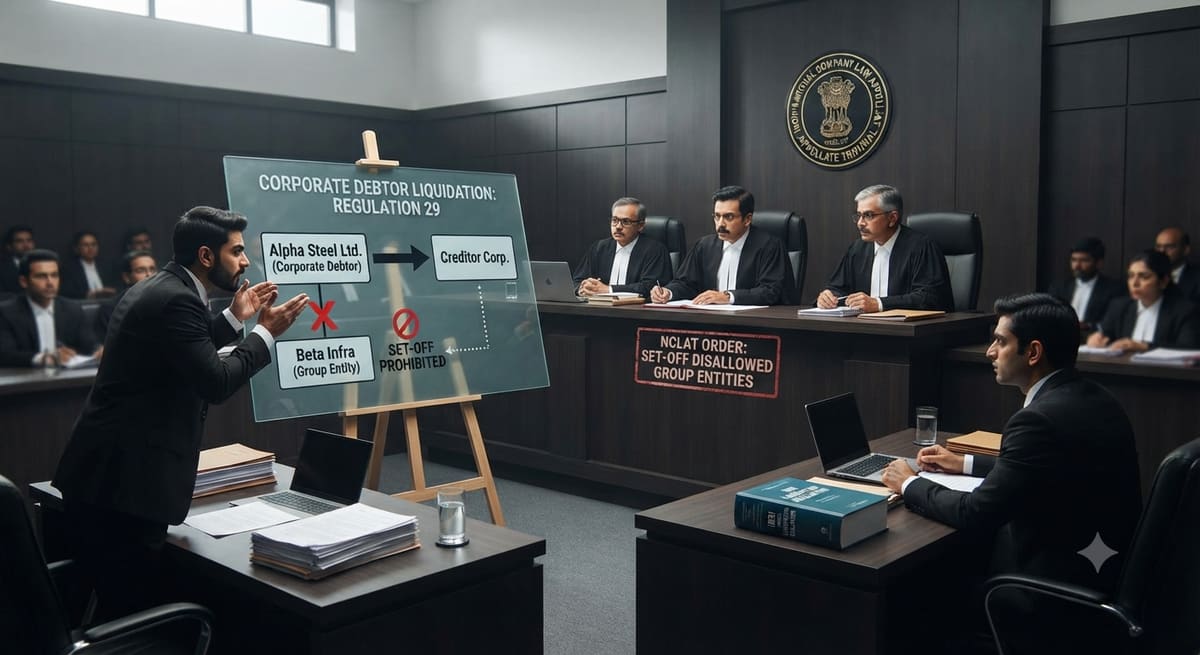
The National Company Law Appellate Tribunal has reaffirmed that the Insolvency and Bankruptcy Code does not permit set-off of claims across separate legal entities within a corporate group, even where commercial integration is evident. This ruling clarifies the strict boundaries of Regulation 29 of the Liquidation Process Regulations, 2016, and reinforces the foundational principle of corporate separateness in insolvency proceedings.
Background & Facts
The Dispute
The dispute arises from the liquidation of Brahmaputra Rolling Mills Pvt. Ltd. (Corporate Debtor), wherein the Appellant, M/s Assam Power Distribution Company Ltd. (Operational Creditor), was directed by the National Company Law Tribunal (Guwahati Bench) to pay admitted dues of ₹37,66,906.80, plus interest from 31.12.2014. The Appellant contested this direction, asserting that it was entitled to set-off this liability against admitted claims of ₹9,07,03,124 owed to it by three other entities within the same Brahmaputra Group of Industries - Brahmaputra Galvochem Pvt. Ltd., Brahmaputra Iron and Steel Co. Pvt. Ltd., and Brahmaputra TMT Bars Pvt. Ltd. - all of which had undergone separate insolvency and liquidation proceedings.
Key Facts
The Appellant, a government-owned power utility, supplied electricity to the Brahmaputra Group entities from 2013 until disconnection on 31.12.2014 due to non-payment.
The Corporate Debtor, Brahmaputra Rolling Mills Pvt. Ltd., had an outstanding electricity bill of ₹37,66,906.80 as of 31.12.2014, which the Appellant admitted in writing on 06.02.2024.
The Appellant’s claims against the other three group entities were admitted as follows:
Brahmaputra Galvochem Pvt. Ltd.: ₹18,48,918.04
Brahmaputra Iron and Steel Co. Pvt. Ltd.: ₹46,63,326.09
Brahmaputra TMT Bars Pvt. Ltd.: ₹8,41,90,880.00
Total: ₹9,07,03,124.13
Each of the four group entities underwent separate Corporate Insolvency Resolution Processes (CIRPs) and subsequent liquidations.
The liquidation proceedings for all group entities were concluded, and final orders of dissolution were passed by the NCLT Guwahati Bench on 13.12.2024.
The Appellant filed its claim in Form B during CIRP on 08.12.2022, disclosing no mutual dealings or set-off claims (marked "N/A").
The Respondent-Liquidator, Mrs. Meena Sureka, verified the claim and issued multiple reminders, including a legal notice dated 13.03.2024, to which the Appellant responded only by seeking extensions and later admitting liability while attempting to invoke set-off.
The Appellant relied on a single letter dated 2024 regarding office relocation to argue a unified group identity, which the NCLT found insufficient to override statutory separateness.
The Appellant’s calculation of dues relied on Regulation 16.3.14 of the AERC Supply Code, which applies to single consumers with multiple connections - a factual misapplication since each group entity had distinct connections and separate billing.
Procedural History
18.11.2022: CIRP initiated against Brahmaputra Rolling Mills Pvt. Ltd. by NCLT Guwahati Bench.
10.02.2023: Mrs. Meena Sureka appointed as Resolution Professional.
13.10.2023: NCLT ordered liquidation of the Corporate Debtor; Mrs. Meena Sureka appointed Liquidator.
08.12.2022: Appellant filed claim in Form B for ₹21,61,779.88.
06.01.2023: Liquidator communicated adjustment of load security and admitted liability of ₹37,66,906.80 against Appellant.
02.12.2023: Appellant filed revised claim in Form C for ₹28,39,285.24, later rejected.
06.02.2024: Appellant admitted liability of ₹37,66,906.80 but sought set-off against ₹8,65,25,177 claimed from group entities.
13.03.2024: Legal notice issued by Liquidator demanding payment.
05.04.2024: Appellant promised response within two weeks.
26.04.2024: Appellant sought extension till 07.05.2024 citing state elections; no payment made.
27.05.2025: NCLT Guwahati Bench passed impugned order directing payment of ₹37,66,906.80 with interest from 31.12.2014.
28.03.2026: Appeal filed before NCLAT (Company Appeal (AT) (Insolvency) No. 1205 of 2025).
03.07.2026: NCLAT delivered judgment dismissing the appeal.
The Parties' Positions
Appellant (Assam Power Distribution Company Ltd.):
Argued that the Brahmaputra Group presented itself as a single economic unit through shared letterheads, common office addresses, and coordinated billing practices.
Invoked Regulation 29 of the Liquidation Process Regulations, 2016, and the doctrine of equitable set-off as recognized in Bharti Airtel Ltd. v. Vijay Kumar V. Iyer (2024) 4 SCC 668.
Contended that denying set-off would result in unjust enrichment of the liquidation estate and violate principles of equity and public interest.
Asserted fiduciary duty as a government entity to protect public funds.
Respondent (Mrs. Meena Sureka, Liquidator):
Emphasized that each group entity was a distinct juristic person with separate CIRPs, liquidations, and dissolution orders.
Stated that Regulation 29 applies only to mutual dealings between the same two parties - the Corporate Debtor and the creditor - not third-party entities.
Highlighted that the Appellant had not disclosed any set-off claim during initial filing (Form B), and had admitted liability in writing.
Argued that the Appellant’s conduct was dilatory and mala fide, designed to delay liquidation.
Cited NCLT’s findings that billing, load security deposits, and voting rights were maintained separately, affirming legal separateness.
Relief Sought
The Appellant sought:
Setting aside of the NCLT’s order dated 27.05.2025.
Permission to set-off the admitted liability of ₹37,66,906.80 against the admitted claims of ₹9,07,03,124 from other group entities.
Cancellation of interest liability from 31.12.2014.
Direction to the Liquidator to recognize the set-off under Regulation 29.
The Legal Issue
Can an operational creditor invoke Regulation 29 of the IBBI (Liquidation Process) Regulations, 2016, to set-off its admitted liability to a corporate debtor against claims it holds against other, separate legal entities within the same corporate group, where those entities have undergone distinct insolvency and liquidation proceedings?
Arguments Presented
For the Appellant
The Appellant relied on Bharti Airtel Ltd. v. Vijay Kumar V. Iyer (2024) 4 SCC 668 to argue that equitable set-off is permissible when claims arise from interconnected transactions and denying it would result in inequity. It contended that the Brahmaputra Group operated as a single economic unit, evidenced by shared administrative practices, common letterheads, and coordinated billing. The Appellant asserted that Regulation 29’s reference to "mutual dealings" should be interpreted purposively to permit set-off across group entities to avoid multiplicity of litigation and ensure fairness. It further argued that as a public utility, it had a fiduciary duty to prevent unjust enrichment of the liquidation estate by paying out funds without adjusting legitimate receivables.
For the Respondent
The Respondent countered that Regulation 29 explicitly applies only to mutual debts between the corporate debtor and the creditor - not third parties. It emphasized that each group entity had distinct CIRPs, separate liquidation proceedings, and final dissolution orders. The Appellant’s failure to disclose any set-off claim in Form B during CIRP, coupled with its written admission of liability, undermined its equitable plea. The Respondent cited NCLT’s findings that billing, load security deposits, and stakeholder committee participation were maintained on an entity-specific basis, confirming legal separateness. It further argued that Section 238 of the IBC overrides any conflicting provisions under the Electricity Act, and that the Appellant’s reliance on the "group of companies doctrine" was legally inapplicable in the absence of a group insolvency proceeding under Part III of the IBC.
The Court's Analysis
The NCLAT undertook a rigorous textual and purposive analysis of Regulation 29 of the IBBI (Liquidation Process) Regulations, 2016, which states: "Where there are mutual dealings between the corporate debtor and another party, the sums due from one party shall be set off against the sums due from the other to arrive at the net amount payable to the corporate debtor or to the other party."
The Tribunal held that the phrase "another party" refers exclusively to the counterparty in the specific debt relationship - here, the Corporate Debtor and the Appellant. It rejected the Appellant’s attempt to extend this to third-party entities, even if part of the same corporate group. The Court observed:
"The benefit of set-off under Regulation 29 is available only if the same parties (i.e. CD and appellant) are involved and the same cannot be applied in case of third-party entities."
The Tribunal distinguished Bharti Airtel on the ground that it concerned mutual debts between two direct parties, not a web of claims across multiple insolvency estates. It noted that the IBC’s framework is built on the principle of corporate separateness, and that the Code does not recognize group insolvency unless expressly provided under Part III - which was not invoked here.
The Court further emphasized that the Appellant’s conduct - admitting liability in writing, failing to disclose set-off claims during CIRP, and repeatedly seeking extensions - amounted to approbate and reprobate. The NCLT’s observation that the Appellant could not "blow hot and cold" was upheld.
The Tribunal also rejected the Appellant’s reliance on the "group of companies doctrine" as a basis for set-off, noting:
"While this may have been adopted as a matter of procedural convenience by the Applicant, the Corporate Debtor retains its nature and character as a separate juristic entity."
The Court held that shared office addresses or administrative coordination do not override statutory legal personality. The fact that each entity had separate load security deposits, distinct billing, and individual stakeholder committees confirmed this.
Finally, the Court noted that all group entities had been dissolved by 13.12.2024, rendering any claim against them non-enforceable in the context of this liquidation. The Appellant’s remedy, if any, lay in its separate liquidation claims - not in set-off against a different corporate debtor.
The Verdict
The appeal was dismissed. The NCLAT upheld the NCLT’s order dated 27.05.2025, directing the Appellant to pay ₹37,66,906.80 to the Liquidator of Brahmaputra Rolling Mills Pvt. Ltd., with interest at the rate applicable under the Electricity Act, commencing from 31.12.2014. The Appellant was directed to bear its own costs. No set-off was permitted against claims held against other group entities. The judgment affirmed that Regulation 29 permits set-off only between the direct parties to a debt, and not across separate insolvency estates.
What This Means For Similar Cases
Set-off Under Regulation 29 Is Strictly Limited to Direct Counterparties
Practitioners must ensure that any set-off claim under Regulation 29 is limited to debts owed directly between the corporate debtor and the creditor.
Claims against third-party group entities, even if part of the same business group, cannot be aggregated or offset unless those entities are part of a single, consolidated insolvency proceeding.
Failure to disclose a set-off claim during CIRP (e.g., in Form B) may bar its assertion later during liquidation.
Corporate Separateness Prevails Over Commercial Integration
Shared administrative practices, letterheads, or office locations do not negate legal separateness under the IBC.
Each entity’s distinct CIRP, liquidation, and dissolution proceedings reinforce its independent legal identity.
Courts will not permit equitable arguments to override statutory structure unless a group insolvency is formally initiated.
Timing and Disclosure Are Critical
Operational creditors must disclose all mutual dealings, including potential set-offs, at the earliest stage - during CIRP claim filing.
Post-admission attempts to invoke set-off after liability is acknowledged will be viewed as dilatory and mala fide.
Liquidators are under statutory duty to recover admitted claims without delay; any attempt to delay payment by invoking unrelated claims will be penalized.