Jammu & Kashmir and Ladakh High Court judgments

90 Jammu & Kashmir and Ladakh High Court judgments explained in plain English: what was decided, the law applied and why it matters.

Section 138 NI Act | Composite Demand Notice for Multiple Cheques Valid; Cognizance After 15-Day Period Cures Premature Filing : J&K HC
Case Law Analysis
|Jammu & Kashmir and Ladakh High Court

Section 138 NI Act | Composite Demand Notice for Multiple Cheques Valid; Cognizance After 15-Day Period Cures Premature Filing : J&K HC

The J&K High Court held that a single composite demand notice covering multiple dishonoured cheques satisfies Section 138 NI Act requirements, and that taking cognizance after the 15-day statutory payment window expires cures any premature filing defect. The ruling clarifies procedural compliance for cheque bounce complainants and limits technical grounds for quashing proceedings.

Stale FIRs & Failure to Notify Representation Authority Invalidate PSA Detention | Preventive Detention : J&K HC
Case Law Analysis
|Jammu & Kashmir and Ladakh High Court

Stale FIRs & Failure to Notify Representation Authority Invalidate PSA Detention | Preventive Detention : J&K HC

The J&K High Court quashed a PSA detention order, ruling that reliance on stale FIRs without a proximate link to current public order prejudice, and failure to inform the detenue of the specific representation authority, violates Article 22(5) safeguards. The decision reinforces that preventive detention requires fresh, live grounds, not mechanical reproduction of past cases.

Magistrate Lacks Power to Direct FIR for Non-Cognizable Offence | Section 156(3) CrPC : J&K HC
Case Law Analysis
|Jammu & Kashmir and Ladakh High Court

Magistrate Lacks Power to Direct FIR for Non-Cognizable Offence | Section 156(3) CrPC : J&K HC

The Jammu & Kashmir High Court ruled that a judicial magistrate cannot compel the police to register an FIR under Section 156(3) when the complaint concerns only a non-cognizable offence such as an IPC 323 assault. The magistrate must instead proceed under Section 155(2) or treat the matter as a private complaint, curbing undue investigative authority.

Section 420 IPC requires fraudulent intent at the time of transaction; civil rent dispute cannot be prosecuted | J&K HC
Case Law Analysis
|Jammu & Kashmir and Ladakh High Court

Section 420 IPC requires fraudulent intent at the time of transaction; civil rent dispute cannot be prosecuted | J&K HC

The Jammu & Kashmir High Court set aside FIR 252/2021, ruling that the rent disagreement between Vision Public School trustees was a civil matter lacking the fraudulent intent essential for a Section 420 offence, thereby barring criminal prosecution and curbing abuse of process. This safeguards parties in commercial lease disputes from unwarranted criminal charges.

Functional disability assessed against earning capacity; unsubstantiated future medical expenses struck down in motor accident compensation : JKHC
Case Law Analysis
|Jammu & Kashmir and Ladakh High Court

Functional disability assessed against earning capacity; unsubstantiated future medical expenses struck down in motor accident compensation : JKHC

The JK High Court cut the motor-accident award by mandating that functional disability be measured against the claimant’s earning capacity, rejecting a 100 % disability assumption. It also struck a Rs 1 lakh future-medical expense claim with no proof. Insurers and claimants must now base compensation on realistic loss of earnings.

Order VII Rule 11 CPC | Plaintiff’s suit cannot be dismissed on basis of defendant’s de-registration; decision rests on plaint’s averments : J&K HC
Case Law Analysis
|Jammu & Kashmir and Ladakh High Court

Order VII Rule 11 CPC | Plaintiff’s suit cannot be dismissed on basis of defendant’s de-registration; decision rests on plaint’s averments : J&K HC

The Jammu & Kashmir High Court ruled that an Order VII Rule 11 application to dismiss a civil suit must be decided solely on the pleadings, not on the defendant society’s de-registration. This safeguards plaintiffs from dismissal merely because the opponent lacks current registration and clarifies locus-standi under the CPC.

Stale FIR Evidence Cannot Satisfy Subjective Satisfaction Under J&K Public Safety Act 1978 | Preventive Detention : JK HC
Case Law Analysis
|Jammu & Kashmir and Ladakh High Court

Stale FIR Evidence Cannot Satisfy Subjective Satisfaction Under J&K Public Safety Act 1978 | Preventive Detention : JK HC

The Jammu & Kashmir High Court set aside a PSA detention order that relied on a 2022 FIR, holding that preventive detention must be based on fresh, current material to meet the authority's subjective satisfaction. This ruling narrows the scope of PSA detentions and obliges officials to base orders on up-to-date evidence, impacting current and future detainees under the Act.

Casual workers can be regularised only in the lowest entry grade, not a higher post | Section 5, J&K Civil Services (Special Provisions) Act, 2010 : JK HC
Case Law Analysis
|Jammu & Kashmir and Ladakh High Court

Casual workers can be regularised only in the lowest entry grade, not a higher post | Section 5, J&K Civil Services (Special Provisions) Act, 2010 : JK HC

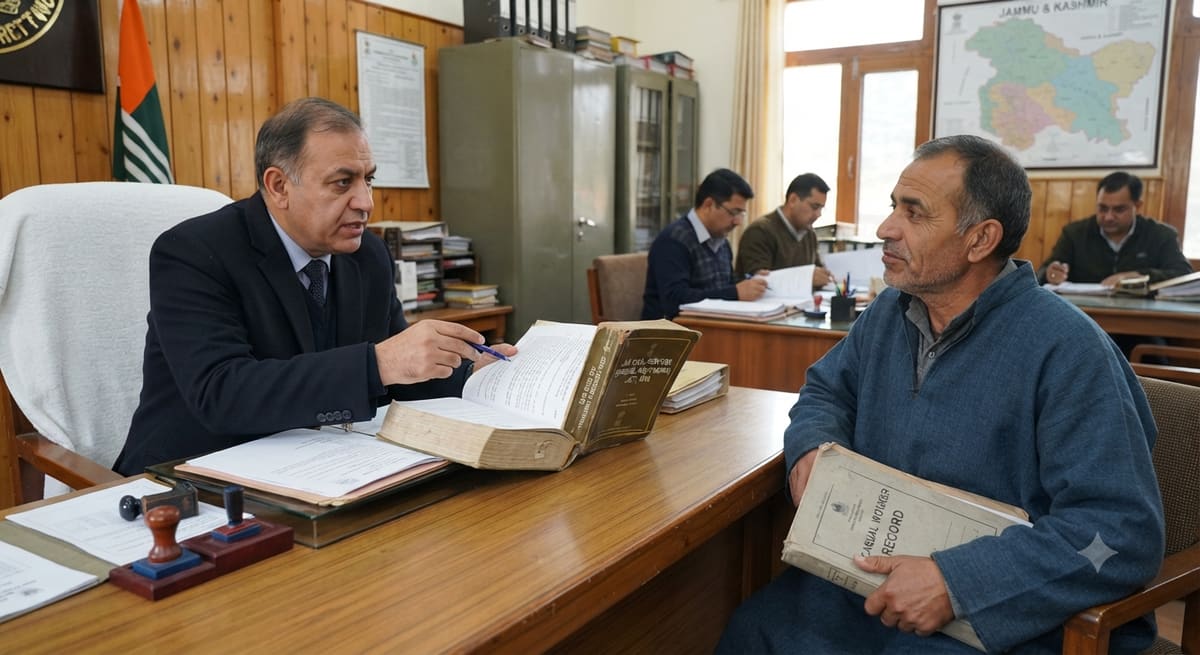
The JK High Court set aside the CAT order that regularised a long-serving casual driver as a driver, ordering regularisation as an orderly in the entry-level grade with arrears and a three-month deadline. The decision confirms that under Section 5 of the J&K Civil Services (Special Provisions) Act, 2010 casual employees must be regularised at the lowest grade, shaping future cases.

S. 1997 Migrant Property Act | Unregistered Mortgage-Cum-Sale Agreement Void Against Statutory Protections : J&K&L HC
Case Law Analysis
|Jammu & Kashmir and Ladakh High Court

S. 1997 Migrant Property Act | Unregistered Mortgage-Cum-Sale Agreement Void Against Statutory Protections : J&K&L HC

J&K&L High Court invalidated an unregistered mortgage-cum-sale agreement, affirming that the Jammu and Kashmir Migrant Immovable Property Act, 1997 overrides such instruments to protect migrant-owned land from unauthorized transfers. The ruling upholds eviction orders against occupants relying on defective agreements.

Section 154 CrPC | FIR Mandatory Upon Discovery of Cognizable Offence Post-Preliminary Inquiry Closure : J&K HC
Case Law Analysis
|Jammu & Kashmir and Ladakh High Court

Section 154 CrPC | FIR Mandatory Upon Discovery of Cognizable Offence Post-Preliminary Inquiry Closure : J&K HC

The J&K High Court has ruled that closure of a preliminary inquiry does not extinguish the duty to register an FIR if subsequent evidence reveals a cognizable offence. This clarifies that administrative closure cannot override statutory obligations under Section 154 CrPC, reinforcing that criminal proceedings remain viable even after disciplinary acquittals.

UA(P) Act Section 43 | Intermediary Role in Terror Funding & Communication with Banned Operatives Justifies Bail Denial : J&K HC
Case Law Analysis
|Jammu & Kashmir and Ladakh High Court

UA(P) Act Section 43 | Intermediary Role in Terror Funding & Communication with Banned Operatives Justifies Bail Denial : J&K HC

The J&K High Court ruled that acting as an intermediary in terror financing and maintaining communication with banned operatives constitutes sufficient grounds for bail denial under the UA(P) Act, even amid trial delays and lack of recovered material. This sets a precedent for stricter bail scrutiny in terror-related offenses involving logistical support roles.

Section 11(6) Arbitration Act | General Reference to Standard Agreement Does Not Incorporate Arbitration Clause: J&K & Ladakh HC
Case Law Analysis
|Jammu & Kashmir and Ladakh High Court

Section 11(6) Arbitration Act | General Reference to Standard Agreement Does Not Incorporate Arbitration Clause: J&K & Ladakh HC

The High Court of J&K & Ladakh ruled that a mere general reference to a standard dealership agreement in a temporary appointment does not automatically incorporate its arbitration clause. The decision underscores the need for explicit inclusion of arbitration terms in contracts, impacting businesses relying on standard agreements for dispute resolution.

Article 14 | No Automatic Parity for Seasonal Labourers Without Identical Duty Profile & Administrative Exigencies : J&K and Ladakh HC
|Jammu & Kashmir and Ladakh High Court

Article 14 | No Automatic Parity for Seasonal Labourers Without Identical Duty Profile & Administrative Exigencies : J&K and Ladakh HC

The J&K and Ladakh High Court ruled that seasonal labourers cannot claim automatic parity with regularized workers under Article 14 unless their duty profiles, seniority, and administrative circumstances are identical. The judgment underscores that equal protection does not mandate uniform treatment without a rational basis, affecting employment policies for temporary workforce engagements.

PSA Detention Valid Despite Six-Year Delay | Persistent Anti-National Conduct Justifies Preventive Detention : J&K HC
Case Law Analysis
|Jammu & Kashmir and Ladakh High Court

PSA Detention Valid Despite Six-Year Delay | Persistent Anti-National Conduct Justifies Preventive Detention : J&K HC

J&K High Court rules that a six-year gap between alleged acts and detention order does not invalidate preventive detention under the Public Safety Act if a persistent pattern of anti-national conduct is established. The ruling underscores that ongoing threats to national security can override procedural delays, even when the detenu is on bail in related cases.

Rafiq Masih Reaffirmed | No Recovery of Erroneous Salary Benefits from Class III/IV Employees; Prospective Pay Correction Permitted : J&K and Ladakh HC
Case Law Analysis
|Jammu & Kashmir and Ladakh High Court

Rafiq Masih Reaffirmed | No Recovery of Erroneous Salary Benefits from Class III/IV Employees; Prospective Pay Correction Permitted : J&K and Ladakh HC

J&K and Ladakh High Court bars recovery of erroneously paid salary benefits from Class III/IV employees under the Rafiq Masih judgment, even if granted by an incompetent authority. The court permits only prospective correction of pay scales, reinforcing protections for lower-rung government employees against financial hardship due to administrative errors.

NDPS Act Section 37 | Habitual Offender Status Overrides Intermediate Drug Quantity for Bail Denial: J&K HC
Case Law Analysis
|Jammu & Kashmir and Ladakh High Court

NDPS Act Section 37 | Habitual Offender Status Overrides Intermediate Drug Quantity for Bail Denial: J&K HC

The J&K High Court ruled that prior criminal antecedents under the NDPS Act can justify bail denial even for intermediate drug quantities, emphasizing that habitual offender status outweighs the scale of recovery. This sets a precedent for stricter bail scrutiny in repeat drug offenses, impacting bail jurisprudence under Section 37.

Suspension Period Must Count for Seniority & Promotion | Double Punishment Violates Service Continuity: J&K HC
Case Law Analysis
|Jammu & Kashmir and Ladakh High Court

Suspension Period Must Count for Seniority & Promotion | Double Punishment Violates Service Continuity: J&K HC

The J&K High Court has ruled that excluding suspension periods from seniority calculations, while crediting them for increments and pension, amounts to double punishment and breaches the principle of service continuity. This impacts all government and public sector employees facing disciplinary suspension, ensuring promotions are based on actual service tenure, not punitive exclusion.

J&K CSR Rule 24-Month Limit | Pension Recovery Post-Retirement Violates Natural Justice : J&K HC
Case Law Analysis
|Jammu & Kashmir and Ladakh High Court

J&K CSR Rule 24-Month Limit | Pension Recovery Post-Retirement Violates Natural Justice : J&K HC

The J&K High Court ruled that recovering excess pay from pension after retirement is illegal under J&K Civil Service Regulations, as the 24-month recovery limit applies. The court emphasized that rescinding benefits without a prior hearing violates principles of natural justice, setting a precedent for protecting retiral dues of government employees.

Delay and Laches Bar Seniority Claims | 15-Year Delay in Challenging CRPF Appointment Fixes Seniority Irrevocably: J&K and Ladakh HC
Case Law Analysis
|Jammu & Kashmir and Ladakh High Court

Delay and Laches Bar Seniority Claims | 15-Year Delay in Challenging CRPF Appointment Fixes Seniority Irrevocably: J&K and Ladakh HC

The J&K and Ladakh High Court has ruled that persistent representations over 15 years cannot revive a stale claim to seniority in the CRPF, as delay and laches extinguish the right to relief under Article 226. This sets a critical precedent for government employees who delay challenging service fixation - even if the grievance remains valid, unexplained inaction for over a decade bars judicial intervention.