The Jammu & Kashmir and Ladakh High Court has reaffirmed that persistent administrative inaction does not create a perpetual cause of action, and that delay in seeking judicial remedy under Article 226 of the Constitution, especially in service matters, will bar relief even where grievances remain unaddressed for years. This judgment clarifies the limits of equitable jurisdiction when litigants fail to act with reasonable diligence.
Background & Facts
The Dispute
The petitioner, Manish Kumar Bharti, sought revision of his seniority in the Central Reserve Police Force (CRPF) as Assistant Commandant, claiming he should be placed either at the bottom of the 30th Batch or at the top of the 31st Batch, rather than with the 33rd Batch, in which he ultimately underwent training. His claim arose from a delay in the issuance of his appointment order due to late police verification of his antecedents.
Key Facts
- The petitioner was selected in the 30th Batch of CPOs in 1997 following a competitive examination.
- His appointment order was delayed due to late clearance of verification reports.
- He was offered appointment with the 32nd Batch, which commenced on 25.02.2000, but did not join.
- He requested and was granted a six-month extension to undergo training.
- Upon expiry of the extension, he was directed to join the 33rd Batch, which commenced on 14.10.2000.
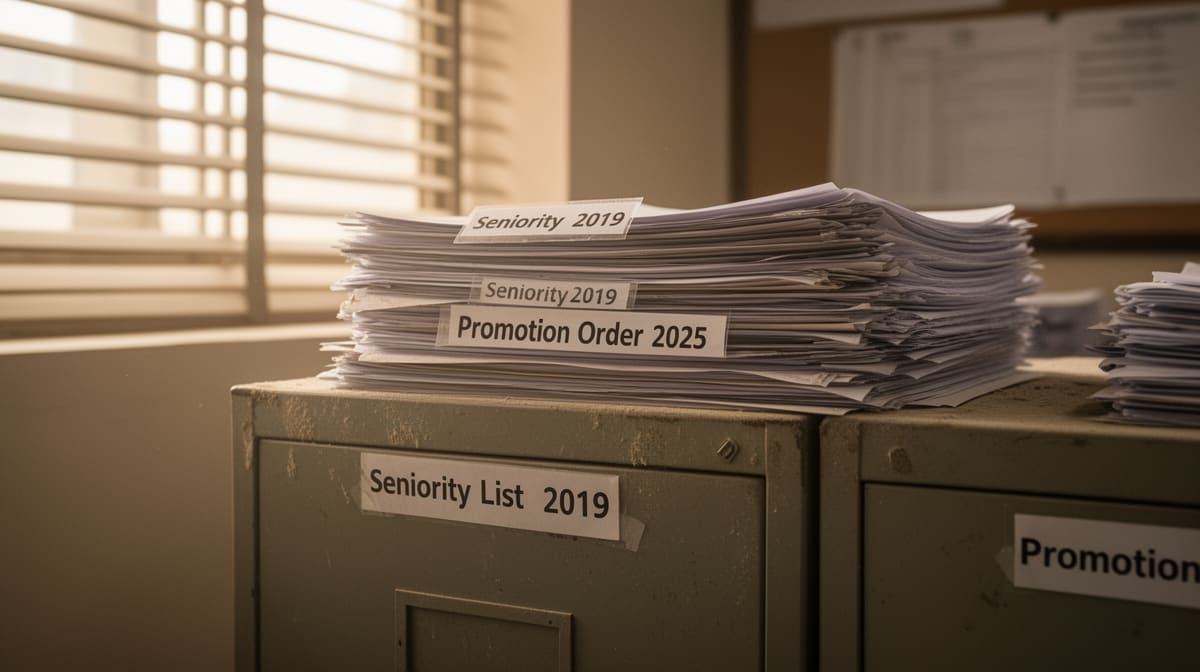
- His seniority was fixed in accordance with Rule 8(b)(ii) of the CRPF Rules, 1955 read with DOP&P OM No.35015/2/93(D) dated 09.08.1995.
- He was informed of his seniority position via Office Order dated 24.01.2002.
- He submitted representations on 26.12.2002, 28.11.2003, and in February 2006, challenging his seniority fixation.
- His representations were formally rejected by communication dated 07.09.2009.
- He filed a writ petition before the High Court of Jharkhand at Ranchi in 2011 (WP(S) No.2280/2011), which was dismissed as withdrawn with liberty to file afresh.
- He filed the present writ petition (SWP No.1283/2017) before the J&K and Ladakh High Court in 2017.
Procedural History
- 24.01.2002: Seniority of petitioner fixed by office order.
- 26.12.2002, 28.11.2003, Feb. 2006: Petitioner submits representations challenging seniority.
- 07.09.2009: Official rejection of representations; first formal communication on seniority.
- 2011: Writ petition filed before High Court of Jharkhand (WP(S) No.2280/2011).
- 2017: Present writ petition (SWP No.1283/2017) filed before J&K and Ladakh High Court.
- 03.12.2020: Single Judge of J&K and Ladakh High Court dismissed writ petition on grounds of delay and laches.
- 28.04.2026: Review petition heard.
- 08.05.2026: Review petition dismissed.
The Parties' Positions
The petitioner contended that his cause of action arose only in 2009 upon formal rejection of his representations, and that his 2011 petition before Jharkhand HC constituted timely recourse. He argued that the delay in filing the 2017 petition was excusable because the 2011 petition was dismissed as withdrawn with liberty to refile.
The respondents maintained that the petitioner had been aware of his seniority position since 2002, had made repeated representations over seven years, and that his 2017 petition was an abuse of process. They emphasized that inter se seniority had crystallized over time, affecting the rights of other officers.
Relief Sought
The petitioner sought revision of his seniority to place him in the 30th or 31st Batch, consequential pay and pension benefits, and a direction to the respondents to issue a corrected seniority list.
The Legal Issue
Can the filing of repeated representations to an employer revive a stale cause of action for seniority fixation, thereby excusing a delay of over fifteen years in approaching the High Court under Article 226 of the Constitution?
Arguments Presented
For the Petitioner
The petitioner relied on the principle that a cause of action arises only upon formal rejection of a representation. He argued that since his representations were rejected only in 2009, his 2011 petition before the Jharkhand High Court was timely, and his 2017 petition was a continuation of that effort. He contended that Article 226 has no fixed limitation period and that courts must exercise discretion in favor of aggrieved public servants who persistently seek redressal.
For the Respondent
The State argued that the petitioner was aware of his seniority position as early as 2002, as evidenced by his own representations dated 2002, 2003, and 2006. The delay of fifteen years in seeking judicial remedy, coupled with the crystallization of seniority rights of other officers, rendered his claim time-barred. The State cited Supreme Court precedents holding that representations alone cannot cure delay and laches.
The Court's Analysis
The Court examined the scope of review jurisdiction under Rule 65 of the High Court Rules and Order XLVII Rule 1 of the CPC, emphasizing that review is permissible only for an error apparent on the face of the record, discovery of new evidence, or a sufficient reason akin to these.
The petitioner’s primary ground for review was that the Single Judge had erred in stating that the petitioner had approached the Court only in 2017, ignoring the 2011 petition before the Jharkhand High Court. The Court acknowledged this factual oversight but held that it was immaterial to the outcome.
"The issue of delay and laches is an important factor in exercise of discretionary relief under Article 226 of the Constitution. When a person who is not vigilant of his rights and he acquiesces with the situation, he cannot be heard after a couple of years to challenge the impugned action of the employer."
The Court cited State of Uttaranchal v. Sri Shiv Charan Singh Bhandari (2013) to hold that acquiescence over years defeats equitable relief. It further relied on C. Jacob v. Director of Geology and Mining (2008), which clarified that replies to stale representations do not create a fresh cause of action. The Court emphasized:
"Filing of representations alone would not save the period of limitation. Delay or laches is a relevant factor for a Court of law to determine the question as to whether the claim made by an applicant deserves consideration."
The Court noted that the petitioner had been aware of his seniority position since 2002 and had made representations over seven years without initiating litigation. The 2009 rejection merely confirmed the existing position; it did not create a new cause of action. The Court concluded that the petitioner’s conduct amounted to laches, and that the rights of other officers who had been promoted and posted based on the settled seniority list had crystallized.
The Verdict
The review petition was dismissed. The Court upheld the order dated 03.12.2020 dismissing the writ petition on grounds of delay and laches. No relief was granted. The petitioner’s claim for revision of seniority, consequential pay, or pension benefits was rejected in its entirety. The Court held that the petitioner’s inaction for over fifteen years, despite knowledge of his position since 2002, rendered his claim time-barred and barred by equitable principles.
What This Means For Similar Cases
Representations Do Not Extend Limitation Period
- Practitioners must advise clients that repeated representations to administrative authorities do not toll limitation or create a fresh cause of action.
- A formal rejection letter does not reset the clock if the grievance has been known for years.
- Litigants must initiate judicial remedies within a reasonable time after becoming aware of the adverse order.
Seniority Claims Are Time-Sensitive
- In service matters involving inter se seniority, courts will not interfere once rights have crystallized among other officers.
- Delay beyond five to seven years is likely to be viewed as fatal, particularly when other officers have relied on the existing seniority list for promotions, postings, and benefits.
- Writ petitions challenging seniority must be filed promptly after the first formal communication of the impugned position.
Article 226 Is Not a Substitute for Delayed Action
- The discretionary nature of writ jurisdiction under Article 226 means courts will not grant relief to those who sleep on their rights.
- Courts will weigh prejudice to third parties and institutional stability when evaluating delay.
- Petitioners must demonstrate diligence; mere persistence in representations is insufficient to justify judicial intervention after prolonged inaction.