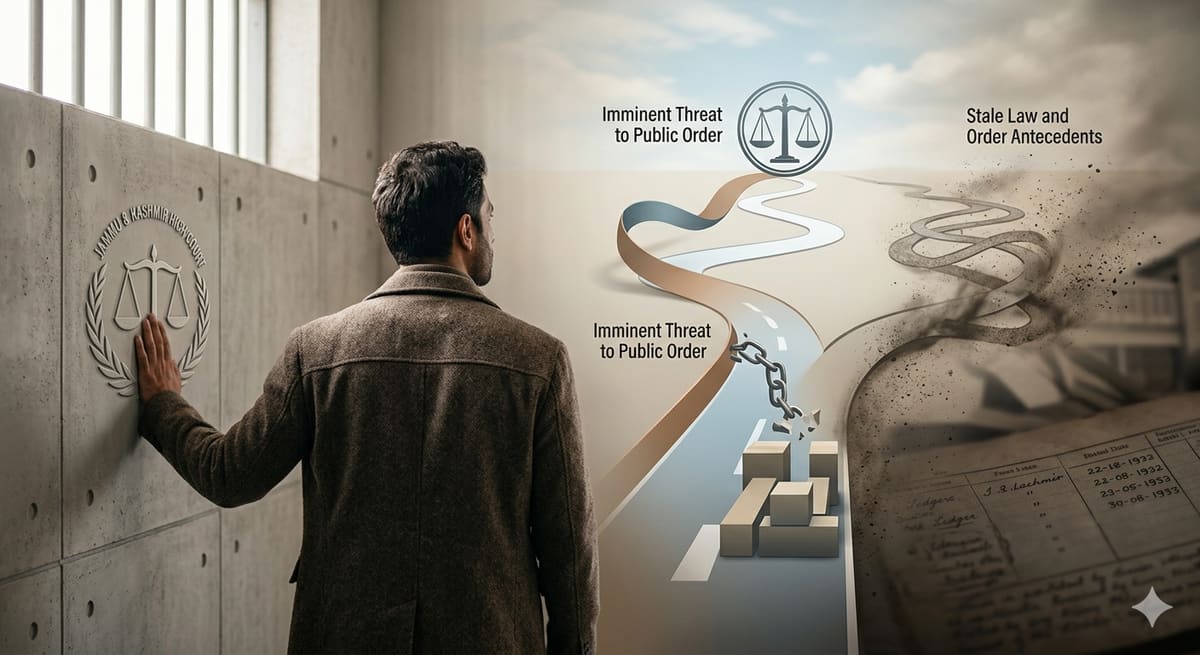
The Jammu & Kashmir High Court set a clear precedent that a detention order under the Public Safety Act must be based on fresh, contemporaneous evidence and genuine subjective satisfaction, striking down an order that relied on stale material from a three-year-old FIR.
Background & Facts
The Dispute
The petitioner, Shameema Banoo, mother of the detainee Suhail Ahmad Bhat (alias Sahil Peer), challenged Order No. 17/DMA/PSA/DET/2025 dated 29.04.2025 issued by the District Magistrate, Anantnag. The order detained the 21-year-old under the Jammu and Kashmir Public Safety Act, 1978 on the ground that his activities were prejudicial to the security of the State/UT.
Key Facts
- 2022: Police received reliable information that the detainee, along with associates, was acting as an Over-Ground Worker for militant groups, providing logistical support and preparing hideouts in Marhama orchards.
- FIR No. 94/2022 was registered at Bijbehara Police Station under Sections 18, 19 and 39 of the ULAP Act.
- 12.06.2022: The detainee was arrested and lodged in the Juvenile Home, Srinagar.
- 22.08.2022: He was released on bail by the Juvenile Justice Board, Anantnag.
- Post-release, security agencies placed him under surveillance but no specific subversive activity was recorded thereafter.
- 29.04.2025: The District Magistrate issued the preventive detention order under the PSA, citing the 2022 FIR and alleged continued links with terrorists.
Procedural History
- 12.06.2022: Arrest and detention in Juvenile Home.
- 22.08.2022: Bail granted by Juvenile Justice Board.
- 29.04.2025: Detention order issued under PSA.
- Petition filed: Shameema Banoo filed a writ petition before the High Court challenging the order.
- Hearing: Arguments presented by counsel for petitioner and respondents.
- 05.08.2026: Judgment delivered by Hon’ble Ms. Justice Moksha Khajuria Kazmi.
Parties' Positions
- Petitioner: Contended that the order was passed without proper application of mind, relied on stale material from 2022, and violated Supreme Court pronouncements on subjective satisfaction.
- Respondents (Union Territory of J&K, District Magistrate, Senior Superintendent of Police): Asserted that the detainee continued to pose a security threat, that the FIR formed a valid basis, and that all statutory and constitutional requirements were fulfilled.
Relief Sought
The petitioner sought quashing of Order No. 17/DMA/PSA/DET/2025 and immediate release of the detainee from preventive custody.
The Legal Issue
Whether the detention order dated 29.04.2025 under the Jammu and Kashmir Public Safety Act, 1978 satisfies the constitutional requirement of subjective satisfaction based on fresh, relevant material, or whether it is invalid for relying on stale grounds.
Arguments Presented
For the Petitioner
- The order was predicated on a three-year-old FIR and lacked any recent evidence of subversive activity after the detainee’s bail on 22.08.2022.
- Cited Ameena Begum v. State of Telangana (2023) 9 SCC 587 and Khaja Bilal Ahmad v. State of Telangana (2020) 13 SCC 632, emphasizing that detention must be based on current, live links to the alleged threat.
- Asserted that the detaining authority failed to apply its mind to the present circumstances, violating the ten-point test laid down by the Apex Court.
For the Respondent
- Relied on the original FIR and intelligence reports indicating the detainee’s past involvement with militant groups.
- Maintained that the surveillance reports post-release justified continued preventive detention.
- Argued that the statutory discretion under the PSA permits detention where there is a likelihood of future prejudicial activity.
The Court's Analysis
The Court began by reiterating the constitutional mandate that preventive detention must be anchored in subjective satisfaction of the detaining authority, as articulated in Ameena Begum v. State of Telangana. It reproduced the Supreme Court’s ten-point checklist (paragraph 28) and applied each element to the present facts.
"In the circumstances of a given case, a Constitutional Court when called upon to test the legality of orders of preventive detention would be entitled to examine whether (i) the order is based on the requisite satisfaction, albeit subjective, of the detaining authority… (x) the timelines, as provided under the law, have been strictly adhered to."
The Court observed that:
- The only material cited by the respondents was the FIR dated 2022, which was stale and bore no live nexus to the 2025 detention order.
- No fresh intelligence, field inputs, or recent incidents were produced to demonstrate a continuing threat.
- The detaining authority had not applied its mind to any new circumstances, thereby failing the second and sixth points of the Supreme Court’s test.
- The order lacked precise, pertinent grounds that would inform the detainee of the basis of his detention, breaching the ninth point.
- The timeline between the FIR and the detention order (three years) violated the tenth point concerning strict adherence to statutory timelines.
Relying on Khaja Bilal Ahmad and Saeed Zakir Hussain Malik decisions, the Court held that reliance on past criminal antecedents without a direct, contemporaneous link is impermissible. The judgment of Suraj Masih v. UT of J&K was also cited to reinforce that stale material cannot substantiate preventive detention.
Consequently, the Court concluded that the impugned order was not in consonance with law and was therefore void.
The Verdict
The High Court quashed Order No. 17/DMA/PSA/DET/2025 dated 29.04.2025, held it legally infirm, and directed the immediate release of Suhail Ahmad Bhat from preventive custody. The detention record was ordered to be returned to the respondents’ counsel.
What This Means For Similar Cases
Fresh Evidence Is Mandatory
- Detaining authorities must produce recent, specific intelligence linking the individual to ongoing threats.
- Past FIRs can be cited only if they demonstrate a continuous pattern with a live nexus to the present.
Strict Compliance With Subjective Satisfaction Test
- Courts will apply the ten-point checklist from Ameena Begum rigorously.
- Any omission - such as vague grounds or reliance on extraneous material - will render the order ultra vires.
Procedural Safeguards Strengthened
- The detainee must be informed of precise grounds, enabling meaningful representation.
- Timelines prescribed under the PSA must be strictly observed; delays can invalidate the order.
Practitioners should ensure that detention orders are backed by up-to-date material, clearly articulated grounds, and a demonstrable subjective satisfaction by the authority.