The High Court of Jammu & Kashmir and Ladakh dismissed petitions under Section 482 CrPC challenging cognizance in two cheque bounce complaints, holding that a composite demand notice for multiple cheques is permissible and that cognizance taken after the statutory 15-day payment period had expired cures any premature filing of the complaint.
Background & Facts
The Dispute
The petitioner, Yudhvir Singh Katoch, a property dealer, entered into an agreement to sell a plot of land situated at Nagrota, Udhampur, to the respondents Basharat Khan and his son Mohsin Khan for a total sale consideration of Rs. 83.00 lakhs. The respondents paid advance amounts of Rs. 12.00 lakhs and Rs. 16.00 lakhs respectively in cash. Subsequently, a dispute regarding the land title came to light, the transaction was cancelled, and the petitioner undertook to refund the advance amounts.
Key Facts
- 29.04.2022: Petitioner issued three cheques to each respondent towards repayment:
- To Basharat Khan: Cheque No. 005169 (Rs. 4.00 lakhs, J&K Bank), No. 022193 (Rs. 3.00 lakhs, J&K Bank), No. 022194 (Rs. 2.50 lakhs, Union Bank of India)
- To Mohsin Khan: Cheque No. 005170 (Rs. 4.00 lakhs, J&K Bank), No. 022192 (Rs. 3.00 lakhs, Union Bank of India), No. 022195 (Rs. 2.50 lakhs, Union Bank of India)
- 31.05.2022: Petitioner transferred Rs. 2.00 lakhs to Basharat Khan via RTGS
- 29.04.2020, 23.05.2022, 14.06.2022: Petitioner transferred amounts to Mohsin Khan via UPI/Google Pay, M-Pay, and RTGS
- 08.06.2022: First cheque returned unpaid
- 04.07.2022: Remaining two cheques returned unpaid
- 07.07.2022: Composite demand notice issued for all three cheques in each complaint
- 15.07.2022: Demand notices delivered to petitioner at 1:10 PM (per postal tracking reports)
- 29.07.2022: Complaints filed before Chief Judicial Magistrate, Srinagar (15th day from delivery)
- 30.07.2022: Cognizance taken and process issued by Judicial Magistrate 1st Class (Sub-Registrar), Srinagar
- 02.03.2023: Petitioner examined by Trial Court; did not dispute issuance or signatures, claimed cheques were security
- 11.05.2023: Present petitions filed under Section 482 CrPC
Procedural History
- 29.07.2022: Complaints Nos. 126/Comp./M and 127/Comp./M filed before Chief Judicial Magistrate, Srinagar
- 30.07.2022: Cognizance taken and process issued by Judicial Magistrate 1st Class (Sub-Registrar), Srinagar
- 02.03.2023: Petitioner examined under Section 251 CrPC
- 11.05.2023: CRM(M) No. 206/2023 and CRM(M) No. 207/2023 filed before High Court
- 09.10.2026: Matters reserved for judgment
- 28.10.2026: Judgment pronounced
Relief Sought
The petitioner sought quashment of both complaints and the cognizance orders dated 30.07.2022 on grounds of: (i) composite demand notice for multiple cheques being contrary to Section 138 NI Act; (ii) statutory notice not issued within 30 days of dishonour for one cheque; (iii) complaints filed prematurely before expiry of 15-day period; (iv) part-payment of cheque amounts; and (v) non-compliance with Section 202 CrPC procedure.
The Legal Issue
The central questions were: (1) Whether a composite demand notice covering multiple dishonoured cheques complies with Section 138 NI Act; (2) Whether filing of complaint on the 15th day from service of notice, with cognizance taken on the 16th day, constitutes premature institution; (3) Whether unsubstantiated claims of part-payment and security cheques can defeat cognizance at the threshold.
Arguments Presented
For the Petitioner
Counsel contended that a composite demand notice for three cheques violates the mandate of Section 138 NI Act which contemplates individual notices per cheque. It was argued that for one cheque dishonoured on 08.06.2022, the notice issued on 07.07.2022 was beyond the 30-day period. The complaints filed on 29.07.2022 were premature as the 15-day payment period expired on 30.07.2022. Counsel further submitted that part-payments via RTGS and UPI had been made towards the cheque amounts, and that Section 202 CrPC inquiry was mandatory since the petitioner resides in Udhampur, outside the territorial jurisdiction of the Srinagar court.
For the Respondents
Senior counsel argued the petitions were an afterthought to delay proceedings. The amounts transferred were towards balance consideration, not part-payment of cheque liabilities. The complaints were instituted after the statutory period, and cognizance was taken on 30.07.2022 when the 15-day period had elapsed. The petitioner never responded to the demand notices nor raised the part-payment plea during his examination on 02.03.2023. The impugned orders suffer no illegality or jurisdictional error.
The Court's Analysis
The Court examined the record and found that the respondents had provided a detailed breakup of amounts advanced, cheques issued, and subsequent digital transfers, while the petitioner placed no material to substantiate his claim that the digital transfers constituted part-payment of the cheque amounts. The petitioner neither responded to the demand notices nor raised this plea during his examination before the Trial Court on 02.03.2023. The Court held this contention to be an afterthought advanced to invoke the High Court's jurisdiction.
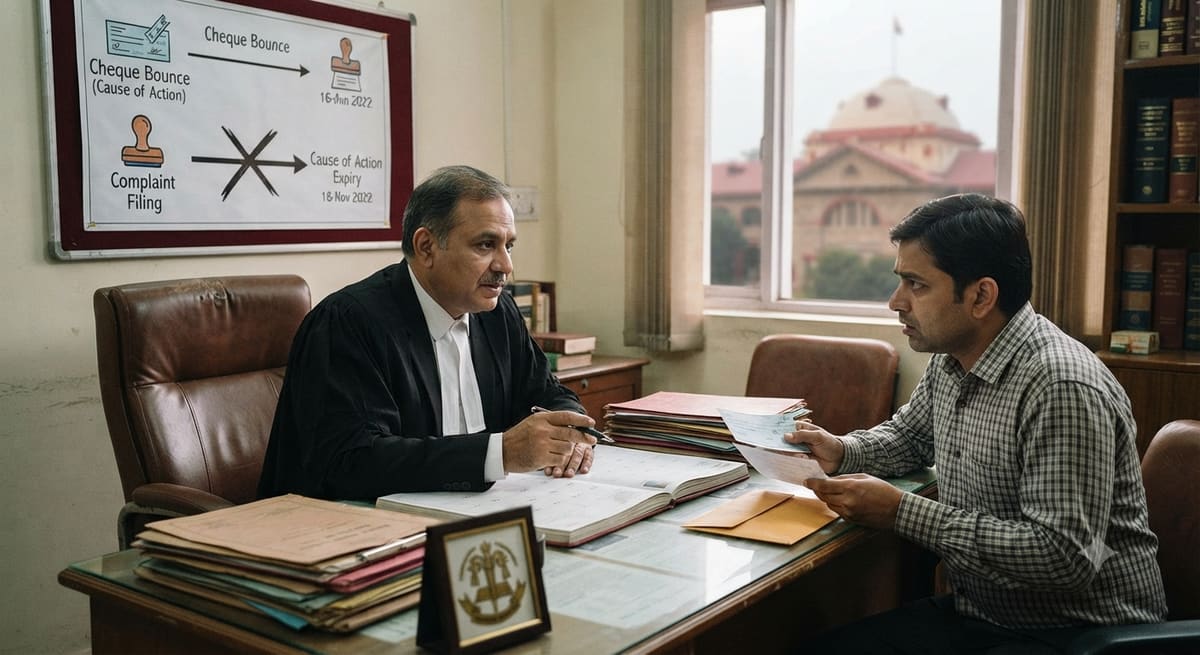
On the premature filing issue, the Court noted the demand notices were delivered on 15.07.2022 at 1:10 PM. The 15-day statutory period for payment expired on 30.07.2022. The complaints were presented on 29.07.2022 and cognizance was taken on 30.07.2022. The Court observed:
"Viewed thus, it is evident that complaints, although instituted before the expiry of the statutory period of fifteen days, yet by the time cognizance thereon was taken on the next day as per the delivery reports of the demand notice, the fifteen days' time for making the payments thereunder was already over. Thus, even if no cause of action had accrued on the date of filing of the complaints, still by the time the complaints were considered and cognizance was taken by the learned Magistrate, the statutory period had expired."
The Court emphasized that Section 138 NI Act provisions must receive a fair, pragmatic, harmonious, and purposive interpretation to achieve the legislative object of addressing financial indiscipline in commercial transactions. Relying on Union of India v. Ranbaxy Laboratories Limited (2008) 7 SCC 502, the Court held that constitutional courts must shun constructions resulting in injustice, absurdity, or anomaly. Citing Narashimaha Murthy v. Susheelabai (1996) 3 SCC 644, the Court reiterated that the spirit and eternal sense of law makes it meaningful. The petitioner had not exhibited any inclination to pay the cheque amounts at any stage during the preceding four years and suffered no prejudice.
The Verdict
The High Court dismissed both petitions (CRM(M) No. 206/2023 and CRM(M) No. 207/2023) and upheld the orders dated 30.07.2022 whereby cognizance was taken and process issued against the petitioner in complaints Nos. 126/Comp./M and 127/Comp./M. All interim directions, if any, were vacated. The Court directed the Registry to send a copy of the judgment to the Trial Court for information.
What This Means For Similar Cases
Composite Demand Notice Is Permissible
The judgment clarifies that a single composite demand notice covering multiple dishonoured cheques does not violate Section 138 NI Act. Practitioners can advise clients that issuing one notice for several cheques returned unpaid is legally valid, provided the notice contains all statutory particulars for each cheque.
Cognizance After Statutory Period Cures Premature Filing
- Filing a complaint on the 15th day from service of notice is not fatal if cognizance is taken on the 16th day when the payment period has expired
- The critical date is the date of cognizance, not the date of filing
- Courts will adopt a pragmatic interpretation to prevent technicalities from defeating the Act's purpose
Part-Payment Plea Requires Substantiation at Threshold
- Bare assertions of part-payment without documentary support or prior pleading will be treated as afterthoughts
- Digital transfers (RTGS, UPI, Google Pay) must be specifically linked to cheque liabilities through contemporaneous records
- Failure to raise the plea during Section 251 CrPC examination weakens the defence significantly
Section 202 CrPC Not Mandatory Where Accused Examined
The Court implicitly rejected the Section 202 CrPC argument by proceeding on merits after the petitioner was examined by the Trial Court, suggesting that once the accused appears and is examined, the territorial jurisdiction objection loses force.