Jammu & Kashmir and Ladakh High Court judgments

90 Jammu & Kashmir and Ladakh High Court judgments explained in plain English: what was decided, the law applied and why it matters. Page 2 of 4.

Section 437 CrPC | Prima Facie Case Based on Dying Declaration Overrides Delay in Incarceration for Bail Denial : J&K HC
Case Law Analysis
|Jammu & Kashmir and Ladakh High Court

Section 437 CrPC | Prima Facie Case Based on Dying Declaration Overrides Delay in Incarceration for Bail Denial : J&K HC

The J&K High Court ruled that a strong prima facie case, particularly one supported by a dying declaration and corroborative evidence, justifies bail denial in murder cases under Section 437 CrPC, even after five years of pre-trial detention. The court emphasized that the gravity of the offence and evidentiary strength outweigh claims of delayed trial or forensic discrepancies.

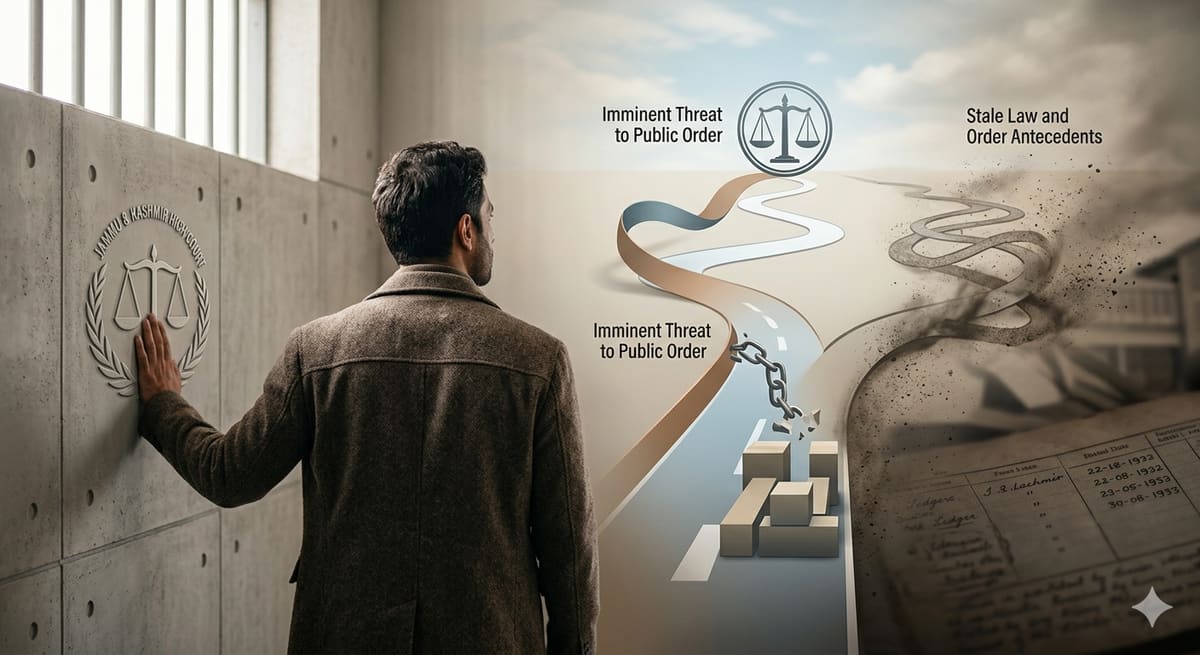
PSA Detention | Grounds Must Relate to Imminent Threat to Public Order, Not Stale Law and Order Antecedents : J&K HC
Case Law Analysis
|Jammu & Kashmir and Ladakh High Court

PSA Detention | Grounds Must Relate to Imminent Threat to Public Order, Not Stale Law and Order Antecedents : J&K HC

The J&K High Court has struck down a preventive detention under the Public Safety Act, ruling that reliance on outdated criminal antecedents tied to routine law and order issues - not a genuine threat to public order - renders the detention illegal. This reaffirms that PSA cannot be used as a tool for punitive detention and sets a vital boundary for executive power in Jammu & Kashmir.

Last Seen Theory & Disclosure Must Form Unbroken Chain for Conviction Under Circumstantial Evidence : J&K HC
Case Law Analysis
|Jammu & Kashmir and Ladakh High Court

Last Seen Theory & Disclosure Must Form Unbroken Chain for Conviction Under Circumstantial Evidence : J&K HC

The J&K High Court acquitted the accused in a murder case, ruling that circumstantial evidence-particularly the 'last seen' theory and disclosure statements-must be unimpeachable and form a conclusive chain. The court emphasized that witness contradictions and unreliable recoveries fatally weaken the prosecution's case, reinforcing strict standards for convictions based on indirect evidence.

Section 67 NDPS Act | Confessional Statements Without Corroboration Inadmissible for Bail: J&K HC Reinforces Tofan Singh
Case Law Analysis
|Jammu & Kashmir and Ladakh High Court

Section 67 NDPS Act | Confessional Statements Without Corroboration Inadmissible for Bail: J&K HC Reinforces Tofan Singh

J&K High Court grants bail in an NDPS case where conviction relied solely on inadmissible confessional statements under Section 67, absent recovery of contraband. The ruling underscores that such statements cannot establish a prima facie case without independent corroboration, aligning with the Supreme Court's Tofan Singh precedent.

Preventive Detention Under PSA | Stale FIRs Without Live Proximate Link Violate Article 21 : J&K HC
Case Law Analysis
|Jammu & Kashmir and Ladakh High Court

Preventive Detention Under PSA | Stale FIRs Without Live Proximate Link Violate Article 21 : J&K HC

The J&K High Court quashed a preventive detention order under the Public Safety Act, ruling that reliance on a 24-year-old FIR without evidence of a current threat fails the 'live and proximate link' test. The judgment reaffirms that preventive detention cannot be used as a tool for punishing past conduct without trial, safeguarding personal liberty under Article 21.

Post-Decretal Interest Under J&K Arbitration Act 1945 | Principal Sum Excludes Pre-Reference & Pendente Lite Interest : J&K & Ladakh HC
Case Law Analysis
|Jammu & Kashmir and Ladakh High Court

Post-Decretal Interest Under J&K Arbitration Act 1945 | Principal Sum Excludes Pre-Reference & Pendente Lite Interest : J&K & Ladakh HC

J&K & Ladakh HC clarifies that post-decretal interest on arbitral awards under the J&K Arbitration Act, 1945, is calculable only on the principal sum, excluding pre-reference and pendente lite interest. This ruling diverges from the broader interpretation permitted under the State CPC, impacting execution of awards in arbitration disputes.

BNS Section 111 | Economic Offences Do Not Automatically Disqualify Bail; Investigation Completion & Time-Barred Charges Favor Release : J&K HC
Case Law Analysis
|Jammu & Kashmir and Ladakh High Court

BNS Section 111 | Economic Offences Do Not Automatically Disqualify Bail; Investigation Completion & Time-Barred Charges Favor Release : J&K HC

J&K High Court rules that economic offences alone cannot justify bail denial under BNS, emphasizing that completed investigations and charges outside the ten-year window under Section 111 BNS strengthen the case for release. The judgment reinforces that pre-trial detention must be justified on case-specific merits, not merely the nature of the offence.

J&K CSR Mandates Reimbursement Between Parent & Borrowing Organizations for Gratuity & Leave Encashment : J&K and Ladakh HC
Case Law Analysis
|Jammu & Kashmir and Ladakh High Court

J&K CSR Mandates Reimbursement Between Parent & Borrowing Organizations for Gratuity & Leave Encashment : J&K and Ladakh HC

J&K and Ladakh High Court reinforces that parent organizations must pay gratuity while borrowing organizations are liable for leave encashment for deputed government servants. Reimbursement under J&K Civil Service Regulations is mandatory, with 10% interest on delayed gratuity and 6% on leave salary from petition filing. The ruling impacts financial liability distribution in deputation cases across public employment.

Order VII Rule 11 CPC | Private Partition & Adverse Possession Claims Require Trial, Not Summary Rejection: J&K HC
Case Law Analysis
|Jammu & Kashmir and Ladakh High Court

Order VII Rule 11 CPC | Private Partition & Adverse Possession Claims Require Trial, Not Summary Rejection: J&K HC

J&K High Court rules that a plaint alleging private partition and 40 years of adverse possession raises triable factual disputes, barring summary dismissal under Order VII Rule 11 CPC. The decision reinforces that co-ownership claims cannot be preemptively rejected without evidence evaluation, impacting property dispute litigation strategy.

MMDR Act Section 4 | No Vested Right to Extract Minor Minerals Even on Proprietary Land; Past Practice or Ownership Irrelevant : J&K HC
Case Law Analysis
|Jammu & Kashmir and Ladakh High Court

MMDR Act Section 4 | No Vested Right to Extract Minor Minerals Even on Proprietary Land; Past Practice or Ownership Irrelevant : J&K HC

J&K High Court rules that extraction of minor minerals (sand, boulders) from nallahs or private land requires statutory concession under the MMDR Act, 1957. Ownership, past practice, or royalty payments do not confer legal rights, and courts cannot direct authorities to bypass statutory compliance. The ruling reinforces the Public Trust Doctrine, impacting livelihoods dependent on unregulated mineral extraction.

SRO 14 of 1996 | Employees of Converted Government Transport Undertakings Not Entitled to Non-Pension Govt. Benefits Unless Explicitly Adopted by Statutory Corporation : J&K HC
Case Law Analysis
|Jammu & Kashmir and Ladakh High Court

SRO 14 of 1996 | Employees of Converted Government Transport Undertakings Not Entitled to Non-Pension Govt. Benefits Unless Explicitly Adopted by Statutory Corporation : J&K HC

The J&K High Court ruled that employees transferred from a government transport undertaking to a statutory corporation under SRO 14 of 1996 retain only pensionary benefits, not other government service perks like in-situ promotions, unless the corporation expressly adopts them. This clarifies the limits of transitional benefits for public sector employees restructured under statutory frameworks, impacting hundreds of similar cases across India.

Article 14 | Senior Adhoc Employees Cannot Be Excluded During Regularization While Juniors Are Included: J&K HC
Case Law Analysis
|Jammu & Kashmir and Ladakh High Court

Article 14 | Senior Adhoc Employees Cannot Be Excluded During Regularization While Juniors Are Included: J&K HC

The J&K High Court ruled that excluding a senior adhoc employee with over two decades of service while regularizing junior staff violates the equality guarantee under Article 14. The repeal of enabling statutes cannot justify such arbitrariness, affirming that legitimate expectation and non-discrimination bind state action even in adhoc appointments.

Section 11(6) Arbitration Act | Referral Court Cannot Reject Arbitration Appointment on Time-Barred Grounds Unless Bar Is Ex-Facie Absolute : J&K HC
Case Law Analysis
|Jammu & Kashmir and Ladakh High Court

Section 11(6) Arbitration Act | Referral Court Cannot Reject Arbitration Appointment on Time-Barred Grounds Unless Bar Is Ex-Facie Absolute : J&K HC

The J&K High Court has ruled that courts must not refuse arbitration appointments merely because a claim appears time-barred - limitation issues are for the arbitrator to decide, and the period spent litigating in the wrong forum may be excluded under Section 14 of the Limitation Act. This empowers parties to bypass procedural delays and ensures arbitrability is preserved unless the limitation defense is unmistakably clear on the face of the pleadings.

Section 82 RP Act | Only Contesting Candidates May Be Impleaded in Election Petitions; Non-Candidate Officials Excluded : J&K and Ladakh HC
Case Law Analysis
|Jammu & Kashmir and Ladakh High Court

Section 82 RP Act | Only Contesting Candidates May Be Impleaded in Election Petitions; Non-Candidate Officials Excluded : J&K and Ladakh HC

The High Court has ruled that Section 82 of the Representation of the People Act, 1951, strictly limits parties to an election petition to contesting or returned candidates only. Non-candidate officials-even those accused of corrupt practices-cannot be joined as respondents, reinforcing that election petitions are not civil suits and must adhere to statutory exclusivity. This sharpens the boundaries of accountability in electoral disputes and impacts how petitioners structure their claims.

Article 14 | Wrongful Exclusion from Selection Process Entitles Notional Seniority & OPS Benefits : J&K HC
Case Law Analysis
|Jammu & Kashmir and Ladakh High Court

Article 14 | Wrongful Exclusion from Selection Process Entitles Notional Seniority & OPS Benefits : J&K HC

J&K High Court rules that a candidate wrongfully excluded from a selection process despite higher merit must be granted notional seniority from the appointment date of peers, along with Old Pension Scheme benefits and refund of deductions. The judgment reinforces constitutional remedies for arbitrary exclusion in public employment.

Section 14 Limitation Act | Time Spent in Bona Fide Writ Petition Excludable Even After Dismissal: J&K and Ladakh HC
Case Law Analysis
|Jammu & Kashmir and Ladakh High Court

Section 14 Limitation Act | Time Spent in Bona Fide Writ Petition Excludable Even After Dismissal: J&K and Ladakh HC

J&K and Ladakh HC rules that time spent pursuing a writ petition dismissed for lack of jurisdiction is excludable under Section 14 of the Limitation Act if the litigation was conducted with due diligence and bona fides. This applies even after dismissal and subsequent restoration, offering relief to litigants facing limitation bars in contractual disputes.

Section 506 IPC | Duplicate Complaints on Same Cause of Action Constitute Abuse of Process: J&K and Ladakh HC Quashes Proceedings
Case Law Analysis
|Jammu & Kashmir and Ladakh High Court

Section 506 IPC | Duplicate Complaints on Same Cause of Action Constitute Abuse of Process: J&K and Ladakh HC Quashes Proceedings

The J&K and Ladakh High Court ruled that filing identical criminal complaints after dismissal of the first amounts to judicial harassment and abuse of process. The Court quashed proceedings under Section 506 IPC, emphasizing that complainants cannot re-agitate the same cause of action through duplicate filings, even if directed to different police stations.

CrPC Section 190 & 202 | Magistrate Must Conduct Preliminary Inquiry Before Issuing Process Against Public Servants : J&K HC
Case Law Analysis
|Jammu & Kashmir and Ladakh High Court

CrPC Section 190 & 202 | Magistrate Must Conduct Preliminary Inquiry Before Issuing Process Against Public Servants : J&K HC

J&K High Court quashes criminal proceedings against bank officials, ruling that magistrates must apply judicial scrutiny under Section 202 CrPC before summoning public servants. The judgment reinforces that vague complaints cannot trigger criminal process without prior inquiry, protecting public servants from frivolous litigation.

Section 3H(4) National Highways Act | Co-ownership Disputes Must Be Decided by Civil Court Before Compensation Disbursement : J&K and Ladakh HC
Case Law Analysis
|Jammu & Kashmir and Ladakh High Court

Section 3H(4) National Highways Act | Co-ownership Disputes Must Be Decided by Civil Court Before Compensation Disbursement : J&K and Ladakh HC

The J&K and Ladakh High Court has ruled that under Section 3H(4) of the National Highways Act, authorities cannot disburse land acquisition compensation until a civil court determines the rightful ownership shares among co-heirs. This binds revenue and acquisition officials to defer payment in disputed inheritance cases, reinforcing procedural fairness and preventing unilateral appropriation of shared property rights.

Agrarian Reforms Act, 1976 | Writ Courts Cannot Invalidate Unchallenged Revenue Mutations; Finality Bars Collateral Attacks : J&K LHC
Case Law Analysis
|Jammu & Kashmir and Ladakh High Court

Agrarian Reforms Act, 1976 | Writ Courts Cannot Invalidate Unchallenged Revenue Mutations; Finality Bars Collateral Attacks : J&K LHC

Revenue mutations under the Agrarian Reforms Act attain finality once unchallenged through proper channels, and writ jurisdiction cannot be invoked to overturn them in possession disputes. This shields land records from collateral litigation, directing aggrieved parties to exhaust statutory revenue remedies first - a critical check on judicial overreach into administrative domain.

Section 34 Drug and Cosmetics Act | Mere Designation Insufficient for Prosecution of Company Officers: J&K HC
Case Law Analysis
|Jammu & Kashmir and Ladakh High Court

Section 34 Drug and Cosmetics Act | Mere Designation Insufficient for Prosecution of Company Officers: J&K HC

The J&K High Court ruled that criminal proceedings against company directors and officers under the Drug and Cosmetics Act require specific allegations of their role in the offence. Prosecution is permissible only if they are formally nominated under Section 34 or directly implicated in the violation, reinforcing the need for individualized culpability in corporate liability cases.

Section 3(d) J&K Wakafs Act | Hereditary Custodianship of Sufi Shrines Does Not Confer Ownership : J&K HC
Case Law Analysis
|Jammu & Kashmir and Ladakh High Court

Section 3(d) J&K Wakafs Act | Hereditary Custodianship of Sufi Shrines Does Not Confer Ownership : J&K HC

The J&K High Court ruled that hereditary custodianship (Sajjada Nasheeni) of Sufi shrines does not equate to ownership, reinforcing that such properties qualify as 'wakaf by user' under Section 3(d) of the J&K Wakafs Act, 1978. The judgment underscores that revenue records prevail over historical texts in determining wakaf status, impacting management rights of religious trusts in J&K.