The High Court of Jammu & Kashmir and Ladakh has partly allowed an appeal against a Single Bench judgment that declined to set aside an arbitral award in a public works contract dispute. The Division Bench held that the period spent by the contractor in bona fide writ and intra-court appeal proceedings must be excluded under Section 14 of the J&K Limitation Act when computing limitation for the substantive claim. The Court also ruled that the appellants, having themselves invoked the arbitration clause, were estopped from challenging the arbitrator's jurisdiction or the validity of the reference. However, the Court modified the interest component of the award, reducing it to 6% per annum across all periods - pre-reference, pendente lite, and post-award - in accordance with Section 31(7) of the J&K Arbitration and Conciliation Act, 1997 as amended and the Supreme Court's decision in Gayatri Balasamy v. ISG Novasoft Technologies Limited.
Background & Facts
The Dispute
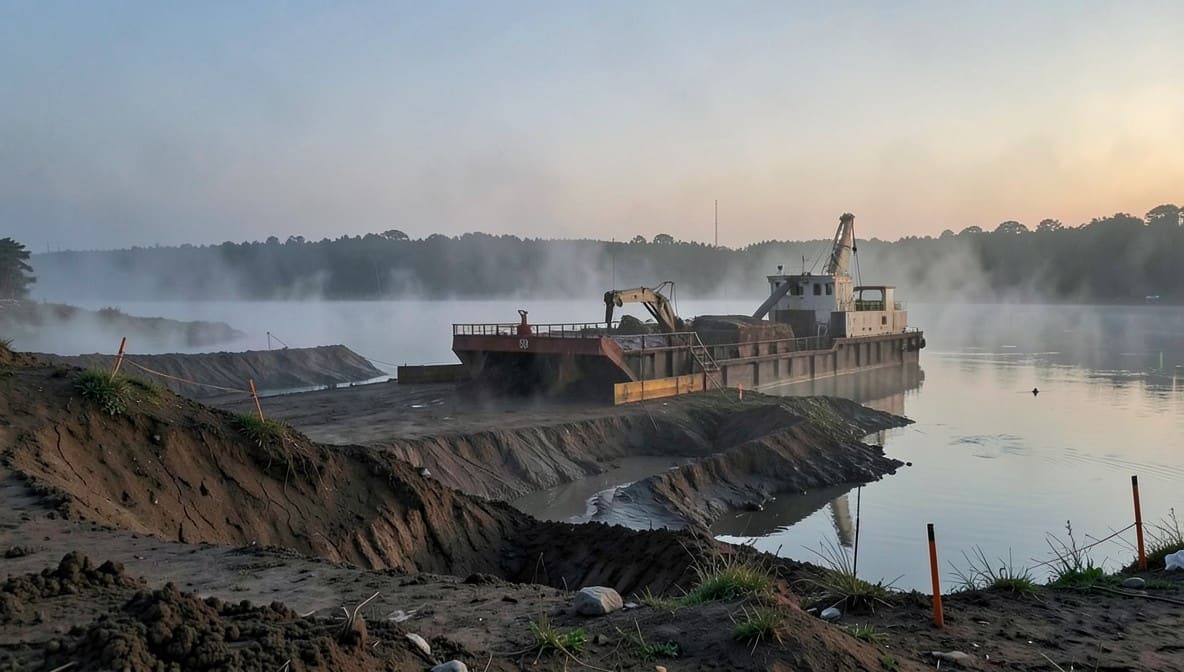
The petitioners, the Lakes and Waterways Development Authority (LAWDA) and its officers, had allotted a contract for mechanical dredging and desilting of the bed of Dal Lake near Shalimar Bridge to respondent No. 1, Ghulam Nabi Kraipak, pursuant to NIT No. 2 of 5/2001 dated 11.05.2001. The work was awarded at a total contract value of Rs. 19,38,850, comprising a lump sum of Rs. 5.00 lakhs for removal of stones and Rs. 175 per cubic metre for earthwork excavation. The allotment order dated 21.06.2001 stipulated that the work be completed within one month from the date of start, to be reckoned within three days of the order. A penalty of Rs. 1,000 per day was prescribed for delay, alongside recovery of extra costs for completion through another agency.
Key Facts
- 27.06.2001: Respondent No. 1 commenced work (per Measurement Book and Works Register entries).
- 07.03.2002: Work completed - a period of eight months and nine days, against the stipulated one month.
- 15.07.2003: Assistant Executive Engineer directed respondent No. 1 to sign a Works Register reflecting a bill of Rs. 6,45,635 against the contractual cost of Rs. 19,38,850.
- 19.08.2003: Respondent No. 1 submitted an independent claim totalling Rs. 21,39,720 (Rs. 19,05,250 for main work, Rs. 97,470 interest, Rs. 1,37,000 haulage charges), which the appellants did not approve.
- The contract required final payment upon completion, with quantities determined via cross-sections and a cross-check mechanism under Clause 7 of the allotment order.
- Respondent No. 1 contended that field records were prepared unilaterally by appellants' engineers without his authentication.
Procedural History
- 2003: Respondent No. 1 filed OWP No. 654/2003 before the High Court.
- 03.11.2006: Writ petition dismissed with liberty to pursue appropriate legal proceedings.
- 2008: LPA No. 177/2008 filed challenging the dismissal.
- 16.04.2010: LPA dismissed with observation that dismissal would not preclude respondent from availing any appropriate remedy.
- Thereafter: Civil suit for recovery of Rs. 35,33,850 and permanent prohibitory injunction filed before Principal District Judge, Srinagar; later assigned to 4th Additional District Judge, Srinagar.
- 26.07.2011: Appellants moved application under Clause 20 of PWD Form-25 seeking reference to arbitration; respondent No. 1 consented. Court appointed Er. Zahoor Ahmad Chat (Executive Director, JKSPDC) as sole arbitrator.
- 27.10.2011: Appellants filed written statement and counter-claim for Rs. 37.13 lakhs penalty.
- 03.07.2012: Arbitrator passed interim order on limitation issue.
- 07.12.2013: Arbitral award passed allowing:
- Excavation: 8030 cum @ Rs. 175 = Rs. 14,05,250
- Stone removal: 189 cum @ Rs. 182.48 = Rs. 34,489
- Penalty deduction: 227 days @ Rs. 1,000 = Rs. 2,27,000
- Net due on 07.03.2002: Rs. 12,12,739
- Interest: 12% p.a. (01.04.2002 - 31.03.2012), 6% p.a. (01.04.2012 - 30.11.2013) = Rs. 15,76,559
- Compensation for loss of business @ 1.5% p.a. (11 years 8 months) = Rs. 2,12,229
- Total: Rs. 30,01,527 plus post-award interest at 12% p.a. for three months.
- 2014: Appellants filed A.A. No. 2/2014 under Section 34 of the J&K Arbitration and Conciliation Act, 1997 challenging the award.
- 16.06.2023: Single Bench dismissed the Section 34 application.
- 14.07.2026: Arguments reserved in present appeal (Arb App No. 01/2024).
- 20.08.2026: Judgment pronounced.
Relief Sought
The appellants sought setting aside of the arbitral award on grounds including: (a) claim barred by limitation (cause of action 2003, arbitration 2011); (b) no valid arbitration agreement; (c) respondent abandoned work midway; (d) counter-claim of Rs. 37.13 lakhs wrongly reduced to Rs. 2.27 lakhs; (e) award passed after two years without extension of mandate (four months stipulated); (f) excessive interest contrary to public policy.
The Legal Issue
The central questions were: (1) Whether the contractor's claim was barred by limitation given the cause of action arose in 2003 and arbitral proceedings commenced in 2011, and whether Section 14 of the J&K Limitation Act mandates exclusion of time spent in bona fide prior proceedings; (2) Whether a valid arbitration agreement existed where the parties consented to a court-referred arbitration under Section 89 CPC without a pre-existing arbitration clause; (3) Whether the arbitral award could be set aside for delay in rendering the award beyond the referral court's four-month direction, absent a statutory time limit at the time; (4) Whether the interest awarded at 12% and 6% violated the statutory cap of 6% per annum under Section 31(7) of the J&K Arbitration Act, 1997 as amended.
Arguments Presented
For the Appellants
Learned counsel contended that the claim was hopelessly barred by limitation under Article 181 of the J&K Limitation Act (three years), as the cause of action accrued in 2003 and the claim was submitted only in 2011. It was argued that the writ court never adjudicated the limitation plea. Counsel further submitted that no arbitration agreement existed between the parties, rendering the reference non est. The appellants emphasized that the respondent abandoned the work midway, disentitling him to relief and rendering him liable for the full penalty of Rs. 37.13 lakhs. Finally, it was urged that the award was contrary to public policy due to excessive interest awarded for both pendente lite and post-award periods, and that the arbitrator exceeded his mandate by delivering the award after two years without seeking extension from the referral court.
For the Respondent
Mr. Mir Suhail, counsel for respondent No. 1, submitted that the scope of interference under Section 34 is extremely circumscribed. He argued that the appellants failed to demonstrate how the award was contrary to public policy or suffered from patent illegality. Having been granted liberty by the Division Bench to pursue appropriate remedies, the respondent was entitled to exclusion of time under Section 14 for the period spent prosecuting the writ petition and LPA bona fide and with due diligence. Crucially, counsel highlighted that the appellants themselves invoked Clause 20 of PWD Form-25 and moved the application for arbitration reference; having actively sought the reference, they were estopped from questioning the arbitrator's mandate or jurisdiction.
The Court's Analysis
The Division Bench, per Justice Rajnesh Oswal, commenced by acknowledging that the Single Bench ought to have examined the limitation issue specifically raised by the appellants. The arbitrator had conflated the limitation for commencing arbitral proceedings with the limitation for the substantive claim, relying on an interim order dated 03.07.2012 and the fact that appellants had entered into settlement negotiations.
On limitation, the Court held that Section 43 of the J&K Arbitration and Conciliation Act, 1997 makes the Limitation Act applicable to arbitration proceedings as it applies to court proceedings. Once Article 181 was invoked, Section 14 inevitably came into play. The respondent had specifically pleaded prior prosecution of the writ petition and LPA in good faith. The Court relied on the Supreme Court's decision in Consolidated Engineering Enterprises v. Principal Secretary, Irrigation Department ((2008) 7 SCC 169), which held that Section 14 applies to arbitration proceedings because Section 43 incorporates the Limitation Act, and the legislative intent is to give relief to a litigant who approached the wrong forum. The interpretation of Section 14 must be liberal to suppress the mischief and advance its object.
On public policy, the Court surveyed the evolution of the doctrine through ONGC v. Saw Pipes, Associate Builders v. DDA, and Ssangyong Engineering v. NHAI. It concluded that denying the benefit of Section 14 exclusion would militate against the mandate of the Limitation Act and run contrary to public policy. Similarly, holding the arbitration commencement time-barred would oppose the principle of estoppel, as the appellants themselves initiated the reference. To hold otherwise would perpetuate a patent illegality.
On the arbitration agreement, the Court found that the appellants moved the court for reference, the respondent consented, and the court appointed the arbitrator under Section 89 CPC. Relying on Afcons Infrastructure v. Cherian Varkey Construction (2010 (8) SCC 24), the Court held that mutual consensus before the court creates a valid and binding arbitration agreement even absent a pre-existing clause. The appellants cannot now challenge a mechanism they themselves requested.
On the delay in award, the Court noted that Section 29-A (prescribing time limit for award) was inserted w.e.f. 01.10.2018, whereas the award was passed on 07.12.2013. Thus, no statutory mandate existed at the relevant time, and the referral court's four-month direction did not carry statutory force.
On delay and penalty, the Court upheld the arbitrator's finding of 227 days' delay and penalty of Rs. 2.27 lakhs. The arbitrator had doubted the authenticity of photocopies of the Measurement Book and Works Register produced by appellants, noting alterations and reductions in recorded quantities. Appellants' witnesses gave inconsistent testimony on the abbreviation "DOC" (date of completion vs. date of closure vs. date of part completion). The arbitrator, drawing on his expertise as former Executive Director of JKSPDC, took judicial notice that "DOC" uniformly denotes "date of completion." The Court found the arbitrator's assessment meticulous and not perverse, citing Punjab State Civil Supplies Corp. v. Sanman Rice Mills (2024 INSC 742) for the principle that courts cannot reappraise evidence in arbitral matters.
On interest, the Court noted that Section 31(7) of the 1997 Act, as amended by Amendment Act No. 6 of 2010, capped interest at 6% per annum for the period between the cause of action and the award. Respondent's counsel conceded this point based on Gayatri Balasamy v. ISG Novasoft Technologies (2025 INSC 605), where a Constitution Bench held that courts possess limited power to modify an award where valid and invalid parts are clearly severable. The Court accordingly modified the interest to 6% per annum across all periods.
The Verdict
The appeal was partly allowed. The Division Bench modified the arbitral award and the Single Bench judgment as follows: (1) Limitation plea rejected - Section 14 exclusion applies; (2) Arbitration agreement upheld - estoppel and mutual consent; (3) Delay in award not a ground for setting aside - no statutory time limit then; (4) Penalty of Rs. 2.27 lakhs for 227 days' delay upheld; (5) Interest reduced to 6% per annum for the entire period from 01.04.2002 to 30.11.2013 (11 years 8 months), recalculated as Rs. 8,48,917 (down from Rs. 15,76,559); (6) Compensation for loss of business at 1.5% p.a. (Rs. 2,12,229) upheld; (7) Modified total award: Rs. 22,73,885 (Rs. 12,12,739 principal + Rs. 8,48,917 interest + Rs. 2,12,229 compensation); (8) Post-award interest at 6% p.a. from 30.11.2013 till payment; (9) No order as to costs; (10) Amount to be released after verification of respondent's identity by the Registry.
What This Means For Similar Cases
Section 14 Exclusion Applies to Arbitration Proceedings
- Practitioners must plead Section 14 explicitly when a claimant has pursued prior bona fide proceedings in a wrong forum before initiating arbitration or suit.
- The period of prior proceedings (writ petitions, appeals, etc.) is excluded from limitation computation if prosecuted with due diligence and good faith.
- Courts must apply Section 14 liberally - it is a beneficial provision intended to suppress the mischief of technical limitation bars.
- Key takeaway: A claimant who diligently pursues remedies in an incorrect forum does not lose the right to later approach the correct forum.
Estoppel Bars a Party from Challenging a Reference It Initiated
- If a party voluntarily moves the court for arbitration reference under Section 89 CPC and the other party consents, a valid arbitration agreement comes into existence by mutual consensus.
- The initiating party cannot subsequently challenge the arbitrator's jurisdiction, the validity of the reference, or the limitation for commencing arbitration.
- This principle applies even absent a pre-existing arbitration clause in the contract.
- Key takeaway: A party that invokes arbitration cannot later approbate and reprobate to defeat the very reference it sought.
Statutory Interest Cap Is Mandatory and Severable
- Section 31(7) of the Arbitration Act (as amended) caps interest at 6% per annum for the period from cause of action to award - this is a mandatory statutory limit.
- An award granting interest above 6% is patently illegal to that extent and contrary to public policy.
- The invalid interest component is severable from the rest of the award; courts can modify the award under Section 34 read with the principle in Gayatri Balasamy without setting aside the entire award.
- Post-award interest is likewise subject to the 6% cap unless the parties agree otherwise.
- Key takeaway: Always check the applicable interest cap under the governing arbitration statute at the time of the award; excessive interest is a ground for modification, not necessarily setting aside.