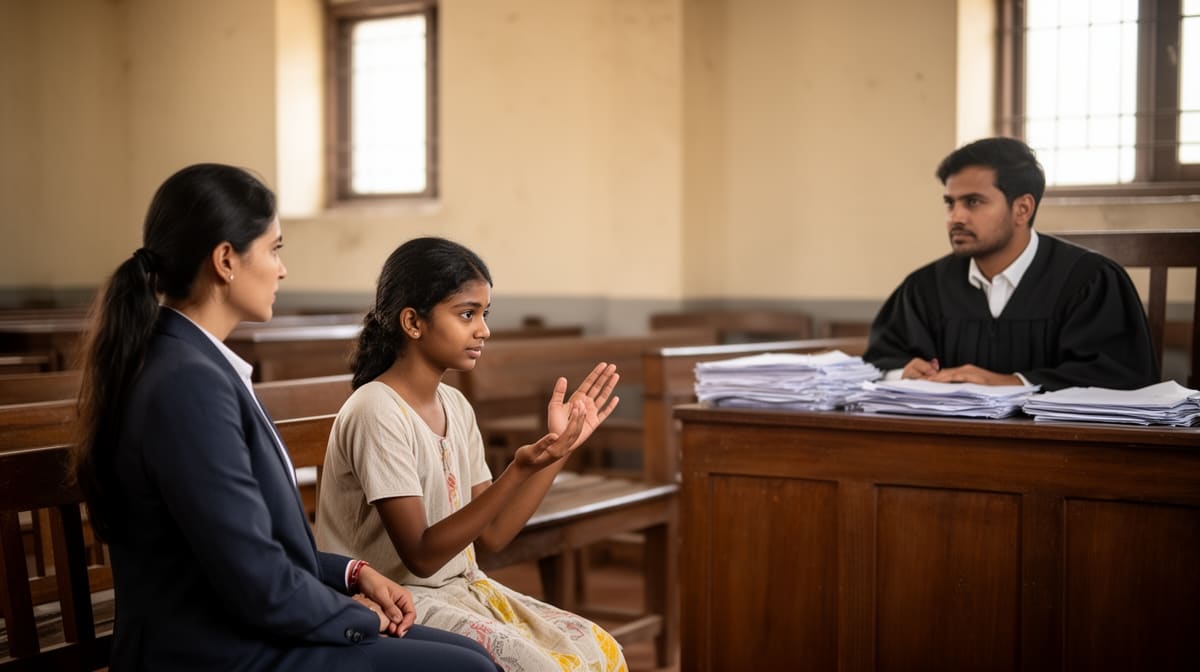
The High Court of Jammu & Kashmir and Ladakh has upheld the conviction of two appellants for kidnapping and rape of an 11-year-old speech-impaired minor, while acquitting a third appellant based on the victim's own exculpatory testimony. The judgment clarifies that non-compliance with the videography mandate under the proviso to Section 119 of the Evidence Act does not automatically vitiate a trial where the accused fails to demonstrate actual prejudice, and affirms that a witness with speech impairment remains competent to testify with the assistance of a qualified interpreter.
Background & Facts
The Dispute
Three appellants - Sanjeev Sharma alias Sanju (29), Rashpal Sharma (38), and Rakesh Singh (30), all residents of Village Kanthan, Tehsil Mahore, District Reasi - were convicted by the Principal Sessions Judge, Reasi, in a challan titled "State vs. Rakesh Singh and others" arising from FIR No. 89/2014 registered at Police Station Arnas under Sections 363, 376, and 109 of the Ranbir Penal Code (RPC). The conviction dated 30 July 2022 sentenced each appellant to rigorous imprisonment for ten years and a fine of Rs. 10,000 for the offence under Section 376 RPC, rigorous imprisonment for six months and a fine of Rs. 500 for the offence under Section 363 RPC, with a default clause of three months' further imprisonment for non-payment of fine.
Key Facts
- 16 November 2014: The victim, an 11-year-old girl with partial visual impairment in one eye and severe stammering, went to her family's field (baadhi) to collect leaves for goats at approximately 3:00 p.m.
- The victim's parents had gone to Judda market to purchase household articles; a function was held at the house of their relative Puran Singh on the occasion of his grandson's birth, which the three appellants attended.
- The victim did not return; family members searched and found three cut branches of a kainthi tree and a sickle (daraati) lying in the field.
- Proceeding further, they saw the three appellants standing in thick bushes; on seeing the search party, the appellants fled.
- The victim was found lying unconscious, naked, with clothes blood-stained and blood on her legs, at a distance of 4-5 jareeb from her house.
- 17 November 2014: The family took the victim to Police Station Arnas early morning; the father submitted a written application (Ext-P1) drafted by Bansi Lal.
- The victim was taken to Government Hospital, Arnas, where she regained consciousness around 10:00-10:30 a.m. and narrated the incident.
- 18 November 2014: FIR No. 89/2014 registered at 1500 hours under Sections 376 and 109 RPC (Section 363 added later). The victim was taken to District Hospital, Reasi, for medical examination.
- 19 November 2014: Dr. Renu Sudha, Consultant Gynecologist, examined the victim at District Hospital, Reasi. General physical examination: conscious, cooperative, left eye blindness, no marks of violence or injury on body, breast developed. Local examination: no marks of violence on external genitalia or inner thighs, hymen intact, vaginal introitus did not admit one finger. Two vaginal slides taken, sent to FSL; report dated 18 February 2015 showed no spermatozoa. Final opinion: no finding suggestive of sexual assault.
- 5 February 2015: CMO, Government Hospital, Sarwal, noted stammering speech, referred to ENT Specialist.
- 6 February 2015: ENT Specialist examined victim, opined dysphonia (difficulty in speaking).
- 11 February 2015: Audiologist and Speech Pathologist, ASCOMS Hospital, Sidhra, opined victim not dysphonic but possessed low intellectual abilities with borderline intelligence and misarticulated speech.
- 20 February 2015: Chargesheet filed before CJM, Reasi, under Sections 363, 376/109 RPC; committed to Sessions Court.
- 5 May 2015: Charges framed - Rakesh Singh and Sanjeev Sharma for Sections 376 and 363 RPC; Rashpal Sharma for Sections 363/109 RPC.
- 9 July 2015: Victim's statement recorded in trial court with assistance of interpreter PW-10 Roshan Bhan (Principal, School for Hearing Impaired, Jammu). Interpreter sworn to translate impartially. Victim not administered oath due to physical disability. Victim identified Rakesh Singh and Sanjeev Sharma, stated they took her to nallah and committed "shameful act." Could not satisfactorily explain her Section 164-A CrPC statement.
- 24 March 2022: Prosecution filed application under Section 540 CrPC for re-examination of victim and interpreter, citing non-compliance with Section 119 Evidence Act procedure.
- 30 July 2022: Trial court convicted all three appellants.
Procedural History
- 18 November 2014: FIR No. 89/2014 registered at PS Arnas.
- 20 February 2015: Chargesheet filed before CJM, Reasi.
- 5 May 2015: Charges framed by Sessions Court.
- 9 July 2015: Victim's testimony recorded with interpreter.
- 24 March 2022: Prosecution's Section 540 CrPC application for re-examination.
- 30 July 2022: Judgment of conviction and order of sentence by Principal Sessions Judge, Reasi.
- 2022: Criminal Appeal (S) No. 10/2022 filed before High Court of J&K and Ladakh at Jammu.
- 29 August 2026: Arguments reserved.
- 31 October 2026: Judgment pronounced.
The Parties' Positions
Appellants' contentions: (1) Victim's trial court statement contradicted her Section 164-A statement on place of occurrence (jungle/nallah vs roof of house). (2) Medical examination did not establish rape (no spermatozoa, hymen intact, no injuries). (3) FIR lodged after four days' delay. (4) Trial court failed to comply with Section 119 Evidence Act - statement not videographed, interpreter not cross-examined despite summons. (5) Prosecution's own Section 540 application admitted irregularity. (6) No evidence against Rashpal Sharma.
Respondent's contentions: (1) Trial court rightly appreciated victim's evidence. (2) ENT report confirmed speech difficulty; Audiologist report confirmed low intellectual abilities but not dysphonia. (3) Victim's testimony reliable and consistent on core facts. (4) Medical evidence does not rule out rape (absence of spermatozoa after 72 hours natural; rape is legal not medical conclusion). (5) FSL report confirmed blood and seminal stains on victim's trouser. (6) Minor contradictions do not discredit prosecution case.
Relief Sought
Appellants sought acquittal by setting aside the conviction and sentence dated 30 July 2022. Specifically, appellants Rakesh Singh and Sanjeev Sharma challenged conviction under Sections 363 and 376 RPC; appellant Rashpal Sharma contended no evidence existed against him for any offence.
The Legal Issue
The central questions were: (1) Whether non-compliance with the videography requirement under the proviso to Section 119 of the Evidence Act and the failure to cross-examine the interpreter vitiates the testimony of a speech-impaired witness where no prejudice is demonstrated. (2) Whether the medical evidence (absence of spermatozoa, intact hymen, no injuries) negatives the offence of rape. (3) Whether contradictions between the victim's Section 164-A statement and trial testimony on the place of occurrence are fatal to the prosecution case. (4) Whether the appellant Rashpal Sharma is entitled to benefit of doubt based on the victim's own testimony exonerating him.
Arguments Presented
For the Appellants
Mr. G.S. Thakur (for appellants 1 and 3) argued that the trial court failed to comply with the mandatory proviso to Section 119 Evidence Act requiring videography of the statement of a witness unable to communicate verbally. The prosecution's own Section 540 CrPC application conceded this irregularity. The interpreter Roshan Bhan was summoned for cross-examination but not examined due to age and personal difficulties, denying appellants the right to test the interpretation. The victim's statement before the trial court placed the occurrence at a jungle/nallah, while her Section 164-A statement mentioned the roof of a house - a material contradiction. Medical evidence showed no spermatozoa, intact hymen, and no injuries, negating rape. The FIR was delayed by four days. The victim's clothes were not proved to have been seized by the IO. Reliance was placed on Ram Singh v. State of Himachal Pradesh (2026 INSC 330), Munna Pandey v. State of Bihar (AIR 2023 SC 788), Dola v. State of Odisha ((2018) 18 SCC 695), and State of J&K v. Ramesh Chander (2017(6) JKJ 206(HC)).
Mr. Ajay Kotwal (for appellant Rashpal) submitted there was absolutely no evidence against Rashpal, as the victim herself did not implicate him in the rape.
For the Respondent
Mr. Sumeet Bhatia, Government Advocate, argued the trial court correctly appreciated the victim's evidence. The ENT Specialist report confirmed speech difficulty; the Audiologist report confirmed low intellectual abilities with borderline intelligence. The victim's testimony was reliable and consistent on material facts. Medical evidence does not rule out rape - absence of spermatozoa after 72 hours is natural; rape is a legal conclusion, not a medical diagnosis (citing Wahid Khan v. State of MP, (2010) 2 SCC 9). FSL report (Ext-P-12) confirmed blood and seminal stains on the victim's trouser. Minor contradictions in witness statements do not discredit the prosecution case (citing State of Punjab v. Gurmit Singh, (1996) 2 SCC 384). The victim's testimony alone can sustain conviction where it inspires confidence.
The Court's Analysis
The Court first addressed the Section 119 Evidence Act compliance issue. The provision permits a witness unable to speak to give evidence by writing or signs in open court, with the proviso that the court shall take assistance of an interpreter or special educator and such statement shall be videographed. The victim's statement was recorded with interpreter Roshan Bhan (PW-10), a qualified Principal of the School for Hearing Impaired since 1995 with diploma training from Lady Noyce School, Delhi. The interpreter was sworn to translate impartially. However, the statement was not videographed.
The Court held that the victim was not "deaf and dumb" but a minor with speech impairment (stammering) and partial visual impairment. The trial court erred in labelling her "deaf and dumb." Nonetheless, even a deaf and dumb person is a competent witness (State of Rajasthan v. Darshan Singh, (2012) 5 SCC 789). The Supreme Court in Darshan Singh held that a deaf and dumb witness may be examined with an interpreter, and if able to read and write, written questions and answers are desirable. The law requires a record of signs, not interpretation of signs.
The Court found that non-videography did not cause a miscarriage of justice. The appellants failed to demonstrate any prejudice before the trial court or the High Court. In their Section 342 CrPC statements, they merely denied the allegations without alleging procedural irregularity. The prosecution's Section 540 application was filed on the premise of procedural non-compliance, not because the victim's testimony was unintelligible. The Court cited Shivanarayan Kabra v. State of Madras (1966 SCC OnLine SC 36), where the Supreme Court held that violation of Section 361 CrPC (language interpretation) was a mere irregularity curable under Section 537 CrPC where no prejudice was shown.
Regarding the interpreter's cross-examination, the Court held an interpreter is not a witness to facts but only interprets the witness's statement. The trial court satisfied itself of the interpreter's competence and administered an oath. The appellants never pleaded inability to cross-examine the victim effectively.
On medical evidence, the Court relied on Wahid Khan and Ranjit Hazarika v. State of Assam ((1998) 8 SCC 635): absence of spermatozoa after 72 hours is natural; non-rupture of hymen and absence of injuries do not belie the prosecutrix's testimony. Rape is a legal conclusion; the medical officer can only state evidence of recent sexual activity. The FSL report confirmed blood and seminal stains on the victim's trouser (Exhibit M-60/2015), corroborating the occurrence.
On contradictions in place of occurrence, the victim's Section 164-A statement mentioned the roof of a house, while trial testimony mentioned a nallah/stream near the field. The site plan showed an open space surrounded by bushes and trees. The victim had low intellectual abilities with borderline intelligence (Audiologist report, 11 February 2015). The Court cited State of HP v. Asha Ram ((2005) 13 SCC 766): minor contradictions or insignificant discrepancies should not throw out an otherwise reliable prosecution case. The victim's detailed narration of the mode and manner of kidnapping and rape demonstrated intellectual capacity. Notably, she stated a man with a short beard stood on the roof but did nothing - exonerating Rashpal.
On seizure of clothes, the IO (PW-16) proved seizure memos (Ext P-16/2 and P-16/3). Marginal witnesses (victim's parents) were not examined on seizure, but the defence did not cross-examine the IO. Citing Mallikarjun v. State of Karnataka ((2019) 8 SCC 359), the Court held the IO's evidence suffices to prove recovery even if panch witnesses turn hostile or are not examined.
On improvements in witness statements (mother, sister, cousin), the Court held these cannot wipe out the victim's own testimony. All witnesses consistently stated the victim went to cut leaves when the incident occurred. No enmity or false implication was suggested.
The Court extensively discussed Patan Jamal Vali v. State of AP ((2021) 16 SCC 225) on the heightened vulnerability of women and girls with disabilities to sexual violence, emphasizing that disability cannot be equated with incapacity to testify. The testimony of a disabled prosecutrix is entitled to full legal weight if it inspires judicial confidence.
The Verdict
The appeal filed by Rakesh Singh and Sanjeev Sharma was dismissed; their conviction and sentence dated 30 July 2022 under Sections 363 and 376 RPC (ten years' rigorous imprisonment and Rs. 10,000 fine for Section 376; six months' rigorous imprisonment and Rs. 500 fine for Section 363; default: three months' further imprisonment) were upheld. The appeal filed by Rashpal Sharma was allowed; the judgment of conviction and sentence dated 30 July 2022 was set aside, and he was acquitted of all charges with directions for immediate release if not required in any other case.
What This Means For Similar Cases
Videography Under Section 119 Is Directory, Not Mandatory Absent Prejudice
The proviso to Section 119 Evidence Act mandates videography of statements by witnesses unable to communicate verbally. However, the Court has clarified that non-compliance is a procedural irregularity, not a fatal defect, where the accused fails to demonstrate actual prejudice. Practitioners must now specifically plead and prove how the absence of videography impaired their ability to cross-examine or test the witness's testimony. Mere non-videography, without more, will not vitiate a conviction.
- Actionable takeaway: In appeals challenging Section 119 non-compliance, file an affidavit detailing specific prejudice - e.g., interpreter mistranslation, inability to verify signs, loss of demeanour evidence.
- Actionable takeaway: At trial, object contemporaneously to non-videography and request the court to direct recording; failure to object weakens the appellate claim.
Speech-Impaired Witnesses Are Competent; Interpreter Competence Is Key
The judgment reinforces that speech impairment (stammering, dysphonia, misarticulation) does not render a witness incompetent. The court must satisfy itself of the interpreter's qualifications, independence, and administer an oath. The interpreter's cross-examination is not a right of the accused where the witness is not deaf but speech-impaired and the interpretation process is transparent.
- Actionable takeaway: When examining a speech-impaired witness, ensure the interpreter's credentials are placed on record (training, experience, independence) and an oath is administered.
- Actionable takeaway: If the witness can read and write, request written questions and answers under Darshan Singh - this is "more satisfactory than any sign language."
Medical Evidence in Rape: Absence of Injuries or Spermatozoa Is Not Exculpatory
The Court reiterated settled law: rape is a legal conclusion, not a medical diagnosis. Absence of spermatozoa after 72 hours, intact hymen, and no genital injuries do not negative rape. Partial penetration suffices. The FSL finding of seminal stains on clothing is strong corroboration. Practitioners should not over-rely on negative medical findings; instead, focus on the prosecutrix's testimony and circumstantial evidence.
- Actionable takeaway: In cross-examination of the medical expert, elicit that negative findings are consistent with the prosecution case (time lapse, partial penetration, washing).
- Actionable takeaway: Secure clothing and forensic evidence promptly; FSL reports on seminal/blood stains on garments carry significant weight.
Victim's Exculpatory Statement Binds Prosecution: Benefit of Doubt for Non-Implicated Accused
The victim's trial testimony explicitly exonerated Rashpal Sharma (a man with a short beard on the roof did nothing). Despite other witnesses implicating him, the Court held the victim's own statement is paramount and granted benefit of doubt. This underscores that the prosecutrix's testimony is the "star witness" in sexual offence cases; her failure to implicate an accused is difficult to overcome.
- Actionable takeaway: If the victim does not identify an accused in court, the prosecution faces an uphill battle - even corroborative witnesses may not suffice.
- Actionable takeaway: Defence counsel must carefully elicit the victim's identification (or non-identification) of each accused during cross-examination.
Minor Contradictions and Improvements Do Not Destroy Credibility
Consistent with State of Punjab v. Gurmit Singh and State of HP v. Asha Ram, the Court held that minor contradictions (place of occurrence: roof vs nallah), omissions in Section 161 statements (feast, timings, accused's clothes), and improvements in court testimony by family witnesses do not discredit the core prosecution case where the victim's testimony is reliable and no motive for false implication exists.
- Actionable takeaway: Focus cross-examination on material contradictions going to the root of the offence (identity, actus reus), not peripheral details.
- Actionable takeaway: Argue that improvements are natural in a trial setting where witnesses recall details afresh, not fabrications.