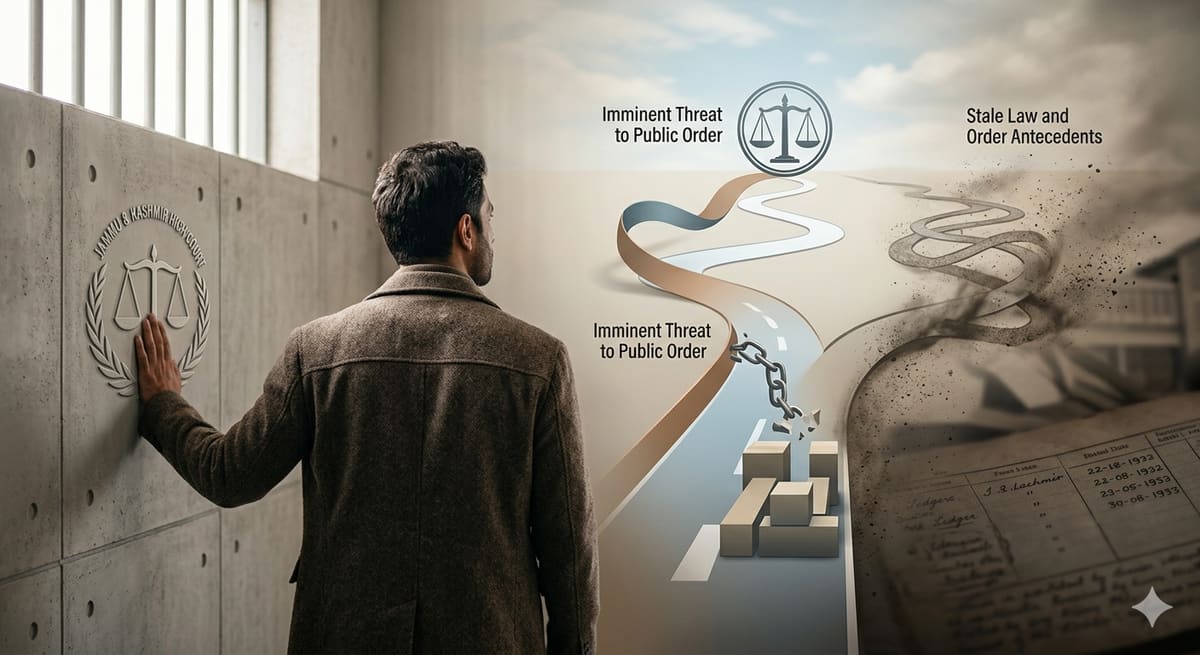
The Jammu & Kashmir High Court set aside a preventive detention order issued under the Public Safety Act, emphasizing that reliance on stale FIRs and the absence of a live nexus with public order render such detention unlawful.
Background & Facts
The Dispute
The petitioner, Mohd. Asgar @ Tola, through his wife Naseem Choudhary, challenged Order No. PSA 32 of 2023 dated 24.11.2023 issued by the District Magistrate, Jammu. The order, made under Section 8(1)(a) of the Jammu and Kashmir Public Safety Act, 1978, directed his preventive detention to pre-empt any activity prejudicial to public order.
Key Facts
- Detention order: PSA 32 of 2023 dated 24.11.2023; execution on 23.04.2026.
- Petitioner’s earlier reliefs: HCP No.130/2024 dismissed on 07.03.2025; subsequent LPA dismissed on 20.05.2026.
- Grounds of challenge: (i) Vague, mechanical reliance on FIRs; (ii) No proximate link between alleged activities and detention; (iii) Stale FIRs; (iv) Failure to inform petitioner of effective representation rights.
- FIRs cited by respondents: FIR No.259/2002 (murder), 119/2011 (theft), 105/2012 (attempted murder), 39/2014 (multiple offences), 45/2021 (land dispute), 182/2021 (missing revenue records), 120/2022, 174/2023 (family property disputes).
- Outcomes of FIRs:
- 259/2002: acquitted on 31.10.2007 by Sessions Court, Jammu.
- 119/2011 and 105/2012: cleared during investigation; final report No.16/2014 exonerated petitioner.
- 39/2014: investigation stayed by Supreme Court on 12.05.2014.
- FIRs 45/2021, 120/2022, 174/2023: settled amicably and quashed by this Court on 01.07.2025, 19.11.2025 and 22.07.2025 respectively.
- Representation: Petitioner's representation filed on 23.04.2026 was rejected without substantive consideration.
Procedural History
- 24.11.2023: Detention order issued.
- 07.03.2025: Petition HCP No.130/2024 dismissed (order 2026:JKLHC-JMU:2676).
- 20.05.2026: LPA before Division Bench dismissed for non-prosecution (order 2026:JKLHC-JMU:2676).
- 23.04.2026: Petitioner's representation against detention filed.
- 20.08.2026: Present Habeas Corpus Petition (HCP No.33/2026) decided, order quashed.
Relief Sought
The petitioner sought quashment of Order No. PSA 32 of 2023, release from preventive custody, and return of the detention record to the respondents.
The Legal Issue
Whether a detention order under Section 8(1)(a) of the Jammu and Kashmir Public Safety Act is valid when it is based solely on FIRs that are stale, lack a proximate link to the alleged threat to public order, and when the detainee has not been afforded a meaningful opportunity to make an effective representation.
Arguments Presented
For the Petitioner
- Asserted that the FIRs cited (2002-2014) are too remote to establish a present threat; the three FIRs of 2021-2023 arise from family property disputes and were settled, thus irrelevant.
- Contended that the detention order violated Article 22(5) of the Constitution because the petitioner was not informed of the specific authority before whom a representation could be made, nor of the earliest opportunity to do so.
- Relied on Supreme Court pronouncements in K.K. Saravana Babu v. State of Tamil Nadu, Sama Aruna v. State of Telangana, and Khaja Bilal Ahmed v. State of Telangana emphasizing the need for a live, proximate nexus and prohibiting reliance on stale incidents.
For the Respondent
- Maintained that eight criminal cases demonstrated the petitioner's propensity to disturb public order and justified preventive detention.
- Asserted that all procedural safeguards under the PSA were observed, including communication dated 24.11.2023 informing the petitioner of his right to make a representation.
- Emphasized that the detaining authority exercised subjective satisfaction that the petitioner posed a serious threat, a permissible ground under Section 3 of the PSA.
The Court's Analysis
The Court first examined whether the procedural requirement of informing the detainee of the specific authority for representation had been complied with. It noted that the communication dated 24.11.2023 merely stated that a representation could be made to “the Government” without naming the competent authority or the timeline, thereby falling short of the constitutional guarantee under Article 22(5).
"The constitutional guarantee of making a representation is meaningful only when the detainee is clearly informed of the authorities before whom such representation can be made and the earliest opportunity to exercise that right."
Turning to the substantive ground, the Court evaluated the relevance of the eight FIRs. It observed that the FIRs dated 2002, 2011, 2012, and 2014 were either acquitted or stayed, and the FIRs of 2021-2023 pertained to intra-family property disputes that had been settled by court orders. Citing Sama Aruna and Golam Hussain, the Court held that only past conduct having a direct, recent nexus with the present threat can justify preventive detention. The Court stressed that a “mechanical” reference to old FIRs without fresh evidence fails the test of subjective satisfaction required under Section 3 of the PSA.
The Court further relied on Khaja Bilal Ahmed to underline that “stale” material cannot form the basis of a detention order because it effectively becomes punitive rather than preventive. The judgment reiterated that preventive detention must be based on a reasonable prognosis of future misconduct, not on historical incidents that lack a live link.
Having found the detention order to be founded on stale incidents and procedurally defective, the Court concluded that the order was unsustainable in law and must be set aside.
The Verdict
The petition was allowed. The High Court quashed Order No. PSA 32 of 2023 dated 24.11.2023, directed the immediate release of the detainee, and ordered the detention record to be returned to the respondents. No monetary award or further costs were stipulated.
What This Means For Similar Cases
Stale Evidence Cannot Underpin Preventive Detention
- Courts will scrutinise the temporal proximity of past offences; incidents older than nine years are presumptively stale.
- Practitioners must ensure that any FIRs relied upon are either recent or have a clear, ongoing nexus with the alleged threat.
Procedural Safeguards Are Mandatory
- The communication informing a detainee of his right to representation must name the specific authority and the earliest date for filing.
- Failure to comply renders the detention order vulnerable to quashment under Article 22(5).
Subjective Satisfaction Must Be Evidently Recorded
- Detaining authorities should articulate, in the order, concrete facts establishing a live link between past conduct and the present risk to public order.
- Generic references to “criminal propensity” without factual nexus will be deemed insufficient.
Practical Checklist for Counsel
- Verify dates of all FIRs cited; exclude those beyond the nine-year threshold unless directly linked.
- Ensure the notice of detention includes precise details of the representation mechanism.
- Prepare detailed submissions on the lack of proximate nexus, citing Sama Aruna and Khaja Bilal Ahmed.