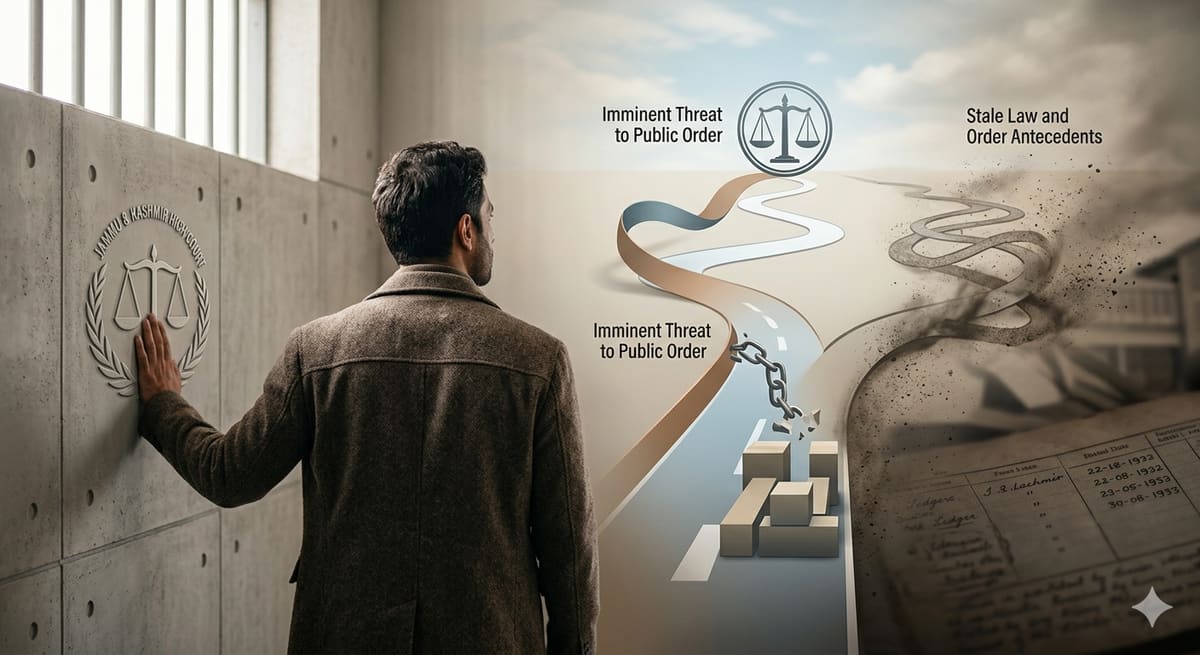
The Jammu & Kashmir High Court has affirmed that preventive detention under the Public Safety Act, 1978 remains valid even when there is a significant delay between alleged anti-national activities and the detention order, provided a consistent pattern of conduct justifies reasonable apprehension of future harm. This ruling reinforces the precautionary nature of preventive detention as distinct from punitive prosecution.
Background & Facts
The Dispute
The petitioner, Sheeraz Ahmad Sheikh, was detained on 01.05.2025 under Section 8(1)(a) of the J&K Public Safety Act, 1978 (PSA) by the District Magistrate, Shopian, on grounds that he was an over ground worker (OGW) of terrorist outfits, providing logistical support, sharing intelligence on security force movements, and engaging in organized crime that threatened public order and state security.
Key Facts
- The detention order was based on three FIRs:
- FIR No. 25/2019 under Sections 3/5 of the Explosive Substances Act and Sections 15, 16 of the Unlawful Activities (Prevention) Act, registered at P/S Sherghari
- FIR No. 509/2010 under Sections 443, 379 RPC, registered at P/S Shopian
- FIR No. 121/2010 under Sections 379, 413, 467 RPC, registered at P/S Pulwama
- The petitioner was enlarged on bail in all three cases, with no application for cancellation of bail filed by the prosecution
- The alleged activities in FIRs 509/2010 and 121/2010 occurred in 2010; the FIR in 2019 was the most recent
- The detention order was passed on 01.05.2025, approximately six years after the last alleged activity
- The petitioner was not charged or convicted in any of the cases
- The dossier submitted by the Senior Superintendent of Police, Shopian, detailed the petitioner’s alleged role in facilitating terrorist operations, including targeting non-local vendors, unarmed police, and laborers to instill terror
Procedural History
- 01.05.2025: Detention Order No. 08/DMS/PSA/2025 issued by District Magistrate, Shopian
- 14.05.2025: Representation on behalf of petitioner submitted by his brother, Gowhar Ahmad Sheikh
- 13.06.2025: Representation forwarded by District Magistrate to Principal Secretary, Home Department
- 12.08.2025: Home Department rejected representation, finding it without merit
- 12.08.2025: Superintendent, District Jail Udhampur, informed that disposal of representation was communicated to petitioner
- 23.04.2026: Hearing concluded
- 29.04.2026: Judgment pronounced
The Parties' Positions
Petitioner’s Position:
- Detention order is invalid due to six-year delay, breaking proximity between allegations and detention
- FIRs cited are for non-PSA offences (theft, criminal breach of trust) and do not qualify under Section 8
- Petitioner was already on bail in all cases, indicating prosecution was active and sufficient
- No subjective satisfaction recorded by detaining authority
- Relevant documents were not furnished; representation was not considered
- Grounds of detention are verbatim copies of the dossier, indicating mechanical application
Respondents’ Position:
- Detention order was based on a consistent pattern of conduct over years
- All 41 pages of the dossier, including FIRs and bail orders, were supplied to petitioner and read over in Kashmiri/Urdu
- Petitioner acknowledged receipt with signature
- Representation was received, forwarded, considered, and rejected by Home Department
- Communication of rejection was conveyed to petitioner through Jail authorities
- Preventive detention is not dependent on pending prosecution or bail status
- Past conduct justifies reasonable apprehension of future threat to state security
Relief Sought
The petitioner sought quashing of the detention order dated 01.05.2025, release from custody, and declaration that his detention violated Articles 21 and 22 of the Constitution.
The Legal Issue
Can preventive detention under the J&K Public Safety Act, 1978 be lawfully ordered after a six-year gap since the last alleged activity, where the detenu is on bail in related cases and no fresh offence has been attributed?
Arguments Presented
For the Petitioner
The petitioner’s counsel argued that the delay of six years between the last alleged activity (2019) and the detention order (2025) severed the causal link required for preventive detention. He contended that the FIRs cited related to non-PSA offences like theft and criminal breach of trust, which are not covered under Section 8 of the PSA. He further argued that since the petitioner had been enlarged on bail in all cases and no application for cancellation of bail was filed, the ordinary criminal law had not failed, making detention under PSA unjustified. He also claimed procedural violations: non-supply of documents, non-consideration of representation, and lack of subjective satisfaction.
For the Respondent
The State countered that preventive detention is not contingent on the pendency or outcome of prosecution. It relied on Haradhan Saha v. State of West Bengal to assert that detention can be ordered even after acquittal or discharge. The dossier demonstrated a sustained pattern of anti-national conduct, including logistical support to terrorists and intelligence sharing. The detaining authority had applied its mind to the totality of conduct, not isolated incidents. All statutory requirements under Article 22(5) were complied with: documents were supplied, read over in the petitioner’s language, and his representation was duly considered and rejected. The High Court’s writ jurisdiction does not permit substitution of its opinion for that of the detaining authority.
The Court's Analysis
The Court began by affirming the foundational principle that preventive detention under the PSA is not punitive but precautionary. It emphasized that the purpose is not to punish past conduct but to prevent future harm to state security. The Court cited Haradhan Saha v. State of West Bengal (1975) 3 SCC 198, quoting Paragraphs 32 - 34, to establish that preventive detention may be ordered even during pendency of prosecution, after acquittal, or after long delays, provided there is a reasonable apprehension based on past conduct.
"The power of preventive detention is qualitatively different from punitive detention. The power of preventive detention is a precautionary power exercised in reasonable anticipation. It may or may not relate to an offence. It is not a parallel proceeding. It does not overlap with prosecution even if it relies on certain facts for which prosecution may be launched or may have been launched."
The Court rejected the petitioner’s argument that the delay of six years invalidated the order. It held that the persistence of a pattern of conduct - evidenced by multiple FIRs over 15 years - justified the detaining authority’s prognosis of future risk. The fact that the petitioner was on bail in all cases was irrelevant, as bail does not negate the threat posed by continued association with terrorist infrastructure.
The Court further dismissed the claim that the grounds of detention were merely copied from the dossier. It found that the grounds were precise, pertinent, and reflected an application of mind to the petitioner’s history of involvement with terrorist logistics, intelligence sharing, and incitement of terror. The Court noted that the detaining authority is not required to independently investigate but may rely on credible material from sponsoring authorities.
Regarding procedural compliance, the Court observed that the petitioner had not filed a rejoinder to refute the respondents’ claim that 41 pages of documents were supplied, read over in Kashmiri/Urdu, and acknowledged with signature. In the absence of rebuttal, the Court accepted the respondents’ version as true. The Court also found that the representation was received, forwarded, considered, and communicated to the petitioner, thereby satisfying Article 22(5).
The Court reiterated that in writ jurisdiction, it cannot sit in appeal over the subjective satisfaction of the detaining authority. The standard is not whether the Court agrees, but whether the satisfaction is based on relevant material and not mala fide.
The Verdict
The petition was dismissed. The detention order dated 01.05.2025 under Section 8(1)(a) of the J&K Public Safety Act, 1978 was upheld. The petitioner remains in custody. The Court directed that the scanned detention record be returned to the respondents. No monetary relief or release was ordered.
What This Means For Similar Cases
Delay Does Not Automatically Invalidate Preventive Detention
- Practitioners must argue that the key test is not temporal proximity but the persistence of a pattern of conduct
- Even if the last alleged act occurred years prior, detention remains valid if the detenu’s history shows habitual involvement in anti-national activities
- A delay of six years, as in this case, is not fatal if the dossier demonstrates continuity of threat
Bail Status Is Irrelevant to PSA Detention
- Being enlarged on bail in criminal cases does not preclude preventive detention
- The existence of pending prosecution or bail orders cannot be used to challenge the legality of PSA orders
- The two systems operate independently: prosecution seeks punishment; detention seeks prevention
Procedural Compliance Must Be Affirmed by Record, Not Assumption
- Detaining authorities must ensure documents are supplied, read over in the detenu’s language, and acknowledged
- Petitioners must file rejoinders to challenge procedural compliance; silence is construed as acceptance
- Courts will uphold detention if the record shows compliance, even if the detenu claims otherwise
Subjective Satisfaction Is Non-Justiciable on Merits
- Courts will not re-evaluate whether the facts justify detention
- The test is whether the satisfaction is based on relevant material, not whether the Court would have reached the same conclusion
- Verbatim adoption of dossier material is permissible if it reflects application of mind