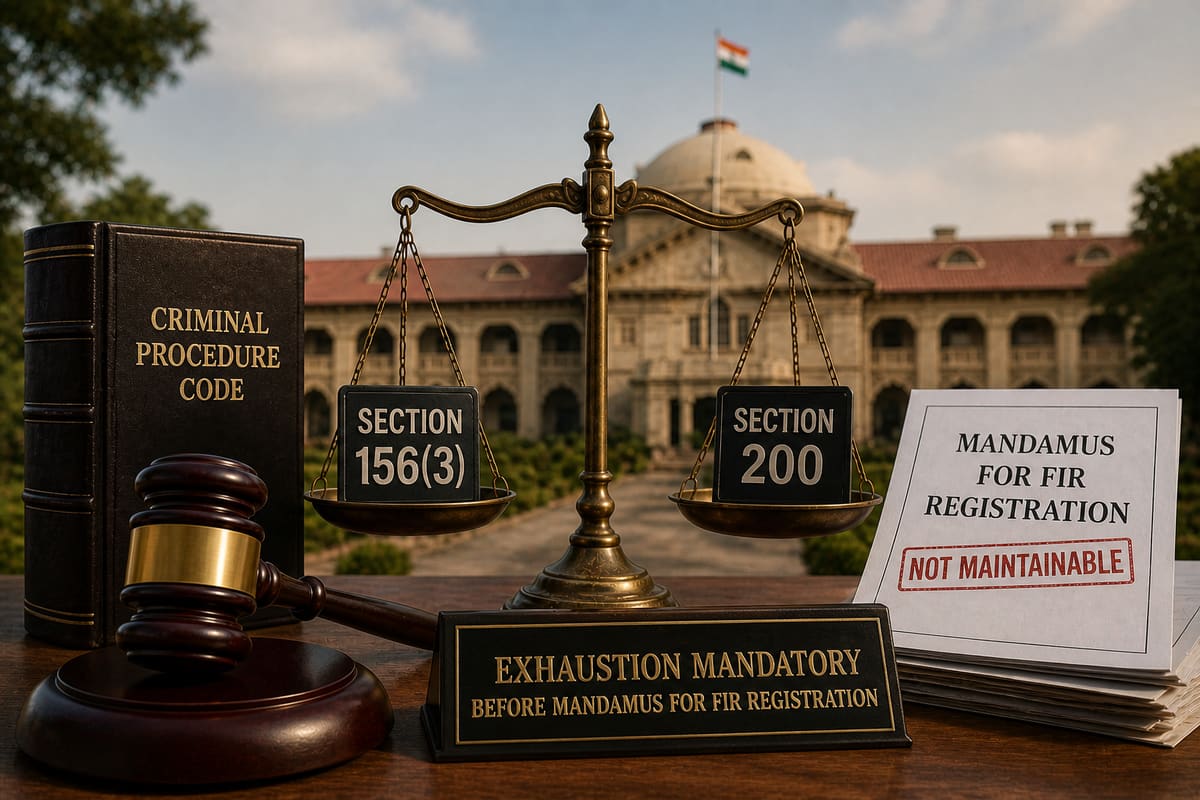
The High Court of Jammu & Kashmir and Ladakh at Jammu has set aside a Magistrate's order directing registration of an FIR under Section 156(3) CrPC where the police, after enquiry, had reported that only a non-cognizable offence under Section 323 IPC was made out. The Court held that Section 156(3) is available only for cognizable offences and the Magistrate was obligated to either proceed under Section 155(2) CrPC for non-cognizable cases or treat the complaint as a private complaint after evaluating the nature of the offence alleged.
Background & Facts
The Dispute
The petitioners, Jaswant Singh and his son Abhishek Singh, are owners of land measuring 4 kanals comprising Survey No. 636 situated in Revenue Village Salehar, Tehsil Bishnah, District Jammu. Their ownership derives from a Sale Deed registered on 22.12.2021 by the Sub Registrar Jammu South, which was mutated in favour of petitioner No.1 on 15.02.2022. The dispute arose when respondent No.1, Anita Devi (wife of Surjeet Singh), allegedly committed criminal trespass into this land along with her husband.
Key Facts
- On the petitioners' complaint, FIR No. 7/2023 was registered on 18.01.2023 at Police Station Arnia for offences punishable under Sections 447, 427, 504, 506 IPC
- As a counterblast, respondent No.1 moved an application on 27.01.2023 before the learned Judicial Magistrate (Munsiff) Bishnah seeking direction to the SHO, P/S Arnia to register an FIR against the petitioners
- The complainant alleged that on 09.12.2022 at about 1.45 PM, the petitioners deliberately trespassed into her land and, on being objected, beat her mercilessly with fists and blows, used unparliamentary language, and caused miscarriage of her unborn child
- She was examined at PHC Arnia on 09.12.2022
- The police submitted a report on 27.02.2023 stating that on examination by a doctor, the complainant was found to have received minor injuries, and only an offence under Section 323 IPC (voluntarily causing hurt) was made out, which is non-cognizable
- The police report indicated that a complaint shall be lodged before the court after seeking permission
- The learned Magistrate passed the impugned order on 13.04.2023, observing that "prima facie" the contents of the application disclose commission of cognizable offences, and directed the jurisdictional police to register an FIR under Section 156(3) CrPC
Procedural History
- 09.12.2022: Date of alleged incident and medical examination of complainant at PHC Arnia
- 18.01.2023: FIR No. 7/2023 registered at P/S Arnia on petitioners' complaint (Sections 447/427/504/506 IPC)
- 27.01.2023: Respondent No.1 filed application before Judicial Magistrate Bishnah seeking FIR against petitioners
- 27.02.2023: Police submitted report stating only non-cognizable offence under Section 323 IPC made out
- 13.04.2023: Impugned order passed by learned Magistrate directing FIR registration under Section 156(3) CrPC
- Date not specified: Revision Petition filed before Principal Sessions Court Jammu, subsequently withdrawn by petitioners in view of Sat Pal Sharma v. Pawan Singh Rathore (judgment dated 17.12.2020)
- 18.08.2026: Matter reserved for judgment
- 20.08.2026: Judgment pronounced and uploaded
Relief Sought
The petitioners sought quashing/setting aside of the order dated 13.04.2023 passed under Section 156(3) CrPC by the learned Judicial Magistrate (Munsiff) Bishnah, directing the SHO, P/S Arnia to register an FIR against them.
The Legal Issue
The central question was whether a Magistrate can direct registration of an FIR under Section 156(3) CrPC - a provision applicable only to cognizable offences - when the police, after conducting an enquiry, has submitted a report concluding that only a non-cognizable offence under Section 323 IPC is made out on the facts alleged.
Arguments Presented
For the Petitioners
Mr. R.S. Kotwal, learned counsel for the petitioners, argued that the complainant/respondent No.1 moved an application on 27.01.2023 against the petitioners. The police, after conducting an enquiry, submitted a report dated 27.02.2023 stating that an offence under Section 323 IPC was made out, which is a non-cognizable offence. Thereafter, the learned Magistrate, on the complaint lodged by respondent No.1, vide impugned order dated 13.04.2023 directed the SHO to register a case under Section 156(3) CrPC. Counsel contended that Section 156(3) CrPC is a provision to be invoked for registration of cases in cognizable offences only. Where the police had already enquired and reported that the offence constituted was non-cognizable under Section 323 IPC, the learned Magistrate, on the basis of the police report, should have passed orders, if any, in terms of Section 155 CrPC, dealing with non-cognizable offences. The learned Magistrate committed grave illegality by invoking Section 156(3) CrPC, and the impugned order is liable to be set aside.
For the Respondents
Mr. Vishal Sadotra, learned counsel for respondent No.1, initially submitted that the police should have registered the case as the complainant had alleged commission of offences under Section 325 IPC (voluntarily causing grievous hurt), which is cognizable. He argued that if after investigation the police concluded the offence was non-cognizable under Section 323 IPC, the case could have been filed for that offence, and there was no illegality in the Magistrate's order. Mr. P.D. Singh, Dy. AG for respondents 2&3, pleaded that inherent powers of the High Court should be exercised sparingly and not as a substitute for appeals and revision. However, both counsel ultimately reconciled to the scheme of the CrPC as contained under Sections 155 and 156 CrPC, dealing with non-cognizable and cognizable offences respectively.
The Court's Analysis
The Court examined Chapter XII of the Code of Criminal Procedure, 1973, which deals with information to the police and their powers to investigate. It delineated the statutory scheme:
"Section 154 CrPC deals with information in cognizable cases, whereas Section 155 CrPC deals with non-cognizable cases and investigation of such cases. Section 156 CrPC deals with police officers' powers to investigate cognizable cases."
The Court noted the admitted facts: the complainant moved a complaint on 27.01.2023 alleging the incident of 09.12.2022 involving trespass, assault, and miscarriage. The police report dated 27.02.2023 stated that on medical examination, the complainant was found to have received minor injuries, and only an offence under Section 323 IPC was made out - a non-cognizable offence.
The Court held that the learned Magistrate, vide impugned order dated 13.04.2023, observed that "prima facie" the contents of the application disclose commission of cognizable offences and directed registration of FIR under Section 156(3) CrPC. However, the Magistrate was under an obligation before passing directions for registration of the case to take a view as to what were the offences constituted and as to what was the reason not to agree with the police report with regard to the commission of a non-cognizable offence.
The Court emphasized that the complainant had alleged miscarriage on being assaulted, and the Magistrate should have enquired into this aspect before directing the police to register a case in a routine manner, that too after a period of more than two months from the date of receipt of the application.
The Court clarified the statutory distinction:
"The police is under an obligation to register a case for investigation in all those cases, which are cognizable, in terms of Section 154 CrPC, however, in the case of non-cognizable cases, the police has to record the information and thereafter refer the informant to the Magistrate having jurisdiction. Sub Section (2) of Section 155 CrPC provides that the police officer is debarred from investigating a non-cognizable offence without the orders of the Magistrate concerned."
The learned Magistrate, on the basis of the complaint and the police report, should have discussed in detail what could be the offence committed against the person of the complainant before directing investigation. The Magistrate had the option to ask for a report from the police concerned with regard to the non-cognizable offence, whereupon investigation could have been ordered in terms of Section 155(2) CrPC, instead of Section 156(3) CrPC. In the alternative, not satisfied with the inquiry of the police, the learned Magistrate could have proceeded in the complaint itself and tried the same as a private complaint.
The Court concluded: "It is settled law that police officer cannot investigate non-cognizable case without the permission of the Magistrate. At the cost of repetition, it is made clear that investigation into a non-cognizable case cannot be undertaken without orders of a Magistrate, whereas, there is no such requirement in case of cognizable cases."
The Verdict
The petition was allowed. The Court set aside the impugned order dated 13.04.2023 passed by the learned Judicial Magistrate (Munsiff) Bishnah as unsustainable. The matter was remanded back to the Trial Court for passing fresh orders on receipt of the police report by taking a cumulative view of the complaint and police report, after affording an opportunity of being heard to both sides. A copy of the order was directed to be forwarded to the learned Judicial Magistrate Bishnah for compliance. The connected applications were also disposed of.
What This Means For Similar Cases
Section 156(3) CrPC Is Not a Blanket Power
The judgment reinforces that Section 156(3) CrPC can only be invoked for cognizable offences. A Magistrate cannot mechanically direct FIR registration under this provision without first determining whether the allegations, read with the police report, disclose a cognizable offence. Where the police report concludes that only a non-cognizable offence is made out, the Magistrate must either:
- Proceed under Section 155(2) CrPC by ordering investigation into the non-cognizable offence after recording reasons for disagreeing with the police assessment, or
- Treat the complaint as a private complaint and proceed to take cognizance under Section 200 CrPC
Magistrate Must Record Reasons for Disagreeing With Police Report
When a police report under Section 155 CrPC indicates a non-cognizable offence, the Magistrate is obligated to apply judicial mind and record specific reasons for disagreeing with the police conclusion before directing registration under Section 156(3) CrPC. The Court's emphasis on the Magistrate's duty to "take a view as to what were the offences constituted" makes clear that a bare "prima facie" observation without engaging with the police report's findings is legally insufficient.
Allegations of Graver Offences Require Specific Enquiry
Where the complainant alleges serious consequences such as miscarriage (potentially attracting Section 312-316 IPC), the Magistrate cannot ignore this aspect and must enquire whether the medical evidence supports a graver, cognizable offence. The two-month delay between the application (27.01.2023) and the order (13.04.2023) further underscored the need for a reasoned order rather than a routine direction.
Practical Takeaways for Practitioners
- Before filing Section 156(3) applications: Ensure the complaint alleges facts constituting a cognizable offence and be prepared to address any contrary police report
- When opposing Section 156(3) applications: Obtain and rely on the police enquiry report classifying the offence as non-cognizable; argue that the Magistrate must proceed under Section 155(2) CrPC or as a private complaint
- For Magistrates: Always record a speaking order analyzing the nature of the offence, the police report's conclusions, and reasons for invoking Section 156(3) over Section 155(2) CrPC
- Remand is the appropriate remedy: Where the Magistrate errs in invoking the wrong provision, the High Court will remand for fresh consideration rather than quashing the complaint entirely