Topic

public purpose

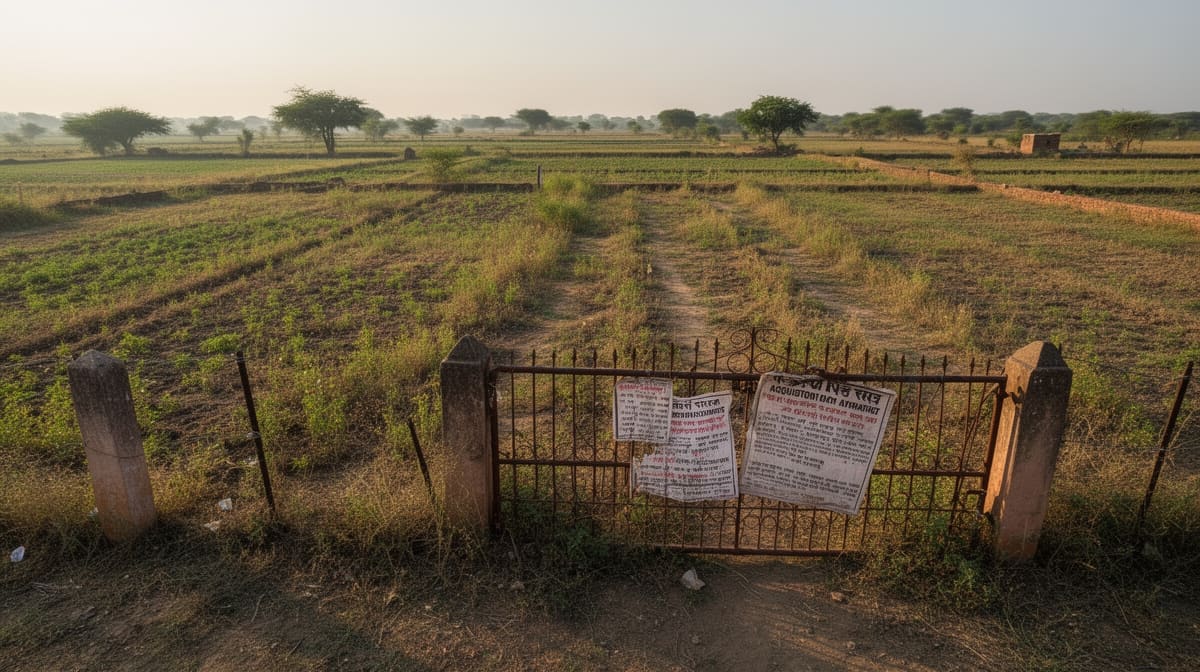
Public purpose under Indian land acquisition law refers to the legitimate governmental reason required to acquire private land, as defined by the Right to Fair Compensation Act, 2013 and Article 300-A of the Constitution.

16 articlesLatest September 2026
KIAD Act | Delay in Final Declaration Breaks Statutory Connectivity; Severability Confines Relief to Contesting Landowners : Karnataka HC
Case Law Analysis
|Karnataka High Court

KIAD Act | Delay in Final Declaration Breaks Statutory Connectivity; Severability Confines Relief to Contesting Landowners : Karnataka HC

The Karnataka HC ruled a 3-year-8-month delay in the final declaration under the KIAD Act broke statutory connectivity, but severability confined relief to landowners who challenged proceedings and refused compensation. Others were barred by estoppel and laches. The decision prevents procedural delays from automatically invalidating entire acquisition schemes where parties have acquiesced.


Section 5A Land Acquisition Act | Effective Opportunity of Hearing Mandatory, Not Mere Formality: SC Reinforces Natural Justice
Case Law Analysis
|Supreme Court of India

Section 5A Land Acquisition Act | Effective Opportunity of Hearing Mandatory, Not Mere Formality: SC Reinforces Natural Justice

The Supreme Court ruled that compliance with Section 5A of the Land Acquisition Act, 1894 requires more than a ritualistic hearing-landowners must be afforded a genuine and effective opportunity to present objections. The judgment quashes acquisition proceedings where objections were mechanically processed, reinforcing the principles of natural justice in administrative actions affecting property rights.

Section 5A Land Acquisition Act | Effective Opportunity of Hearing Mandatory, Not Mere Procedural Formality : SC
Case Law Analysis
|Supreme Court of India

Section 5A Land Acquisition Act | Effective Opportunity of Hearing Mandatory, Not Mere Procedural Formality : SC

The Supreme Court ruled that landowners cannot bypass Section 5A proceedings and later challenge acquisition on grounds of denied hearing. The opportunity of hearing must be substantive, not just ritualistic, and procedural compliance suffices only if objections lack merit. This reinforces natural justice principles in eminent domain cases, impacting landowners, government agencies, and administrative law practitioners.

Section 23 Land Acquisition Act | Bombay HC Upholds 20% Deduction for Development Charges in Public Purpose Acquisitions : Bombay HC
Case Law Analysis
|Bombay High Court

Section 23 Land Acquisition Act | Bombay HC Upholds 20% Deduction for Development Charges in Public Purpose Acquisitions : Bombay HC

Bombay High Court affirms that a 20% deduction for development charges in land acquisition compensation is justified under Section 23 of the Land Acquisition Act for public purpose projects like schools. The ruling mandates strict comparability of sale instances and rejects escalation claims without concrete proof, setting a precedent for compensation principles in infrastructure acquisitions.

Land Acquisition Consent | 80% Must Be Calculated Project-Wide Under Integrated Township Policy, 2023, Not Per Village : Allahabad HC
Case Law Analysis
|Allahabad High Court

Land Acquisition Consent | 80% Must Be Calculated Project-Wide Under Integrated Township Policy, 2023, Not Per Village : Allahabad HC

The Allahabad High Court has ruled that consent for land acquisition under the Integrated Township Policy, 2023, must be aggregated across the entire project area, not counted separately per village. This sets a critical precedent for large-scale urban development projects, ensuring that developers cannot circumvent community consent by fragmenting acquisition into smaller geographic units.

Section 5A Land Acquisition Act | Absence of Objector at Hearing Does Not Vitiate Proceedings: Rajasthan HC Upholds Government Discretion on Public Purpose
Case Law Analysis
|Rajasthan High Court

Section 5A Land Acquisition Act | Absence of Objector at Hearing Does Not Vitiate Proceedings: Rajasthan HC Upholds Government Discretion on Public Purpose

Rajasthan High Court rules that non-participation of landowners in Section 5A hearings under the Land Acquisition Act does not invalidate acquisition proceedings. The judgment reinforces judicial deference to the government’s determination of public purpose, limiting judicial review to procedural fairness rather than substantive merits.

Section 48 Land Acquisition Act | Unused Acquired Land Must Be Returned to Owners Post-Project Completion: MP HC Jabalpur
Case Law Analysis
|Madhya Pradesh High Court

Section 48 Land Acquisition Act | Unused Acquired Land Must Be Returned to Owners Post-Project Completion: MP HC Jabalpur

The Madhya Pradesh High Court ruled that landowners are entitled to the reversion of acquired land under Section 48 of the Land Acquisition Act, 1894, if the land remains unused after project completion. This decision reinforces landowners' statutory rights and imposes a duty on authorities to act within a stipulated timeframe, failing which the land must be returned.

LARR Act 2013, Section 4 | No Compensation Without Formal Acquisition Proceeding: Chhattisgarh HC
Case Law Analysis
|Chhattisgarh High Court

LARR Act 2013, Section 4 | No Compensation Without Formal Acquisition Proceeding: Chhattisgarh HC

The Chhattisgarh High Court ruled that using private land for road widening without initiating acquisition under the LARR Act 2013 violates Article 300-A and due process, mandating immediate compensation with 9% interest from the date of possession. This sets a critical precedent for state agencies using land for public infrastructure without following statutory acquisition procedures.

Legitimate Expectation in Land Donation | State Must Finalize Employment Concession Process Even Without Automatic Right : Meghalaya HC
Case Law Analysis
|Meghalaya High Court

Legitimate Expectation in Land Donation | State Must Finalize Employment Concession Process Even Without Automatic Right : Meghalaya HC

The Meghalaya High Court has ruled that while donors of land for public infrastructure have no automatic entitlement to employment, the state is legally bound to conclude any initiated process for employment concession fairly and without undue delay. This sets a critical precedent for administrative accountability when public contributions are made in good faith, reinforcing that procedural fairness trumps policy gaps.

Article 300-A | State Cannot Retain Acquired Land Indefinitely Without Public Purpose: Rajasthan HC
Case Law Analysis
|Rajasthan High Court

Article 300-A | State Cannot Retain Acquired Land Indefinitely Without Public Purpose: Rajasthan HC

The Rajasthan High Court has ruled that prolonged non-use of land acquired for a public purpose-here, a BARC facility abandoned since 2004-violates the constitutional right to property under Article 300-A. Authorities must release such land or face judicial intervention, setting a binding precedent against bureaucratic inertia in land acquisition processes affecting thousands of landowners nationwide.

Burden of Proof in Environmental Challenges | Rajasthan HC Sets Evidentiary Standard for Land Allotment Writ Petitions
Case Law Analysis
|Rajasthan High Court

Burden of Proof in Environmental Challenges | Rajasthan HC Sets Evidentiary Standard for Land Allotment Writ Petitions

Rajasthan High Court dismisses writ petition challenging land allotment for an Ayurved Hospital, ruling that ecological concerns must be substantiated with cogent evidence. The judgment reinforces that mere allegations without proof cannot stall public projects under environmental law, impacting future land use disputes and administrative decision-making.