The Kerala High Court has clarified a critical principle in land administration: a condition attached to land assignment regarding public purpose must be assessed as of the date of assignment, not years later. This ruling reinforces legal certainty for landholders and curbs arbitrary revocation of assignments based on belated claims by local bodies.
Background & Facts
The Dispute
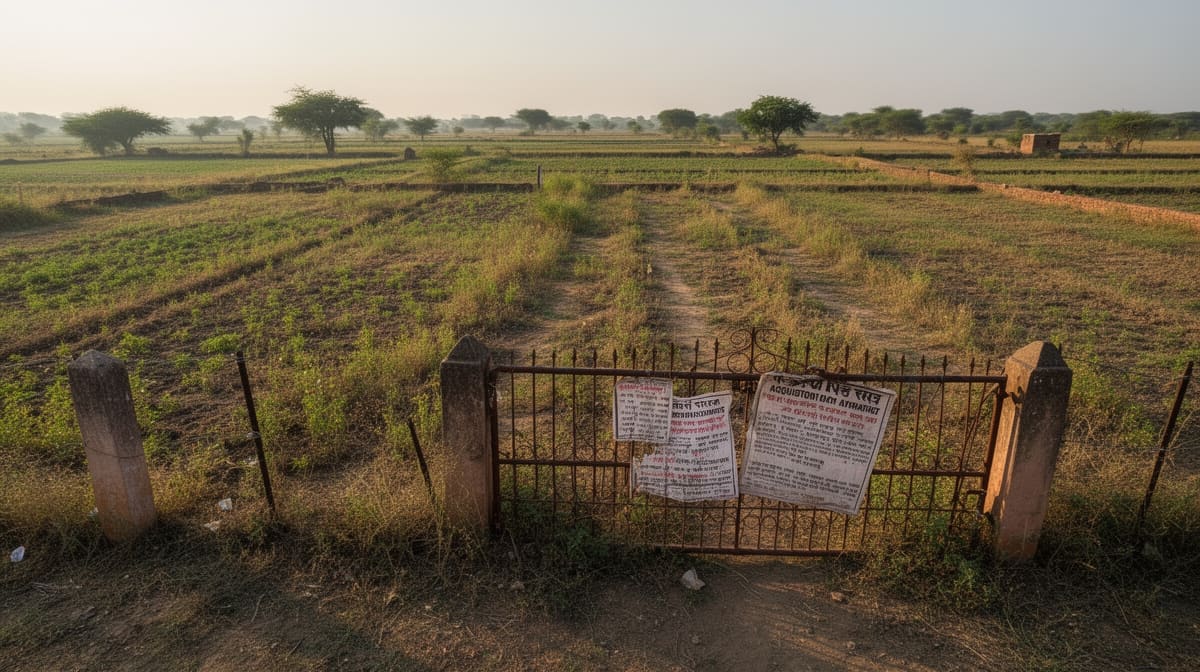
The dispute centers on 2.4 cents of land in Survey No. 498/1A, Mannarkad Village, Kottayam, originally assigned to the 1st respondent, C. Kuruvila Korah, through Government Order Ext.P6 dated 21.05.1996. The assignment was made subject to the condition that it would take effect only if the Manarcadu Grama Panchayat did not require the land for any public purpose. The Panchayat later claimed the land for a drinking water pond, leading to revocation attempts via Ext.P9 dated 30.11.2007 and Ext.P10 dated 22.05.2015.
Key Facts
- The 1st respondent was initially granted 3.662 cents of land under Ext.P1 and sketch Ext.P2.
- A separate assignment of 15.060 cents was made to Mathew Chandy from the same survey number, leaving 2.4 cents in the 1st respondent’s possession.
- The Panchayat initially claimed the 2.4 cents for a public well but later withdrew that claim.
- The Revenue Divisional Officer conducted an inquiry and submitted a report; however, the Government issued Ext.P4 on 25.01.1990 assigning the 2.4 cents to Mathew Chandy and cancelling prior orders.
- The 1st respondent challenged Ext.P4 in O.P. No. 6231 of 1990; this Court set it aside on 08.02.1993 and directed reconsideration based on possession.
- Ext.P6 dated 21.05.1996 was issued thereafter, assigning the 2.4 cents to the 1st respondent, subject to the condition that the Panchayat had no public purpose need.
- The 1st respondent was permitted to cut and remove an anjili tree on the land, which he had bid for in auction.
- Due to lack of survey, the 1st respondent filed W.P.(C) No. 27474/2003; this Court ordered demarcation and sketch preparation on 23.10.2003.
- On 30.11.2007, the District Collector issued Ext.P9, for the first time asserting that the Panchayat required the land for a drinking water pond.
- Ext.P10 dated 22.05.2015 confirmed the cancellation of Ext.P6.
- The 1st respondent filed W.P.(C) No. 12748 of 2008 seeking quashing of Ext.P9 and Ext.P10 and mandamus to implement Ext.P6.
Procedural History
- 21.05.1996: Ext.P6 issued assigning 2.4 cents to 1st respondent, subject to public purpose condition.
- 23.10.2003: High Court directed survey and demarcation of assigned land.
- 30.11.2007: Ext.P9 issued by District Collector citing new public purpose claim.
- 22.05.2015: Ext.P10 issued confirming cancellation of Ext.P6.
- 2008: W.P.(C) No. 12748 filed by 1st respondent.
- 22.05.2015: Single Judge quashed Ext.P9 and Ext.P10 and directed implementation of Ext.P6.
- 16.06.2026: Writ Appeal filed by Revenue Department and others.
Relief Sought
The appellants sought to set aside the Single Judge’s order dated 22.05.2015, uphold Ext.P9 and Ext.P10, and cancel the assignment of 2.4 cents to the 1st respondent. The respondents sought enforcement of Ext.P6, issuance of patta, and demarcation of the land.
The Legal Issue
The central question was whether the condition in Section 3(2) of the Land Assignment Act that assignment is subject to the absence of public purpose must be assessed as of the date of assignment (21.05.1996), or whether a subsequent claim by the Panchayat in 2007 can validly nullify a long-standing assignment.
Arguments Presented
For the Appellant
The appellants contended that the Panchayat’s later claim for a drinking water project constituted a valid public purpose under the Land Assignment Act, and that the assignment under Ext.P6 was conditional and therefore revocable upon emergence of such a need. They argued that the delay in survey and issuance of patta rendered the assignment incomplete and that the State retained overriding authority to reallocate land for public welfare.
For the Respondent
The respondents argued that the condition in Ext.P6 was clearly tied to the situation as of 21.05.1996, when the Panchayat had explicitly stated in Ext.P4 that the land was not required for any public purpose. They emphasized that the State’s own delay in surveying and issuing patta could not be used to defeat a vested right. They relied on the principle that administrative inaction cannot be weaponized to revoke lawful assignments.
The Court's Analysis
The Court examined the language of Section 3(2) of the Land Assignment Act, which permits assignment subject to the condition that the land is not required for public purpose. The Court held that the phrase "required for any public purpose" must be interpreted in context - specifically, as of the date of the assignment order.
"It is to be noted that in Ext.P4, the Panchayath had specifically stated that the land was not required for any public purpose."
The Court noted that Ext.P6 was issued after a decade of litigation and administrative delay, and that the Panchayat had never raised any public purpose objection until 2007 - over eleven years after Ext.P6. The Court emphasized that the State cannot remain silent for over a decade and then invoke a condition to revoke an assignment.
The Court further held that the delay in survey and demarcation was attributable to the State’s own inaction, and that the respondent had acted in good faith by cultivating and maintaining the land. The Court cited the principle that equitable estoppel applies against the State when it permits a person to act to their detriment based on a government order.
The Court also affirmed that Ext.P6 had attained finality after the dismissal of O.P. No. 6231 of 1990 and the subsequent compliance with the Court’s directions in W.P.(C) No. 27474/2003. The issuance of Ext.P9 and Ext.P10 was therefore an abuse of power.
The Verdict
The writ appeal was dismissed. The Court upheld the Single Judge’s order dated 22.05.2015, quashing Ext.P9 and Ext.P10. The assignment under Ext.P6 dated 21.05.1996 was confirmed as valid and enforceable. The respondents are entitled to immediate issuance of patta and demarcation of the 2.4 cents of land in Survey No. 498/1A. The Court clarified that if the Panchayat requires the land for a public purpose in future, it must initiate proceedings under the Land Acquisition Act.
What This Means For Similar Cases
Public Purpose Must Be Established At Assignment Time
- Practitioners must argue that any conditionality in land assignments (e.g., "subject to no public purpose") is time-bound to the date of issuance.
- Subsequent claims by local bodies, even if genuine, cannot override a vested right established by a final order.
Administrative Delay Cannot Be Used to Invalidate Rights
- Delays in survey, demarcation, or patta issuance by government agencies cannot be invoked to deny lawful assignments.
- Courts will apply equitable principles to protect individuals who have relied on official orders over long periods.
Land Acquisition Is the Only Remedy for Later Public Needs
- If a public purpose emerges after assignment, the only lawful recourse is initiation of acquisition proceedings under the Land Acquisition Act.
- Revocation of assignment via administrative order is illegal and ultra vires.
Documentary Evidence Prevails Over Oral or Later Claims
- Written records such as Ext.P4 (stating no public purpose) carry decisive weight.
- Oral assertions or informal claims by Panchayats cannot override formal government orders.
The Burden Shifts to the State
- Once an assignment order is issued and not challenged within a reasonable time, the burden shifts to the State to prove that the condition was triggered at the time of assignment.
- The State cannot rely on silence or inaction to later justify revocation.