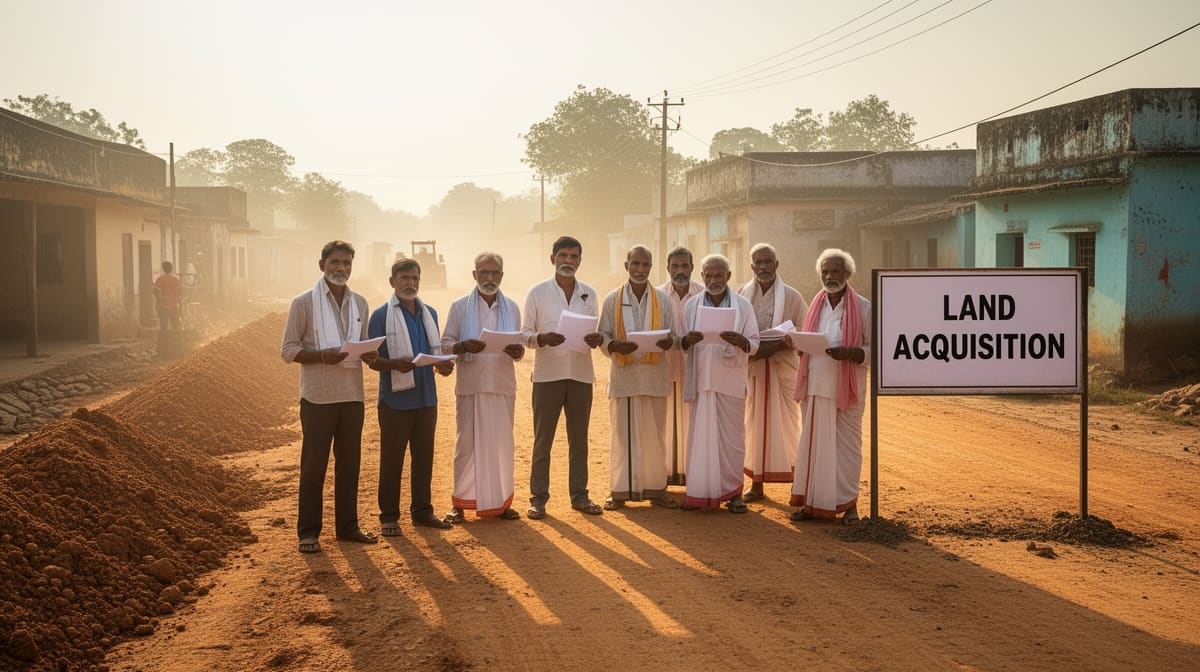
The Allahabad High Court has affirmed that compulsory land acquisition under the Right to Fair Compensation and Transparency in Land Acquisition, Rehabilitation and Resettlement Act, 2013, is lawful when the mandatory 80% consent requirement under the Integrated Township Policy, 2023, is satisfied across the entire project area, not on a village-by-village basis. The judgment reinforces statutory compliance and clarifies the scope of judicial review in public purpose acquisitions.
Background & Facts
The Dispute
The present batch of six writ petitions challenges land acquisition proceedings initiated by the Ghaziabad Development Authority (GDA) for the development of an Integrated Township Project named "Park Town" in Village Mahrauli, Pargana Dasna, District Ghaziabad. The petitioners, who are landowners and tenure holders in the village, contend that the acquisition violates the Integrated Township Policy, 2023, and the procedural safeguards under the Act, 2013, particularly the requirement that developers must first obtain consent or purchase 80% of the land before initiating compulsory acquisition.
Key Facts
- The total project area for the Integrated Township is 46.5212 hectares, spanning multiple villages including Mahrauli.
- The developer, M/s Utility Estates Private Limited, had purchased 33.9013 hectares (73%) of the total project land through willing agreements with tenure holders.
- An additional 7% of affected families had separately consented to the project, bringing the total consent/purchase to over 80% of the entire project.
- The preliminary notification under Section 11(1) of the Act, 2013, dated 07.03.2025, was issued for 2.86844 hectares (approximately 6.2% of the total project area) in Village Mahrauli.
- A letter dated 03.03.2025 from the developer to GDA, submitted four days before the preliminary notification, explicitly stated the 80% compliance and enclosed the list of land to be acquired compulsorily.
- After the preliminary notification, the developer further purchased 0.838419 hectares, reducing the area subject to compulsory acquisition under Section 19 to 2.030021 hectares.
- A Social Impact Assessment (SIA) study was conducted by an authorised agency and approved by the State Government on 23.03.2024.
- The SIA Report concluded that no family was likely to be displaced, no public property was affected, and a Rehabilitation and Resettlement (R&R) Scheme would be prepared.
- Petitioners filed objections under Section 15 of the Act, 2013 on 05/09.05.2025, which were rejected by the Collector without a dated order.
- A declaration under Section 19(1) was issued on 05.03.2026, and a general notice under Section 21(1) and 21(2) was issued on 17.04.2026, fixing 18.05.2026 as the deadline for claims and 21.05.2026 for hearing.
- Earlier acquisition proceedings under the Land Acquisition Act, 1894, initiated in 2013, had lapsed due to non-deposit of acquisition cost.
Procedural History
- 19.12.2013: Preliminary notification issued under the Land Acquisition Act, 1894 for the same project.
- 20.10.2014: Declaration under Section 6 of the 1894 Act issued.
- 2015: Writ-C No. 55473 of 2015 filed by petitioners challenging lapse of 1894 proceedings.
- July 2023: Integrated Township Policy, 2023 came into force.
- 03.03.2025: Developer’s letter confirming 80% consent/purchase submitted to GDA.
- 07.03.2025: Preliminary notification under Section 11(1) of the Act, 2013 published.
- 12.03.2025: Notification published in Dainik Jagran and Amar Ujala.
- 05/09.05.2025: Petitioners filed objections under Section 15.
- 23.03.2024: SIA Report approved by State Government.
- 05.03.2026: Declaration under Section 19(1) issued for 2.030021 hectares.
- 17.04.2026: General notice under Section 21 issued, fixing 18.05.2026 for claims and 21.05.2026 for hearing.
- 21.05.2026: Judgment reserved.
- 29.05.2026: Judgment delivered.
The Parties' Positions
Petitioners: Argued that the 80% consent requirement under the Policy, 2023 was not met for Village Mahrauli alone; that objections under Section 15 were rejected mechanically without a date; that no R&R Scheme was prepared; and that the acquisition was a colourable exercise of power to benefit private developers.
Respondents (State and GDA): Contended that the 80% threshold was satisfied across the entire 46.5212-hectare project; that the SIA process was fully compliant; that the Section 15 objections were considered and rejected within statutory limits; that the R&R Scheme would be prepared before award; and that the acquisition was for a legitimate public purpose under Section 2(1)(e) of the Act, 2013.
Relief Sought
The petitioners sought quashing of the preliminary notification dated 07.03.2025 and the general notice dated 17.04.2026, and a direction to halt the acquisition proceedings. They also sought a declaration that the acquisition violated the Integrated Township Policy, 2023 and Article 300-A of the Constitution.
The Legal Issue
The central question was whether the mandatory 80% consent or purchase requirement under the Uttar Pradesh Integrated Township Policy, 2023, must be satisfied for each individual village within a multi-village project, or whether it may be computed on the basis of the entire project area.
Arguments Presented
For the Petitioner
Shiv Sagar Singh, learned counsel, argued that the 80% requirement under Clause 3.4 of the Policy, 2023 must be met village-wise, and that the developer had acquired only a fraction of land in Village Mahrauli. He contended that the objections under Section 15 were rejected without a date, indicating non-application of mind. He further argued that the earlier lapsed proceedings under the 1894 Act rendered the current acquisition invalid, and that no R&R Scheme had been prepared. He relied on Article 300-A and alleged a colourable exercise of power to benefit private developers.
For the Respondent
The State and GDA, through their counsel, submitted that the Policy, 2023 treats the Integrated Township as a single project. The developer had secured consent for 73% of the total land and additional consent from 7% of affected families, satisfying the 80% threshold. The SIA process was fully compliant with Sections 4 to 8 of the Act, 2013. The Section 15 objections were considered, and the absence of a date on the rejection order was a procedural irregularity, not an illegality. The R&R Scheme would be prepared before award, and the acquisition was for a public purpose under Section 2(1)(e). The judgment in Vijay Pal Singh v. State of U.P. was cited as binding precedent.
The Court's Analysis
The Court undertook a comprehensive review of the statutory framework under the Act, 2013 and the Integrated Township Policy, 2023. It held that the Policy, 2023, by its very design, contemplates the Integrated Township as a unified development unit, not a collection of isolated village acquisitions. The developer’s letter dated 03.03.2025, submitted before the preliminary notification, provided contemporaneous documentary evidence that 80% consent had been secured across the entire 46.5212-hectare project. This was further corroborated by the Tehsildar’s report and the reduction in compulsory acquisition area post-notification.
"The Policy does not require separate 80% compliance for each village. An Integrated Township may cover more than one village, and the land purchase process under Clause 3.4 is meant for the entire project, not village-wise."
The Court distinguished Vijay Pal Singh as directly on point, where it was held that consent must be calculated project-wide, not village-wise. The Court also rejected the petitioners’ argument that the absence of a date on the Section 15 rejection order invalidated the proceedings, holding that the sequence of events - objections filed, declaration issued within 12 months, and notice under Section 21 issued - conclusively demonstrated compliance with Section 15(2) and (3). The Court cited Prabhakar v. Joint Director of Sericulture Department to affirm that procedural irregularities do not vitiate administrative action unless prejudice is shown.
The Court found the SIA process fully compliant with Sections 4, 5, 7, and 8 of the Act, 2013. Although the Expert Group’s report was not separately produced, the Court held that the approval of the SIA Report under Section 8 necessarily implied compliance with Section 7, and that the petitioners had not pleaded or proved non-compliance. The Court relied on State of U.P. v. Brijendra Singh to uphold the presumption of regularity of official acts.
Regarding Article 300-A, the Court applied the seven-sub-right framework from Kolkata Municipal Corporation v. Bimal Kumar Shah, and found that all safeguards - notice, hearing, reasoned decision, public purpose, fair compensation, expeditious process, and conclusion - were satisfied. The non-invocation of Section 40 (urgency clause) was held to be evidence of due process, not procedural shortcut.
The Court also held that the remedy under Section 64 of the Act, 2013 - referral to the Land Acquisition, Rehabilitation and Resettlement Authority - was an efficacious alternative to writ jurisdiction, and that the petitioners’ grievances regarding compensation and R&R were properly addressable in the award proceedings.
The Verdict
The writ petitions were dismissed. The Court held that the acquisition proceedings were lawful and in full compliance with the Act, 2013 and the Integrated Township Policy, 2023. The Collector/Additional District Magistrate (Land Acquisition), Ghaziabad, was directed to conduct the enquiry under Sections 22 and 23 of the Act, 2013 and pass the award strictly in accordance with Sections 26 to 31, including the Rehabilitation and Resettlement Award under Section 31 read with the Second Schedule. Possession of the land shall not be taken until full payment of compensation and R&R monetary components as required under Section 38(1). Any aggrieved person may file a reference under Section 64 of the Act, 2013.
What This Means For Similar Cases
Consent Must Be Project-Wide, Not Village-Wise
- Practitioners must now calculate consent or purchase percentages across the entire project area under the Integrated Township Policy, 2023, not per village or parcel.
- Developers must maintain contemporaneous, documented proof of consent/purchase (e.g., signed agreements, affidavits, official letters) dated prior to the Section 11 notification.
- Challenges based on village-specific compliance will fail if the overall project meets the 80% threshold.
Procedural Irregularities Do Not Vitalize Acquisition
- Absence of a date on an order rejecting Section 15 objections is an irregularity, not an illegality, if the statutory process was followed.
- Courts will look at the sequence of events - e.g., issuance of Section 19 declaration after Section 15 objections - to infer compliance.
- Petitioners must specifically plead and prove prejudice from procedural lapses; mere technicalities will not suffice.
R&R Obligations Are Progressive, Not Pre-Conditioned
- The absence of a finalized R&R Scheme before the Section 19 declaration does not invalidate acquisition.
- The obligation to prepare the R&R Scheme arises under Section 16 and must be completed before the award under Section 31.
- Petitioners must raise R&R grievances during the Section 21 - 23 award proceedings, not at the notification stage.
Judicial Restraint in Public Purpose Acquisitions
- Courts will not interfere under Article 226 unless fraud or colourable exercise is proved.
- The existence of an efficacious statutory remedy under Section 64 is a strong ground for non-interference.
- The non-invocation of the urgency clause under Section 40 is now a positive indicator of procedural integrity.
The Precedent of Vijay Pal Singh Is Binding
- The Allahabad HC’s own judgment in Vijay Pal Singh is now binding precedent on all land acquisition matters under the Integrated Township Policy, 2023.
- Courts will uniformly apply the project-wide consent calculation and the presumption of regularity in SIA and Expert Group compliance.