The Allahabad High Court has clarified a critical legal principle in its judgment dated 02 July 2026: the Places of Worship (Special Provisions) Act, 1991 does not immunize religious structures from acquisition for public purposes. The Court held that while the Act prohibits conversion of places of worship, it does not derogate from the State’s sovereign power to acquire land, including Waqf properties, under the Right to Fair Compensation and Transparency in Land Acquisition, Rehabilitation and Resettlement Act, 2013, provided fair compensation and rehabilitation are ensured.
Background & Facts
The Dispute
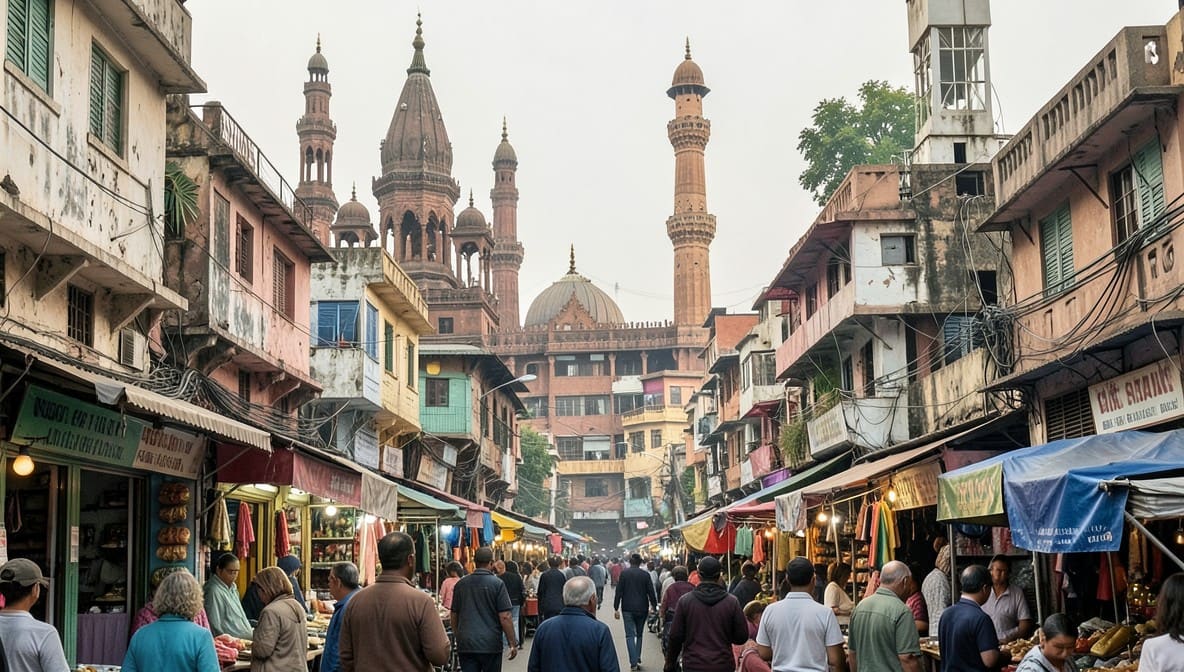
The petitioners, six tenants and shopkeepers in Dalmandi Market/Street, Varanasi, filed a writ petition seeking multiple directions against the State of Uttar Pradesh and other respondents. Their primary grievance was the proposed widening and beautification of Dalmandi Street as part of the Kashi Vishwanath Corridor development project, which threatened their shops and six ancient mosques in the area. The petitioners alleged that the respondents were attempting to dispossess them arbitrarily, without due process, and in violation of their legal and human rights.
Key Facts
- The petitioners are tenants in six shops located at Dalmandi Market/Street, Varanasi, bearing numbers CK43/168-169, CK68/1, CK69/32, CK43/147, CK68/36, and CK43/181.
- They have been running businesses in these shops for decades, with some shops being occupied by their ancestors.
- The shops are part of a dense market area dominated by the Muslim community, serving Purvanchal and beyond.
- The State Government issued Government Orders dated 31.03.2025 and 30.07.2025, allocating ₹21,588.24 lakhs for widening and beautification of Dalmandi Street, which has a maximum width of 70 feet.
- The petitioners alleged that the respondents, along with the Police and paramilitary forces, threatened and harassed them to vacate their shops without due process.
- Six ancient mosques in Dalmandi, constructed before 15.08.1947, were also proposed to be demolished as part of the project: Anjuman Intezamia Masjid, Masjid Rangile Shah, Masjid Ali Raza Khan, Masjid Karimullah Baig, Masjid Nisaran, and Masjid Sangamarmar.
- The petitioners secured documents under the Right to Information Act, 2005, showing that the Public Works Department (PWD) intended to acquire and demolish these mosques.
- A representation dated 29.01.2026 by one Dr. Sanjay Singh Gautam to the Nagar Nigam, alleging dilapidation of some buildings, was used as a pretext for demolition. The Nagar Nigam demolished 29 buildings from 09.02.2026 onwards.
- The petitioners alleged violations of their fundamental rights under Articles 14, 21, 19(1)(a), and 300A of the Constitution.
Procedural History
- Writ Petition (C) No. 16649 of 2026 filed before the Allahabad High Court.
- The petitioners sought protection of their shops and the six mosques from arbitrary dispossession and demolition.
- The matter was heard by a Division Bench comprising Hon’ble J.J. Munir and Hon’ble Arun Kumar, JJ.
- The judgment was reserved and delivered on 02 July 2026.
Relief Sought
The petitioners sought the following reliefs:
- A direction to the respondents not to dispossess them from their shops arbitrarily or illegally.
- Prevention of deployment of Police or paramilitary forces to effect dispossession.
- A direction to the respondents to take over and change the character of the six ancient mosques.
- Development of an alternative street nearer the Kashi Vishwanath Dham Corridor for widening purposes.
The Legal Issue
The central legal questions before the Court were:
- Whether Section 4 of the Places of Worship (Special Provisions) Act, 1991 prohibits the acquisition of religious structures, including mosques existing before 15.08.1947, for public purposes like road widening.
- Whether the petitioners, as tenants, have locus standi to challenge the acquisition of their shops or the proposed demolition of the six mosques.
- Whether the acquisition of Waqf properties under the Act of 2013 is permissible under Sections 51 and 91 of the Waqf Act, 1995.
Arguments Presented
For the Petitioners
- The petitioners argued that the Places of Worship (Special Provisions) Act, 1991 prohibits any alteration or acquisition of religious structures existing before 15.08.1947.
- They relied on Sections 2(b), 2(c), 3, 4, and 7 of the Act of 1991 to contend that the proposed acquisition of the six mosques was illegal.
- They emphasized that the Social Impact Study Report showed that 50% of families reside in Dalmandi and 45% have businesses there, and the demolition would deprive them of livelihood and shelter.
- They alleged that the respondents acted arbitrarily and in violation of Articles 14, 21, and 19(1)(a) of the Constitution.
- They contended that the Waqf Act, 1995 requires consultation with the Waqf Board before acquiring Waqf properties, and the acquisition must not contravene the Act of 1991.
For the Respondents
- The respondents argued that the petitioners, being tenants, lacked locus standi to challenge the acquisition of the shops or mosques. Only the owners or the Waqf Board could raise such objections.
- They submitted that the Act of 1991 prohibits conversion of places of worship but does not prohibit acquisition for public purposes. The State’s sovereign power under the Act of 2013 allows acquisition of any property, including religious properties, provided fair compensation and rehabilitation are granted.
- They relied on the Supreme Court’s observations in Dr. M. Ismail Faruqui v. Union of India to argue that a mosque does not enjoy any special immunity from acquisition.
- They pointed out that the Act of 2013 provides for compensation, rehabilitation, and resettlement for affected families, including tenants.
- They submitted that the Waqf Act, 1995 does not prohibit acquisition of Waqf properties under the Act of 2013, provided the acquisition complies with Sections 51 and 91 of the Waqf Act.
- They argued that the petitioners had not made any prior demand for justice before approaching the Court, rendering the petition defective under the law governing mandamus.
The Court's Analysis
The Court conducted a detailed analysis of the legal principles involved:
-
Locus Standi of the Petitioners:
- The Court held that the petitioners, being tenants, had limited rights in the matter. Their status as tenants did not grant them proprietary rights over the shops or the mosques.
- The Court observed that the petitioners’ primary concern was protecting their source of livelihood, rather than proprietary rights. The owners of the shops had not challenged the acquisition, and the tenants lacked the legal standing to question the acquisition.
- The Court noted that the Mutawalli and the Waqf Board had the primary locus to protect the mosques, not the petitioners.
"The rights of these petitioners are, therefore, limited to their tenancies... The moment the owner's rights vest in the State either by transfer of land or acquisition, the land vests free from all encumbrances in the State."
-
Scope of the Places of Worship (Special Provisions) Act, 1991:
- The Court examined Sections 2(b), 2(c), 3, and 4 of the Act of 1991 and held that the Act prohibits conversion of places of worship from one religious denomination to another but does not prohibit acquisition for public purposes.
- It emphasized that the Act preserves the religious character of places of worship as it existed on 15.08.1947 but does not place them beyond the State’s power of acquisition under the doctrine of eminent domain.
- The Court relied on the Supreme Court’s observations in Dr. M. Ismail Faruqui v. Union of India to hold that a mosque, like any other place of worship, is subject to acquisition for public purposes, provided the acquisition does not extinguish the right to practice religion.
"The Act of 1991 is not a shield against acquisition by the State for public purpose or welfare... The right to worship is not at any and every place, so long as it can be practised effectively, unless the right to worship at a particular place is itself an integral part of that right."
-
Harmonious Construction of the Act of 1991 and the Act of 2013:
- The Court held that Sections 3 and 4 of the Act of 1991 must be read harmoniously. Section 3 prohibits conversion of places of worship, while Section 4 preserves their religious character as of 15.08.1947. Neither provision prohibits acquisition for public purposes.
- It observed that the Act of 2013 provides for fair compensation and rehabilitation, ensuring that the acquisition does not violate the rights of affected parties.
-
Waqf Act, 1995 and Acquisition of Waqf Properties:
- The Court examined Sections 51 and 91 of the Waqf Act, 1995, and held that acquisition of Waqf properties is permissible under the Act of 2013, provided the acquisition is made in consultation with the Waqf Board and complies with the conditions laid down in the proviso to Section 51(1A).
- It noted that the proviso to Section 51(1A) explicitly states that acquisition shall not be in contravention of the Act of 1991, but this does not prohibit acquisition for public purposes.
-
Precedents and Judicial Pronouncements:
- The Court relied on Dr. M. Ismail Faruqui v. Union of India to emphasize that no place of worship enjoys immunity from acquisition under the doctrine of eminent domain.
- It also referred to Yusuf Ajij Shaikh v. Special Land Acquisition Officer No. 2, Pune, where the Bombay High Court held that the Act of 1991 does not prohibit acquisition under the Land Acquisition Act.
"The correct position may be summarised thus... A mosque is not an essential part of the practice of the religion of Islam and namaz (prayer) by Muslims can be offered anywhere, even in open. Accordingly, its acquisition is not prohibited by the provisions in the Constitution of India."
The Verdict
The Court dismissed the writ petition, holding that:
- The petitioners, being tenants, lacked locus standi to challenge the acquisition of their shops or the proposed demolition of the six mosques.
- The Places of Worship (Special Provisions) Act, 1991 does not prohibit acquisition of religious structures for public purposes, provided fair compensation and rehabilitation are granted under the Act of 2013.
- The acquisition of Waqf properties is permissible under Sections 51 and 91 of the Waqf Act, 1995, subject to consultation with the Waqf Board and compliance with the conditions laid down in the Act of 2013.
- The petitioners’ apprehensions about dispossession were unfounded, as the Act of 2013 provides for compensation, rehabilitation, and resettlement for affected families.
The Court directed no order as to costs.
What This Means For Similar Cases
Tenants Cannot Challenge Acquisition of Property
- Tenants have limited rights in matters of land acquisition. Their rights are subordinate to those of the property owners, and they cannot challenge the acquisition unless they have a specific legal interest or proprietary right.
- Once the owner’s rights vest in the State, either through acquisition or negotiated transfer, the land vests free from all encumbrances, including tenancy rights.
Places of Worship Are Not Immune From Acquisition
- The Places of Worship (Special Provisions) Act, 1991 prohibits conversion of places of worship but does not prohibit acquisition for public purposes like road widening, infrastructure development, or urban planning.
- Religious structures, including mosques, temples, and churches, are subject to the State’s sovereign power of eminent domain, provided fair compensation and rehabilitation are ensured.
- The judgment reaffirms that no religious structure enjoys special immunity from acquisition, and the right to worship is not tied to a particular place unless it is an integral part of the religious practice.
Waqf Properties Can Be Acquired With Due Process
- Acquisition of Waqf properties under the Act of 2013 is permissible, provided the acquisition complies with Sections 51 and 91 of the Waqf Act, 1995.
- The Waqf Board must be consulted, and the acquisition must not contravene the Act of 1991 or any other law.
- The judgment clarifies that the Waqf Act does not prohibit acquisition but merely imposes procedural safeguards to protect the interests of the Waqf and its beneficiaries.