MV Act Section 96 | State Can Fix 15-Year Age Limit For School Vehicles : HP HC
Himachal Pradesh HC upholds Rule 73-A(1)A(xi) restricting school transport vehicles to 15 years, rejecting ultra vires and arbitrariness challenges.
297 Himachal Pradesh High Court judgments explained in plain English: what was decided, the law applied and why it matters.

Himachal Pradesh HC upholds Rule 73-A(1)A(xi) restricting school transport vehicles to 15 years, rejecting ultra vires and arbitrariness challenges.


The Himachal Pradesh High Court upheld the acquittal under Section 138 of the NI Act, holding that a notice must specify the exact cheque amount to be valid. It further clarified that any alteration in the cheque initialled by the accused does not void the instrument, refining the evidentiary requirements for dishonoured cheque cases.

HP HC held that complaint under Sec 141 NI Act must show averments linking a director to dishonoured cheque; mere resignation does not quash proceedings. This sets the evidentiary standard for director liability and shields officers from baseless claims.

The Himachal Pradesh High Court held that a birth certificate proving Indian birth overrides an adverse police verification report for passport applications under Section 3 of the Citizenship Act, 1955. It directed the Regional Passport Officer, Shimla to conduct fresh verification within two weeks and issue the passport, affecting applicants whose citizenship is questioned despite documentary proof of birth in India.

Providing accommodation or transport in a POCSO case attracts abetment under Section 17, HP HC held, refusing to suspend sentence absent strong acquittal chance noting that support in child sexual abuse cases is punishable as abetment limits bail relief.

Himachal Pradesh High Court held that a clerical error in revenue records does not bar court jurisdiction under Section 57 of the Consolidation Act when the dispute arises from that error, protecting landowners’ title and injunction rights.

The HP HC rejected the State’s laches defence, holding that delay did not bar the petitioners’ right to challenge the Recruitment Act or seek relief grounded in their contractual service.

HP HC held that under BNSS §432, prosecution may submit a matriculation certificate as additional evidence to prove a victim's age in a POCSO case at the appellate stage if it supports the case. This clarifies age-proof evidence rules in POCSO trials.

Section 90 of the Evidence Act applies only to original documents, not certified copies, the HP High Court held, leading to the dismissal of the redemption suit and underscoring the need to rely on original documents.

The Himachal Pradesh High Court ruled that a complainant may invoke Section 193(9) BNSS to demand further investigation before charges are framed, rejecting the view that only the investigating agency can move such an application. The decision strengthens victim participation in ensuring a thorough probe at the pre-trial stage.

The Himachal Pradesh High Court set aside a cheque bounce conviction because the complaint was filed before the statutory 15-day notice period expired, ruling that a premature complaint is jurisdictionally defective and legally non-existent. The decision reinforces that strict compliance with Section 138's procedural timeline is a jurisdictional prerequisite, not a mere formality.

The Himachal Pradesh High Court set aside a bank’s termination of a probationary employee, ruling that FIRs lodged during probation cannot be used as a ground for dismissal without a proper inquiry, as it breaches natural justice and Article 311. The decision safeguards probationers from stigmatic discharge pending criminal investigations.

The Himachal Pradesh High Court held that coparcenary property devolves by survivorship when surviving coparceners exist, rejecting succession under Mulla's Para 43. The court also affirmed that a compromise decree entered with a guardian's consent binds minor coparceners.

The Himachal High Court ruled that a written statement cannot be amended after the trial starts unless the party shows prior due-diligence, upholding the trial court’s refusal. The decision limits the court’s supervisory jurisdiction under Article 227, warning litigants that pleadings must be finalised before trial.

The Himachal Pradesh High Court annulled the conviction of a public servant under Section 13(2) of the Prevention of Corruption Act because the prosecution lacked a valid sanction, rendering the proceedings non-est. The ruling reinforces that any PC-Act charge against a public servant must be preceded by a proper sanction, or the case is liable to be dismissed. This decision benefits officials facing similar charges where sanction was not duly obtained.

The Himachal Pradesh High Court upheld the First Appellate Court's reversal of an adverse possession decree, ruling that a co-sharer's forcible ouster cannot satisfy the 'peaceful possession' requirement under the Limitation Act. The court also found the claimants' reliance on unproven wills and absence of documentary evidence fatal to their case.

The Himachal Pradesh High Court held that Article 227 supervisory jurisdiction cannot be invoked to challenge a trial court's discretionary decision to admit secondary evidence under Section 65 of the Evidence Act for proving a Will. The ruling clarifies that evidentiary rulings, even if debatable, must be challenged through appellate channels rather than constitutional writs, preserving the trial court's domain over procedural evidence management.

The Himachal Pradesh High Court clarifies that Section 11(2) of the Electricity (Duty) Act, 2009 can only raise rates within defined limits and must be guided by clear principles, impacting stone-crusher industries.

The Himachal Pradesh High Court affirmed a Rs 4,000-per-month maintenance order for a divorced wife, holding that Section 125 CrPC guarantees support until she remarries, regardless of the husband’s financial-hardship pleas. This safeguards divorced women’s livelihood until they enter a new marriage.

Contractual lecturers who completed two years of uninterrupted service must be regularised retroactively, with all accrued benefits, and the clause that made the order prospective was struck down. This obliges the Himachal Pradesh education department to grant permanent status and back pay to eligible staff, reinforcing that service-regularisation cannot be deferred by administrative notifications.

A gift deed that obliges the donee to maintain the donor and his spouse becomes void if that obligation is breached. The Himachal High Court reinstated the trial court’s decree, confirming that the donor’s right to revoke the gift under Section 123 of the Transfer of Property Act stands even after the deed’s execution. This clarifies that beneficiaries of conditional gifts must honour maintenance promises or risk losing title.

An appellate bench cannot replace a trial judge’s discretionary decision on an Order 39 application unless the lower order is perverse, preserving the trial court’s authority in specific relief matters. This limits higher courts from rewriting factual findings, affecting parties seeking interim injunctions under the Specific Relief Act.

The Himachal High Court ruled that an appeal is extinguished if a deceased co-owner’s legal representative is not brought on record, preventing contradictory decrees. Parties must ensure representation of all owners before pursuing an appeal.

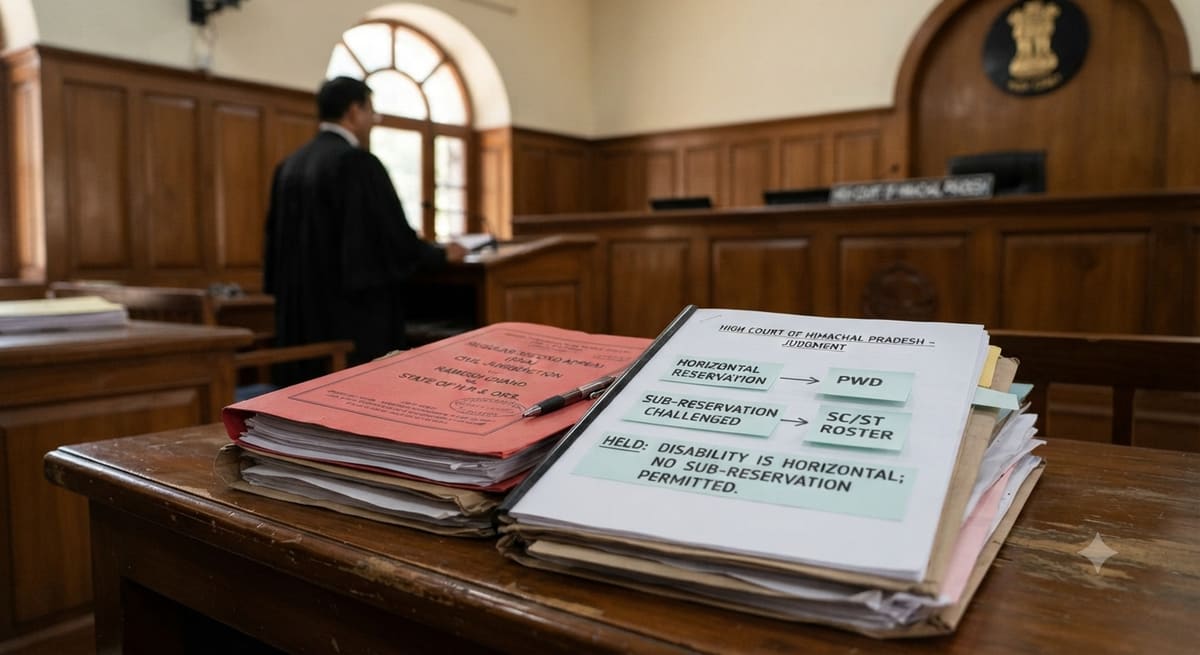
The Himachal Pradesh High Court ruled that reservations for persons with physical disabilities are a horizontal reservation under Article 16(4) and therefore cannot be further earmarked for Scheduled Caste candidates. This invalidates any sub-reservation scheme that tries to allocate a share of disability seats to SCs, affecting future recruitment drives that combine disability and caste criteria.