The Himachal Pradesh High Court has set aside a conviction under Section 138 of the Negotiable Instruments Act, holding that a complaint filed before the expiry of the 15-day period following deemed service of a demand notice is not a complaint in the eyes of law and cannot sustain cognisance. The Court emphasised that revisional jurisdiction does not permit reappreciation of evidence absent perversity, but a jurisdictional defect such as a premature complaint can be raised at any stage.
Background & Facts
The Dispute
The petitioner, Basant (accused in the original complaint), purchased 300 cartons of apples from the respondent, Virender Singh (complainant), for ₹5,25,000 at ₹1,750 per box. The petitioner paid ₹1,25,000 in cash and issued a cheque of ₹4,00,000 for the balance. The cheque was presented but dishonoured with the endorsement "funds insufficient". The complainant served a demand notice upon the accused, which was not returned undelivered and was deemed served. The accused failed to pay within 15 days, prompting the complaint.
Key Facts
- Transaction: Sale of 300 apple cartons for ₹5,25,000
- Payment: ₹1,25,000 cash; ₹4,00,000 by cheque
- Cheque dishonour: Endorsed "funds insufficient"
- Notice date: 19.10.2016 (sent by registered post)
- Deemed service: 18.11.2016 (30 days from dispatch)
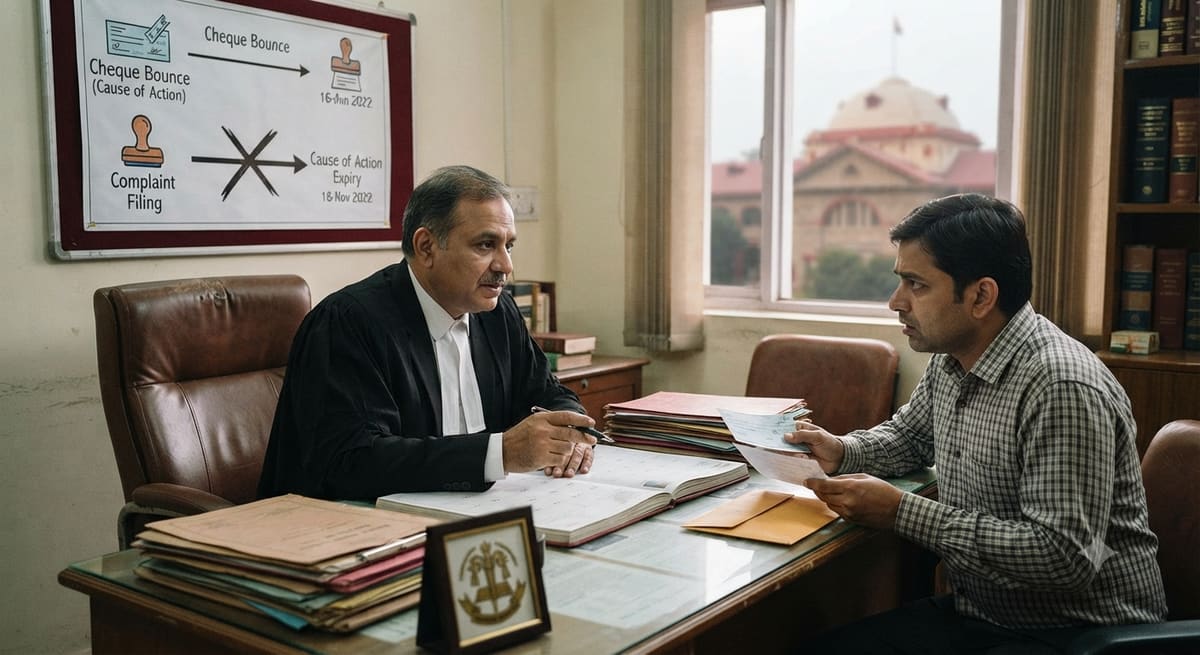
- Complaint filing: 08.11.2016 (before expiry of 15 days from deemed service)
- Accused's defence: Denied liability; claimed cheque was for road construction; alleged false case; stated ₹70,000 already paid during trial
- Trial Court finding: Complainant's version probable; cheque carried presumption of consideration; accused failed to rebut presumption
Procedural History
- 19.10.2022: Judicial Magistrate First Class, Chopal, convicted accused under Section 138 NI Act; sentenced to 1 year simple imprisonment and ₹4,70,000 compensation (6 months default)
- 28.10.2022: Order of sentence passed
- 25.03.2025: Sessions Judge (Forest), Shimla dismissed appeal, affirming conviction and sentence
- 2025: Criminal Revision No. 354 of 2025 filed before High Court of Himachal Pradesh
- 31.08.2026: Matter reserved for judgment
- 07.09.2026: Judgment delivered
Relief Sought
The petitioner sought setting aside of the conviction and sentence on grounds that: (i) the complaint was premature as filed before expiry of 15 days from deemed service of notice; (ii) ₹70,000 paid during trial was not deducted; (iii) complainant failed to prove existence of orchard and apple crop maturity at 5,000 feet in July.
The Legal Issue
The central question was whether a complaint under Section 138 NI Act filed before the expiry of 15 days from the deemed service of the statutory demand notice is maintainable, and whether such a jurisdictional defect can be raised for the first time in a revision petition.
Arguments Presented
For the Petitioner
Mr Abhay Gupta submitted that the notice dated 19.10.2016 was deemed served only after 30 days (18.11.2016), but the complaint was filed on 08.11.2016 - well before the 15-day payment window expired. He relied on Gajanand Burange v. Laxmi Chand Goyal and the three-judge bench decision in Yogendra Pratap Singh v. Savitri Pandey to argue that a premature complaint is "no complaint at all" and cognisance on such basis is contrary to law. He also contended that ₹70,000 paid during trial was not adjusted.
For the Respondent
Mr N.S. Chandel, Senior Advocate, argued that the plea of prematurity was not raised before the lower courts and is impermissible at the revisional stage. He submitted that the complainant is entitled to file a fresh complaint within the limitation period under Section 142(b) NI Act.
The Court's Analysis
The Court first delineated the scope of revisional jurisdiction under Section 397 CrPC (now Section 438 BNSS), citing Kuntegowda v. Thurubaiah (2026 SCC OnLine SC 1485):
"The revisional court does not act as an appellate court and it can only determine the correctness, legality and propriety of the findings, sentence and order recorded by the lower court... the court, in revision, considers the material only to satisfy itself about the correctness, legality and propriety of the findings, sentence and order recorded by the lower court, and should refrain from substituting its conclusion on an elaborate consideration of evidence."
The Court reiterated that concurrent findings of fact by two lower courts should not be disturbed in revision unless perverse, grossly erroneous, or based on no material (State of Maharashtra v. Jagmohan Singh Kuldip Singh Anand; State of Kerala v. Puttumana Illath Jathavedan Namboodiri; Sanjabij Tari v. Kishore S. Borcar).
On the deemed service of notice, the Court followed Subodh S. Salaskar v. Jayprakash M. Shah (2008) 13 SCC 689, Manoj Kumar Nag v. State of Jharkhand, Anil Kumar Goel v. State of U.P., and Damodar Mallick v. State of Jharkhand, holding that where a notice sent by registered post is not returned undelivered within 30 days, it is deemed served on the 30th day. The Court distinguished Rakesh Kumar v. Vishal Pathania (Cr. Revision No. 674 of 2023) where the registered letter was returned with a postman's endorsement.
Applying the 30-day deemed service rule, the notice dated 19.10.2016 was deemed served on 18.11.2016. The 15-day payment period would expire on 03.12.2016. The complaint filed on 08.11.2016 was therefore premature. Citing Gajanand Burange and Yogendra Pratap Singh, the Court held:
"Any complaint filed before the expiry of 15 days from the date on which the notice has been served on the drawer/accused is no complaint at all in the eyes of the law. It is not a question of prematurity... it is no complaint at all under the law... no cognisance of an offence can be taken on the basis of such a complaint."
The Court rejected the respondent's argument that the plea could not be raised for the first time in revision, holding that prematurity goes to jurisdiction and can be raised at any stage.
The Verdict
The petitioner succeeded. The High Court allowed the revision, set aside the judgment dated 19.10.2022 and order dated 28.10.2022 of the Judicial Magistrate First Class, Chopal, as affirmed by the Sessions Judge (Forest), Shimla on 25.03.2025, and dismissed the complaint as premature. The records were directed to be returned forthwith.
What This Means For Similar Cases
Premature Filing Is A Jurisdictional Nullity
A complaint under Section 138 NI Act filed before the expiry of 15 days from service (actual or deemed) of the demand notice is not merely premature - it is "no complaint at all" and cannot sustain cognisance. This defect is jurisdictional and can be raised at any stage, including for the first time in revision.
- Practitioners must calculate the deemed service date (30 days from dispatch if not returned) and ensure the complaint is filed only after the subsequent 15-day period expires
- Filing even one day early renders the complaint a legal nullity, not curable by subsequent events
Deemed Service Presumption Is 30 Days, Not 7 Days
The Court firmly rejected the argument that deemed service should be presumed at 7 days. Where a registered notice is not returned undelivered, the presumption of service arises only after 30 days from dispatch (Subodh S. Salaskar; Manoj Kumar Nag; Anil Kumar Goel; Damodar Mallick).
- The 7-day presumption applies only where the postal endorsement shows a specific failed delivery attempt (e.g., "addressee not found") and the return date is ascertainable
- Absent such endorsement, the default deemed service period is 30 days
Revisional Court Cannot Reappreciate Evidence But Can Correct Jurisdictional Errors
While a revisional court under Section 397 CrPC / Section 438 BNSS cannot reappreciate evidence or substitute its findings for those of two concurrent lower courts (Kuntegowda; Sanjabij Tari), it must intervene where a jurisdictional error - such as taking cognisance on a legally non-existent complaint - is apparent.
- Lawyers should frame jurisdictional challenges (limitation, prematurity, lack of cognisable offence) distinctly from factual challenges in revision petitions
- Concurrent findings on facts are binding; jurisdictional defects are not