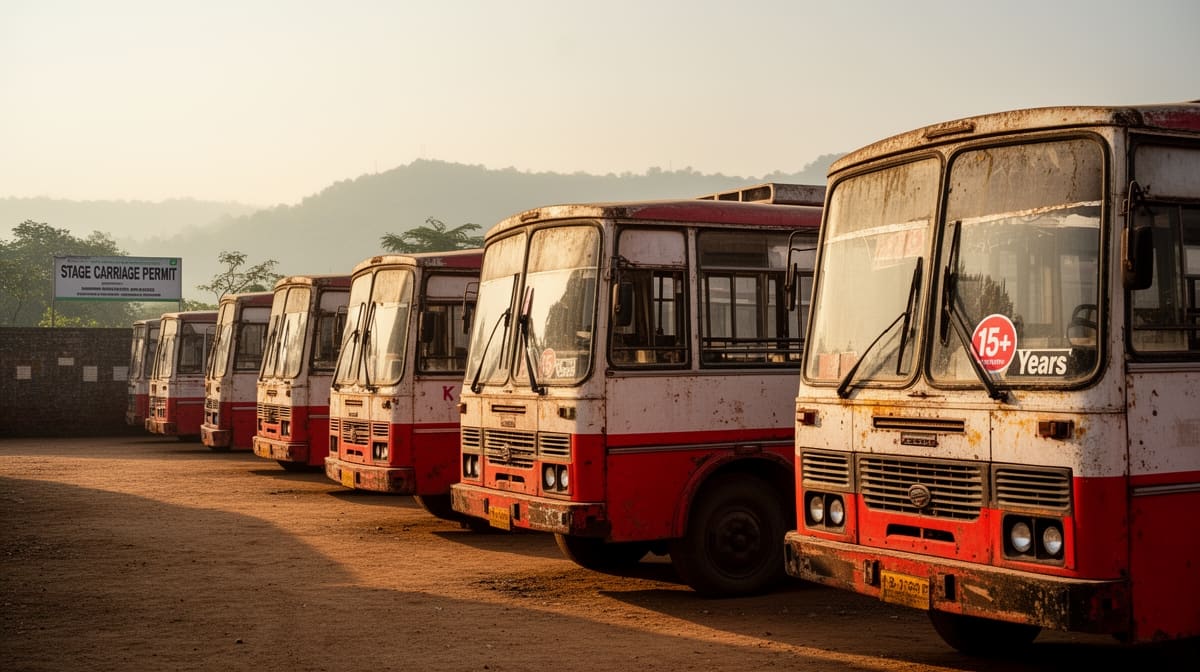
The Himachal Pradesh High Court upheld the constitutional validity of Rule 73-A(1)A(xi) of the Himachal Pradesh Motor Vehicles Rules, 1999, which restricts vehicles providing transportation facilities to schools and educational institutions to a maximum operational age of 15 years. The Division Bench dismissed 21 consolidated writ petitions filed by private schools and educational societies, holding that the State Government acted within its rule-making power under Section 96 of the Motor Vehicles Act, 1988, and that the age restriction constitutes a reasonable preventive safety measure triggered by a tragic 2018 school bus accident that claimed 27 lives including 23 children.
Background & Facts
The Genesis
The litigation originated from a catastrophic school bus accident on 09.04.2018 near Nurpur, District Kangra, Himachal Pradesh, in which a 42-seater school bus fell into a 700-foot gorge, killing 27 persons including 23 children under 12 years of age. The magnitude of young lives lost prompted the Division Bench of this Court to initiate suo motu proceedings on 10.04.2018 (CWP No. 73 of 2018), treating news reports as a Public Interest Litigation. The Court questioned the regulatory mechanism supervising private educational institutions' transportation of children.
In response, the State Government constituted a High Level Committee under the Chairmanship of the Chief Secretary on 10.04.2018 to examine and recommend measures for school transportation safety. Draft school transport safety guidelines were uploaded on the official website on 17.04.2018 inviting stakeholder comments. After deliberations on 05.05.2018, the Committee recommended incorporation of various safety measures including restriction on the life-span of a school vehicle up to 15 years. The matter was reconsidered at Government level and Rule 73-A was inserted in the Himachal Pradesh Motor Vehicles Rules, 1999 by Notification dated 12th October 2018, prescribing conditions for buses/vehicles owned or attached with schools/educational institutions, including Clause (xi): "Vehicles providing transportation facilities to schools will not be more than 15 years old."
Key Facts
- Petitioners: 21 educational institutions including Shivalik Institute of Nursing, Rising Field Public High School, Shiva Educational Society (three petitions), Vijay Memorial Senior Secondary School, Dharampal Soni Memorial Dp.A.V. Convent, Katiani Education Society, Swami Vivekanand Educational Society, Noorpur Public School, Shashank Shiksha Society, Sarav Hitkari Vidya Niketan, Swami Shri Rajeshwara Nand Bharti Nursing Training Institute, Shishu Model Public School, Adarsh Bhartiya Public School Society, Alpine Public School Education Society, Come Mensa Educational Society, Galaxy International Education & Research Foundation, Rose Public School, Dhan Gurudev Educational Trust, and Arean Public High School.
- All petitioners hold private service vehicle permits under Section 76 of the Motor Vehicles Act for vehicles used exclusively to pick up and drop students and staff, covering minimal daily distances.
- The impugned Clause (xi) of Rule 73-A(1)A prohibits use of vehicles for school transportation after 15 years from date of manufacture, irrespective of roadworthiness.
- Petitioners contended that vehicle life exceeds 20-25 years if maintained well, and that the rule ignores economic viability of institutions unable to replace vehicles.
- Some petitioners (nursing/pharmacy institutions) argued they are not "schools" and thus outside Clause (xi)'s ambit.
- Government Notification dated 07.02.2024 mandates all government vehicles completing 15 years or declared condemned, whichever earlier, to be sold via e-auction and scrapped.
Procedural History
- 12.10.2018: Notification inserting Rule 73-A in HP Motor Vehicles Rules, 1999
- 2025-2026: 21 writ petitions filed before High Court of Himachal Pradesh (CWP No. 11377/2025 lead case, with 20 connected matters)
- 27.10.2026: Matters reserved for judgment
- 31.10.2026: Judgment pronounced, all petitions dismissed
The Parties' Positions
Petitioners argued: (1) Section 59 MV Act vests exclusive power in Central Government to fix vehicle life; State cannot create parallel age disability; (2) 15-year limit is arbitrary, ignores vehicle condition and economic viability; (3) Nursing/pharmacy institutions are not "schools"; (4) Rule 73-A per se ultra vires as beyond State's legislative competence under Section 96.
Respondents (State) argued: (1) Section 96(1) read with Section 96(2)(xxxiii) confers broad rule-making power for Chapter-V (including Section 76 permits); (2) Rule 73-A prescribes permit conditions, not vehicle life under Section 59; (3) Age limit based on expert recommendations, stakeholder consultation, and Supreme Court Road Safety Committee directions; (4) Other States prescribe similar limits: Chhattisgarh (12 years), Uttar Pradesh (15 years), Haryana (15 years); (5) Chhattisgarh HC Full Bench in Ghanshyam Das Rungta Foundation v. Union of India upheld State's competence; (6) "School" in Rule 73-A read harmoniously includes all educational institutions.
Relief Sought
Petitioners sought: (I) Mandamus directing respondents not to apply Rule 73-A(1)A(xi); (II) Certiorari quashing Clause (xi); (III) Mandamus to produce records of government institute buses; (IV) Any other appropriate relief.
The Legal Issue
The central questions were: (1) Whether the State Government has legislative competence under Section 96 of the Motor Vehicles Act, 1988 to prescribe a maximum operational age of 15 years for vehicles providing transportation to schools/educational institutions via Rule 73-A(1)A(xi); (2) Whether Clause (xi) is arbitrary and violative of Article 14 for ignoring vehicle roadworthiness and institutional economic viability; (3) Whether the term "School" in Clause (xi) excludes nursing, pharmacy, and other higher educational institutions.
Arguments Presented
For the Petitioners
Mr. Nitin Thakur submitted that nursing/pharmacy institutions are not "schools" and Clause (xi) cannot be applied to them. He argued Section 59 MV Act vests exclusive power in the Central Government to fix vehicle life, rendering the State's rule ultra vires. Roadworthiness, not age, should be the benchmark, and Transport Department officers certify fitness.
Mr. Vijender Katoch emphasized that petitioners' buses cover minimal daily kilometers, a fact ignored by the State. He contended the financial burden of replacement would shift to students.
Mr. Shubham Singh Guleria and Mr. Vishal Thakur relied on Naresh Chandra Agrawal v. Institute of Chartered Accountants of India (2024) 13 SCC 241 to argue Rule 73-A exceeds State's rule-making power. They submitted Section 59 deals specifically with vehicle age consequences and vests power in the Centre; the State's residuary power under Section 96(2)(xxxiii) cannot create an independent age-based disability operating notwithstanding statutory fitness/permit regimes.
For the Respondents
Mr. Anup Rattan, Advocate General, submitted that Section 96 confers ample power to frame Rule 73-A. The 15-year limit was fixed considering Himachal's hilly terrain and student safety. The rule only prohibits school transport use post-15 years; vehicles may be used for other purposes. Business concerns cannot override paramount student safety. The High Level Committee's deliberations, stakeholder consultations (17.04.2018), and expert recommendations (05.05.2018) demonstrate due process, not knee-jerk reaction. He cited Chhattisgarh Rule 76-B(16) (12 years), UP Rule 222-D (15 years), and Haryana Rule 67A (15 years) as consistent state practices. The Chhattisgarh HC Full Bench in Ghanshyam Das Rungta Foundation held Section 96(2)(xxxiii) does not bar such conditions. Section 2(11) MV Act defines "educational institution bus" to include colleges, schools, and other institutions; Rule 73-A applies uniformly. Government Notification 07.02.2024 confirms government vehicles also scrapped at 15 years.
The Court's Analysis
The Court began by distinguishing Section 59 (Central Government's power to specify "life of a motor vehicle" after which it shall not comply with the Act) from Rule 73-A(1)A(xi) (State's prescription of operational period for school transport). The Court held: "Unlike Section 59, which specifies the life of a motor vehicle, this Clause of the Rule does not specify the life of the motor vehicle, but it only specifies as to for what period, obviously as from the date of its manufacture, a vehicle providing transportation facility to School can be used" (para 43). A vehicle exceeding 15 years may still be used for other purposes if within the Central Government's prescribed life under Section 59. Thus, the State has not usurped Central powers (para 46).
On Section 96, the Court emphasized that Chapter-V (Control of Transport Vehicles) includes Section 76 (private service vehicle permits). Section 96(1) empowers States to make rules for carrying into effect Chapter-V provisions. Section 96(2)(xxxiii) further authorizes rules on "any other matter which is to be or may be prescribed." The Court held: "The purpose of the rules is to supplement what is not there in the main statute... Section 96 of the Act confers upon the State Government the power to make rules for the purpose of carrying into effect the provisions of Section 76, which obviously also includes the power to frame rules as to for how many years old vehicle can be used for providing transportation facilities to School" (para 55).
Applying the ultra vires test from State of T.N. v. P. Krishnamurthy (2006) 4 SCC 517 and Naresh Chandra Agrawal (2024), the Court found: (1) Source of power flows from Section 96; (2) Rule 73-A prescribes permit conditions for educational institution buses; (3) Rule is consistent with and within delegated scope (paras 61-65).
On arbitrariness, the Court held the 15-year limit is a preventive safety measure: "Older vehicles, even if maintained, are more prone to structural fatigue, material degradation, outdated safety technology, and sudden mechanical failure risks, which cannot be detected through periodic fitness inspections" (para 71). Economic viability cannot outweigh student safety: "The life of the young generation is far more precious than the monetary considerations of the petitioners" (para 73). The Court noted Chhattisgarh's stricter 12-year limit, confirming 15 years is not excessive.
On "School" interpretation, the Court applied harmonious construction to Rule 73-A. The heading covers "School/Educational Institutions"; general conditions (Clauses i-x, xii-xx) apply to all categories including nursing/pharmacy institutions. Since petitioners accept compliance with other clauses, they cannot claim immunity from Clause (xi). "Any Institution... which is bound by the conditions... is also bound by Clause (xi)" (para 80).
The Verdict
All 21 writ petitions were dismissed. The Court upheld Rule 73-A(1)A(xi) as valid and within the State's legislative competence under Section 96 MV Act. The 15-year age restriction for vehicles providing transportation to schools/educational institutions was held not arbitrary, not in conflict with Section 59, and applicable to all educational institutions (including nursing, pharmacy, engineering, medical, and vocational institutes) bound by the general conditions of Rule 73-A(1)A. Interim orders were vacated forthwith. No order as to costs.
What This Means For Similar Cases
State Rule-Making Power Upheld for School Transport Safety
The judgment affirms that States possess broad rule-making authority under Section 96(1) read with Section 96(2)(xxxiii) MV Act to prescribe permit conditions for educational institution buses, including age caps. This power is distinct from the Central Government's Section 59 power to fix vehicle "life" for statutory compliance. Practitioners challenging similar state rules must demonstrate a direct conflict with Section 59, not merely a parallel age restriction.
"Educational Institution" Interpreted Expansively
The Court's harmonious construction of Rule 73-A establishes that "School" in school-transport regulations encompasses all educational institutions (colleges, nursing, pharmacy, engineering, medical, vocational) that operate or attach vehicles for student transport. Institutions cannot selectively comply with favorable conditions (painting, GPS, driver norms) while rejecting age limits. This principle extends to any regulatory scheme where a general condition framework applies uniformly.
Preventive Safety Measures Trump Economic Arguments
- Age-based restrictions are valid preventive regulations even if vehicles remain roadworthy; courts will not substitute judicial wisdom for expert safety assessments.
- Stakeholder consultation and expert committee reports (here: High Level Committee, 05.05.2018 recommendation) insulate rules from arbitrariness challenges.
- Inter-state uniformity (Chhattisgarh 12 years, UP/Haryana 15 years) supports reasonableness.
- Government's own compliance (Notification 07.02.2024 scrapping govt vehicles at 15 years) negates discrimination claims.
- Economic burden on institutions is irrelevant where student safety is at stake; "one fatal incident... can ruin and shatter lives forever" (para 73).