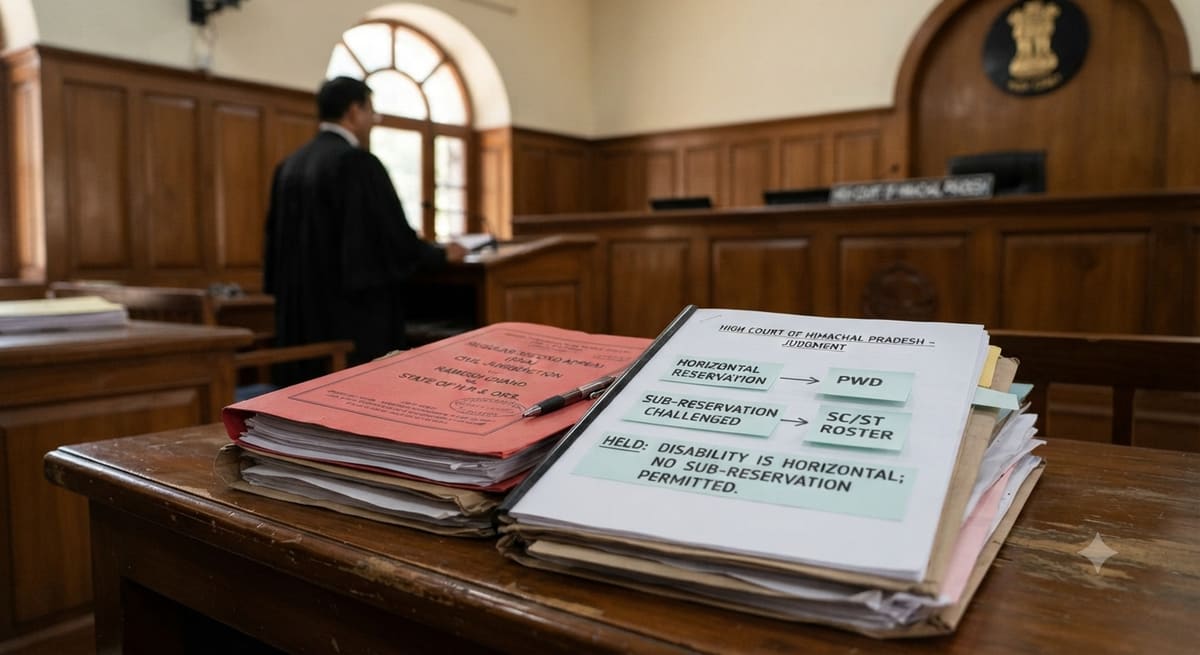
The Himachal Pradesh High Court set aside the appointment of a physically disabled teacher on the ground that the post, reserved for disabled persons, cannot be further sub-reserved for a particular caste, thereby affirming the principle of horizontal reservation under Article 16(4) of the Constitution.
Background & Facts
The Dispute
The petitioner, Hoshiyar Singh, a physically challenged individual with 46% hearing impairment, applied for the post of Physical Education Teacher (P.E.T.) (Craft & Vocational category) in District Kullu. The selection process, conducted in early 2008, resulted in the appointment of respondent No.5, who belonged to a different district and a different disability category. The petitioner contended that the appointment violated the reservation policy for disabled persons and the district-specific eligibility criteria.
Key Facts
1991: Petitioner completed matriculation.
2002: Obtained B.P.E. degree from Nagpur University.
16.01.2008: Interview letter issued to petitioner to appear on 27.01.2008.
27.01.2008: First interview held; only petitioner and Shri Thakur Dass attended.
23.02.2008: New interview notice directing petitioner to appear before Special Selection Committee on 28.02.2008.
28.02.2008: Second interview held with four candidates; respondent No.5 selected.
01.03.2008: Office order appointing respondent No.5 as P.E.T. (pay-scale Rs.5,000-8,100).
29.03.1993: Circular establishing 3% reservation for blind and 2% for other physically disabled persons.
01.01.2004: State order clarifying that posts were vacant under the handicapped quota.
04.02.2004: State’s presumption that “handicapped” referred only to SC/ST candidates.
2007: Supreme Court decision in Mahesh Gupta v. Yashwant Kumar Ahirwar (AIR 2007 SC 3136) holding “a disabled is a disabled”.
15.06.2026: Petition filed (CWPOA No.165 of 2019, reserved on this date).
29.07.2026: Judgment delivered.
Procedural History
15.06.2026: Petition filed before the High Court of Himachal Pradesh seeking quash of respondent No.5’s appointment and direction to appoint petitioner.
29.07.2026: Single Judge Jiya Lal Bhardwaj delivered the judgment.
Parties' Positions
Petitioner: Argues that the selection was illegal, arbitrary, and discriminatory; the post was meant for physically disabled persons from District Kullu and could not be sub-reserved for Scheduled Caste (SC) candidates.
Respondents (State officials and respondent No.5): Claim the appointment was genuine, based on a reservation roster for SC/PH (hearing impaired) and that the district-wide cadre permits selection irrespective of domicile.
Relief Sought
Quash the selection and appointment of respondent No.5 dated 01.03.2008.
Direct the State to issue an appointment letter to the petitioner as the second-ranked candidate, or alternatively, conduct fresh interviews.
The Legal Issue
Whether a reservation for physically disabled persons under Article 16(4) can be further sub-reserved for Scheduled Caste candidates, and whether the State may restrict appointment to candidates from a particular district when the vacancy is meant for the disabled category.
Arguments Presented
For the Petitioner
The appointment violates the Supreme Court’s pronouncement that “a disabled is a disabled” and that disability-based reservation is a horizontal reservation not subject to further caste-based sub-reservation.
The selection ignored the merit-based marks (petitioner scored 38.11 vs. 37.56 for the other hearing-impaired candidate) and the original non-caste-specific reservation.
District restriction contravenes the principle of equal opportunity under Article 14 and Article 16(1).
For the Respondent/State
The selection was made in accordance with a reservation roster that allocated a seat for SC/PH (hearing impaired) candidates.
The post falls under a district cadre, allowing the State to consider domicile as a legitimate criterion.
The appointment of respondent No.5 was genuine and based on the requisition from the Labour Commissioner-cum-Director, Employment and Training (Special Cell of Physically Handicapped).
The Court's Analysis
The Court began by reiterating the constitutional framework governing reservations. Article 16(4) permits vertical reservation for socially and educationally backward classes, while Clause (1) of Article 16 embodies horizontal reservation for categories such as disability. The Court emphasized that the Supreme Court in Mahesh Gupta v. Yashwant Kumar Ahirwar held that “a disabled is a disabled” and that further reservation on the basis of caste, creed or religion “ordinarily may not arise”.
"The action on the part of the respondents-State to reserve the post of P.E.T. to be filled up from physically challenged person of Scheduled Caste category is illegal, arbitrary, discriminatory and unconstitutional."
The Court examined the 1993 circular and the 2004 State order, finding that the intention was to create a horizontal reservation for all physically disabled persons, without any sub-classification. The later presumption that “handicapped” implied only SC/ST candidates was a misinterpretation, violating the rule of executive construction and the principle of reasonableness under Article 14.
Regarding the district restriction, the Court noted that the advertisement explicitly required candidates to produce a domicile certificate of Kullu District, but the subsequent selection of a candidate from Hamirpur breached this condition. The Court held that such a restriction, when the vacancy is meant for a disabled category, is “totally arbitrary and illegal”.
The Court also rejected the State’s reliance on the reservation roster, observing that at the time of the first interview (27.01.2008) the post was not reserved for SC candidates, and the petitioner’s higher marks demonstrated merit. The later reservation for SC/PH (hearing impaired) was introduced without any statutory basis and contravened the Supreme Court’s ratio.
Consequently, the Court concluded that the appointment of respondent No.5 must be set aside, and the petitioner, being the eligible physically disabled candidate, must be offered the post with all consequential benefits, except monetary benefits which are deemed notional.
The Verdict
The petition was allowed. The respondents-State is directed to appoint the petitioner to the post of P.E.T. effective from 01.03.2008 with all consequential benefits, except monetary benefits which are notional. If the appointment is not made within three months from the date of the judgment, the petitioner shall be deemed to have received the salary thereafter. No order as to costs was made.
What This Means For Similar Cases
Horizontal Reservation Cannot Be Sub-Reserved
Courts will treat disability-based reservation as a horizontal reservation; any attempt to further reserve such posts for SC/ST or other categories will be struck down as unconstitutional.
Practitioners must ensure that recruitment advertisements and selection criteria reflect the horizontal nature of disability reservation without caste-based qualifiers.
District-Specific Restrictions Are Unlawful When Not Stated
Unless the vacancy expressly mentions a district-wise limitation, imposing such a restriction violates Article 14 and Article 16(1).
Legal counsel should scrutinize the terms of the advertisement; any implicit district restriction not backed by statutory authority is vulnerable to challenge.
Judicial Scrutiny of Reservation Rosters
Authorities must maintain clear, contemporaneous records showing that reservation rosters are applied consistently with the original policy.
Any post-hoc alteration of reservation categories (e.g., converting a general disabled seat to an SC-disabled seat) will be deemed arbitrary and liable to be set aside.
Actionable Takeaways
Verify that recruitment notices for disabled categories do not contain caste-based sub-reservation language.
Ensure domicile requirements are expressly stated if intended; otherwise, they may be invalidated.
Counsel should cite Mahesh Gupta v. Yashwant Kumar Ahirwar and Indra Sawhney v. Union of India when defending the horizontal nature of disability reservation.