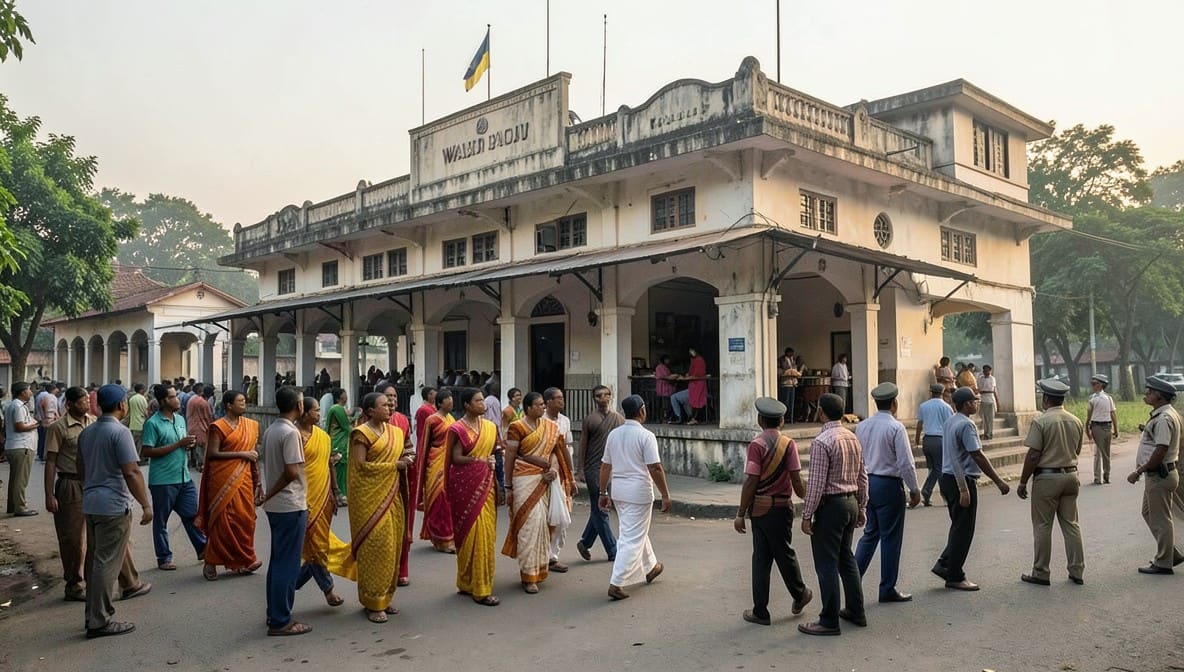
The Andhra Pradesh High Court has reaffirmed that police protection must be provided in accordance with orders issued by the Waqf Board, even amidst disputes over the title of Waqf properties. This judgment underscores the primacy of administrative decisions by statutory bodies like the Waqf Board in matters of religious processions, while clarifying that civil disputes over property title do not justify police interference with lawful permissions granted by such bodies.
Background & Facts
The Dispute
The petitioner, Shaik Jeelani alias Saida, is the notified hereditary Mutawalli of Lanka Peer Run Hussaini Panja, a Waqf institution in Vijayawada. The property was declared a Waqf under Gazette Notification No. 26 dated 28.06.1962. The petitioner sought permission from the Chief Executive Officer (CEO) of the Andhra Pradesh State Waqf Board to conduct the Muharram festival from 15.06.2026 to 30.06.2026, which was granted vide Proceedings No. F.No.89/NTR/Per/2023 dated 09.06.2026. The order explicitly directed the concerned Station House Officer (SHO) to provide police assistance to ensure the petitioner could conduct the festival without obstruction.
Despite this, Respondent Nos. 6 to 8 (hereinafter referred to as the "unofficial respondents"), who claim the property as private land acquired through registered documents, allegedly interfered with the petitioner’s activities with the help of local police. The petitioner contended that this interference violated the Waqf Board’s orders and the High Court’s earlier directions.
Key Facts
- 1962: The property was declared a Waqf under Gazette Notification No. 26 dated 28.06.1962.
- 09.06.2026: The CEO of the Waqf Board granted permission to the petitioner to conduct Muharram celebrations from 15.06.2026 to 30.06.2026, with a direction to the police to provide assistance.
- 15.06.2026 to 30.06.2026: The period during which the petitioner was authorized to conduct the Muharram festival.
- Unofficial respondents' claim: They assert the property is private land, acquired through registered documents, and deny its Waqf status. They further alleged that an enquiry was pending before the CEO to determine the property’s status.
- Civil litigation: The unofficial respondents had filed 8 suits to evict tenants from shops on the property, which were decreed, and execution petitions were filed. Tenants were allegedly evicted pursuant to these decrees.
Procedural History
The dispute has traversed multiple judicial forums:
- W.P. No. 13245 of 2026: Filed by the petitioner seeking recognition as Mutawalli and permission to conduct the Muharram festival. The High Court disposed of this petition on 18.06.2026, upholding the Waqf Board’s proceedings dated 09.06.2026.
- W.P. No. 15440 of 2026: Filed by the unofficial respondents challenging the Waqf Board’s proceedings. This was dismissed by a common order dated 18.06.2026.
- W.A. No. 752 of 2025: A Division Bench of the High Court had earlier permitted the petitioner to conduct Muharram celebrations from 25.06.2025 to 09.07.2025.
- W.P. No. 15742 of 2026: Filed by the unofficial respondent (Shaik Aktar Basha), wherein a Coordinate Bench of the High Court passed interim orders on 18.06.2026, directing the police not to interfere with the petitioner’s possession of the property without legal cause.
- Present Writ Petition (W.P. No. 16420 of 2026): Filed by the petitioner seeking a Writ of Mandamus to declare the actions of the unofficial respondents as illegal and to direct the police to provide protection for conducting the Muharram festival.
Positions Before This Court
For the Petitioner
- The petitioner relied on the Gazette Notification of 1962 and the Waqf Board’s proceedings dated 09.06.2026, which granted permission to conduct the Muharram festival.
- He contended that the unofficial respondents were interfering with his lawful activities despite the High Court’s orders in W.P. No. 13245 of 2026 and W.A. No. 752 of 2025.
- The petitioner argued that the police were failing to provide the protection mandated by the Waqf Board’s proceedings, thereby defeating the court’s orders.
- He further submitted that the Enquiry Officer had informed the parties that no enquiry could be conducted regarding the property’s title, rendering the unofficial respondents’ contentions untenable.
For the Respondents
- Waqf Board: Supported the petitioner’s claim, asserting that the property was notified as Waqf property in 1962 and that the CEO’s proceedings dated 09.06.2026 were issued after following due procedure. The Board contended that the police must provide protection as directed.
- State of Andhra Pradesh (Home Department): Submitted that the police were not interfering with the petitioner’s activities and were bound by the orders dated 18.06.2026 passed by the Coordinate Bench.
- Unofficial Respondents (Respondent Nos. 6 to 8): Vehemently opposed the petition