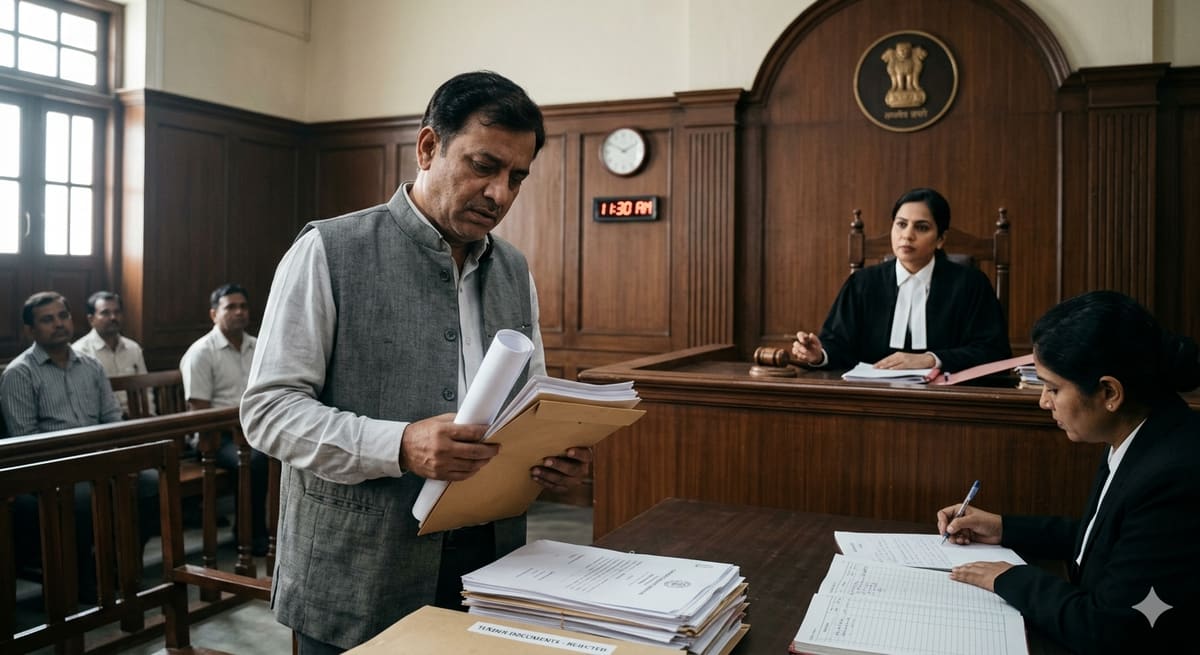
The Karnataka High Court has delivered a significant ruling affirming that public procurement authorities cannot impose arbitrary or inconsistent eligibility criteria in tender processes, particularly when such conditions disproportionately exclude qualified bidders without rational justification. This judgment reinforces the constitutional mandate of equal opportunity in state contracting.
Background & Facts
The Dispute
The Karnataka State Forest Development Corporation Limited (KFDC) invited e-tenders for the extraction, debarking, loading, and transportation of Eucalyptus, Casuarina, and Subabool timber across its Shivamogga, Bengaluru, and Chikkamagaluru divisions. The initial tender notification dated 07 - 08 November 2025 contained no experience requirements. Subsequently, KFDC issued corrigenda on 20 - 24 November 2025, introducing a mandatory three-year work experience criterion, restricted to experience gained with KFDC, the Forest Department, or Mysore Paper Mills Limited (MPM). This was followed by a cancellation of the original tender and issuance of fresh notifications on 26 December 2025, replacing the three-year requirement with a one-year experience condition - but inconsistently across divisions.
Procedural History
- 07 - 08 November 2025: Initial e-tender notification issued without experience criteria.
- 20 - 24 November 2025: Corrigenda introduced mandatory three-year experience with specified entities.
- 26 December 2025: Original tenders cancelled; new notifications issued with one-year experience requirement, but with inconsistent timeframes:
- Shivamogga: One year in the last five years
- Bengaluru: One year (no time frame specified)
- Chikkamagaluru: One year in the last five years
- Petitioners, including declared L1 bidders, challenged the cancellation and new eligibility criteria under Article 226.
Relief Sought
Petitioners sought quashing of the 26 December 2025 tender notifications and directions to KFDC to proceed with the original tender process, recognizing their bids as valid. Alternatively, they sought extension of time to submit bids under the original terms, without the restrictive experience clause.
The Legal Issue
The central question was whether the Karnataka State Forest Development Corporation’s imposition of inconsistent and arbitrarily defined work experience criteria in public tenders violates the principle of equal opportunity and non-arbitrariness under Article 14 of the Constitution.
Arguments Presented
For the Petitioner
Petitioners, represented by senior advocates, contended that:
- The experience requirement, particularly its restriction to experience with KFDC, Forest Department, or MPM, created an artificial barrier excluding qualified contractors with equivalent experience elsewhere.
- The inconsistency in the timeframes (one year with no specification in Bengaluru vs. one year in the last five years in other divisions) rendered the criteria arbitrary and violative of Article 14.
- The doctrine of level playing field, as affirmed in Vinishma Technologies Private Limited v. State of Chhattisgarh, mandates that tender conditions must not favor insiders or create de facto monopolies.
- The cancellation of the original tender lacked compliance with Section 14 of the Karnataka Transparency in Public Procurements Act, 1999, as the reasons cited (collusive bids, unscientific pricing) were speculative and not substantiated with conclusive evidence.
For the Respondent
The State, through the Advocate General, argued that:
- The cancellation of the original tender was justified under Section 14(1) of the KTPP Act due to collusive bidding patterns and unscientific pricing, particularly where family members bid for different units with suspiciously low rates.
- The Executive Director, as the Tender Accepting Authority, had the discretion to cancel tenders to protect public interest and prevent financial loss.
- The experience criterion was introduced to ensure contractors had proven capacity, given past delays in execution that exposed KFDC to contractual liabilities.
- The communication of cancellation and re-transfer of EMDs on the Karnataka Public Procurement Portal satisfied Section 14(2).
The Court's Analysis
The Court undertook a two-pronged analysis: first, on the validity of the tender cancellation; second, on the legality of the eligibility criteria.
Regarding cancellation, the Court accepted that the Executive Director, acting with the Managing Director’s approval, was the competent authority under the KTPP Act. The publication of cancellation on the public portal and re-transfer of EMDs satisfied procedural compliance under Section 14(2). The Court also found the reasons for cancellation - collusive bidding and unscientific pricing - were not frivolous or mala fide, citing Subodh Kumar Singh Rathour v. Kolkata Metropolitan Development Authority. Judicial review, the Court held, does not require it to second-guess administrative discretion unless arbitrariness or ulterior motive is evident. No such malice was proven.
However, the Court turned decisively to the eligibility criteria. It observed that while the State has broad discretion to set tender conditions, such conditions must be rational, non-discriminatory, and consistent. The impugned notifications contained glaring inconsistencies: Bengaluru required one year of experience with no temporal limit, while Shivamogga and Chikkamagaluru required one year within the last five years. This inconsistency, the Court held, was not merely technical - it was substantive and arbitrary.
"The infusing of an element of arbitrariness by inconsistent terms on the Work Experience Certificate cannot be countenanced. The Corporation cannot proceed further with the impugned Notifications."
The Court emphasized that such inconsistency undermines the level playing field doctrine. It is not sufficient for the State to claim expertise or hindsight; the conditions must be uniformly applied and rationally justified. The restriction to experience with KFDC, Forest Department, or MPM was not part of the final notifications and thus could not be grounds for quashing. But the internal inconsistency within the final notifications was fatal.
The Court declined to interfere with the cancellation of the original tender, but held that the new notifications could not stand due to their arbitrary structure.
The Verdict
The petitioners succeeded on the eligibility criteria issue. The Karnataka High Court quashed the 26 December 2025 tender notifications for Shivamogga, Bengaluru, and Chikkamagaluru divisions. The Court directed KFDC to re-issue fresh tender notifications with consistent, rational, and non-arbitrary eligibility criteria. The original bids were not reinstated, but the process must restart with legally sound terms.
What This Means For Similar Cases
Consistency in Tender Conditions Is Mandatory
- Practitioners must challenge tender conditions that vary inconsistently across similar procurements, even if each condition appears reasonable in isolation.
- Public authorities must ensure identical eligibility criteria are applied uniformly across all divisions or units under the same tender.
- Inconsistent timeframes (e.g., "one year" vs. "one year in the last five years") constitute arbitrariness under Article 14.
Experience Criteria Must Be Non-Discriminatory
- Requiring experience exclusively with the procuring agency or its affiliates may be struck down as creating a closed circle of preferred bidders.
- Experience criteria must be objectively verifiable and open to equivalent experience from other credible sources.
- Courts will not uphold conditions that functionally exclude qualified private contractors merely because they lack prior ties to the State.
Procedural Compliance Alone Is Insufficient
-
Even if cancellation complies with statutory procedures (e.g., publication, EMD refund), the substance of the new terms remains subject to judicial review.
-
Administrative discretion is not absolute; it must be exercised with rationality and fairness.
-
Petitioners should focus not only on procedural lapses but on the substantive arbitrariness of new eligibility conditions.
-
Always scrutinize tender documents for internal inconsistencies in timeframes, entities recognized, or experience thresholds.
-
File writ petitions early to prevent irreversible procedural steps (e.g., bid opening) under flawed conditions.
-
Cite Vinishma Technologies and Subodh Kumar Singh Rathour to anchor arguments on level playing field and reasonableness.