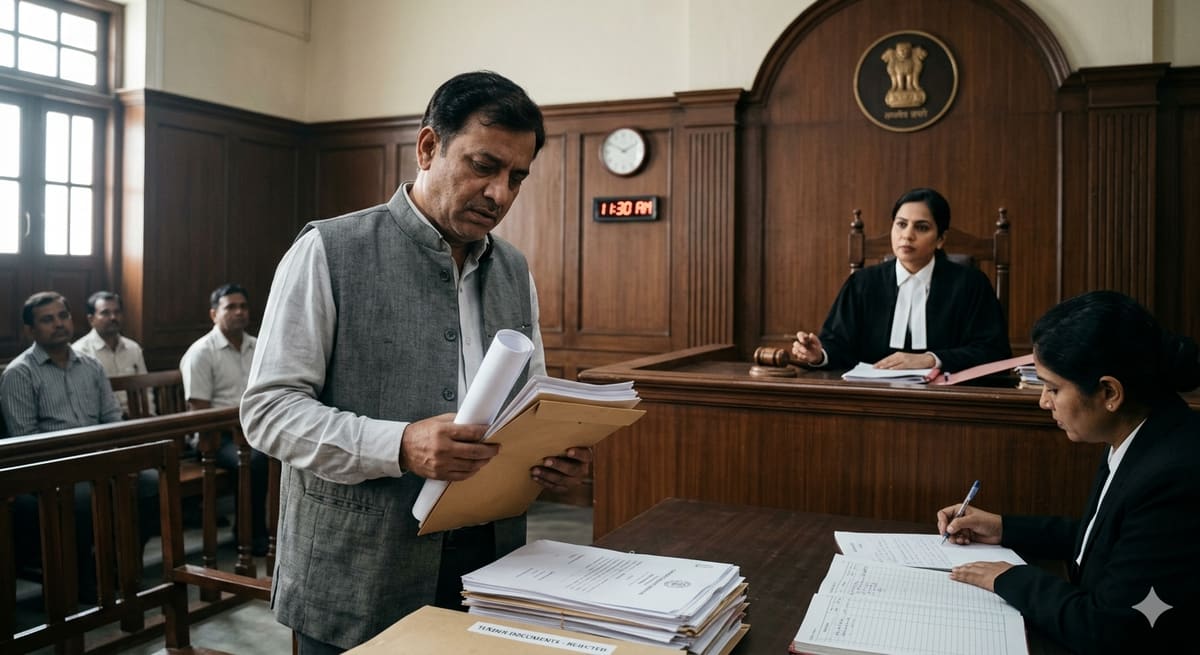
The Uttarakhand High Court has disposed of a writ petition challenging a tender condition that required bidders to possess a certificate of prior experience in collecting hill area entry or tourist fees, after the State voluntarily relaxed the requirement. The judgment underscores the principle that public procurement must not be structured to exclude genuine competition, even if the challenged clause is later modified.
Background & Facts
The Dispute
The petitioner challenged Clause 14 of the tender notice dated 08.04.2026 issued by the Nagar Palika Parishad, Nainital, for the collection of entry fees and tourist fees in hill areas. The clause mandated that any bidder must possess a certificate issued by a local body or any other government department of a hill state, confirming either: (i) a minimum of three years’ experience in collecting entry fee/tourist fee, or (ii) experience in executing related work worth a minimum of Rs. 2 crores in any one year.
Key Facts
- The tender was issued to engage entities for collection of entry fees and tourist fees in hill areas of Uttarakhand.
- Clause 14 required documentary proof of prior experience from a government or local body authority.
- The petitioner contended that the requirement was arbitrary and exclusionary, as the system of collecting entry fee, octroi duty, or toll tax has been abolished across Uttarakhand and neighboring hill states for years.
- Only two or three entities in the entire region - namely, Nagar Palika Mussoorie and Nagar Palika Nainital - had ever collected such fees, making compliance with Clause 14 practically impossible for all but a handful of bidders.
- The stated objective of the tender - to maximize revenue through competitive bidding - was undermined by a condition that effectively precluded competition.
Procedural History
- 08.04.2026: Tender notice issued by Nagar Palika Parishad, Nainital, containing Clause 14.
- 15.04.2026: Writ Petition (WPMB 276/2026) filed before the Uttarakhand High Court challenging Clause 14 as violative of Articles 14 and 19(1)(g) of the Constitution.
- 20.04.2026: Supplementary affidavit filed by Mr. Rohitash Sharma, Executive Officer, Nagar Palika Parishad, Nainital, clarifying the intent of Clause 14.
- 20.04.2026: Statement made by Mr. D.S. Patni, Senior Advocate for the Nagar Palika Parishad, before the Court, confirming relaxation of the certificate requirement.
The Parties' Positions
Petitioner: Argued that Clause 14 was manifestly arbitrary, discriminatory, and designed to favor a select few entities with historical access to such certificates. The condition had no rational nexus with the object of the tender and violated the principles of fair competition under public procurement law.
Respondent (State & Nagar Palika Parishad): Initially defended Clause 14 as ensuring technical competence. However, in the supplementary affidavit and oral submission, they conceded that the certificate requirement was overly restrictive and not practically enforceable.
Relief Sought
The petitioner sought quashing of Clause 14 of the tender notice, a direction to reissue the tender without the challenged condition, and costs.
The Legal Issue
The central question was whether a public authority may impose a tender eligibility condition that, by its very nature, limits participation to a handful of entities with historical access to a now-defunct administrative system, thereby defeating the purpose of competitive bidding under Article 14 of the Constitution.
Arguments Presented
For the Petitioner
The petitioner relied on M/s. M. R. S. Enterprises v. Union of India and Tata Cellular v. Union of India to argue that public procurement must be transparent, non-discriminatory, and open to all qualified bidders. The certificate requirement was not only obsolete but also created an artificial barrier with no rational connection to the tender’s objective. The condition violated the principle of equal opportunity and amounted to administrative arbitrariness.
For the Respondent
The State initially defended the clause as ensuring experience in hill area operations. However, in the supplementary affidavit and oral submission, the State conceded that the certificate requirement was impractical and unnecessary. The State clarified that the intent of Clause 14 was to assess financial capacity, and the experience requirement could be satisfied through other means.
The Court's Analysis
The Court observed that the tender’s objective was to maximize revenue through competitive bidding. The condition in Clause 14, as originally framed, directly contradicted this objective by restricting participation to only two or three entities. The Court noted that the collection of entry fees and tourist fees by local bodies in Uttarakhand had ceased long ago, rendering the certificate requirement an anachronism.
"The very purpose of inviting bids is to ensure competition, which in turn ensures optimal revenue and fairness. A condition that effectively limits the field to two or three bidders defeats this constitutional and commercial imperative."
The Court accepted the State’s concession that the certificate requirement would no longer be enforced. It held that the relaxation of the condition rendered the petitioner’s grievance infructuous. The Court emphasized that public authorities must not design eligibility criteria that are either obsolete or exclusionary, even if unintentionally.
The Verdict
The writ petition was disposed of in terms of the statement made by Mr. D.S. Patni. The condition requiring a certificate of experience in collecting entry or tourist fees is hereby dropped. Bidders shall now be eligible if they can demonstrate experience in executing related work worth a minimum of Rs. 2 crores in any one year, supported by audited financial records or other verifiable documentation. No bidder shall be rejected solely for lack of a certificate from a local body or hill state government department.
What This Means For Similar Cases
Certificate Requirements Must Reflect Current Reality
- Public authorities must ensure that eligibility criteria in tenders are aligned with current administrative practices, not historical relics.
- Requiring certificates for abolished systems (e.g., octroi, toll collection) will be struck down as arbitrary under Article 14.
- Practitioners should challenge such conditions at the pre-bid stage, as courts are likely to intervene where competition is artificially restricted.
Financial Experience Can Replace Obsolete Credentials
- Where technical experience is genuinely relevant, authorities may rely on verifiable financial performance (e.g., turnover, project value) rather than non-existent certifications.
- Audited accounts, project completion certificates, or bank guarantees may serve as valid alternatives to outdated government-issued documents.
- This judgment sets a precedent for replacing subjective or inaccessible proof with objective, document-based financial metrics.
Competitive Bidding Is a Constitutional Imperative
- The principle of competitive bidding is not merely procedural - it is a constitutional value under Article 14.
- Any tender condition that reduces competition to a handful of entities invites judicial scrutiny.
- Authorities must proactively review tender conditions to avoid exclusionary outcomes, even if no formal complaint is filed.