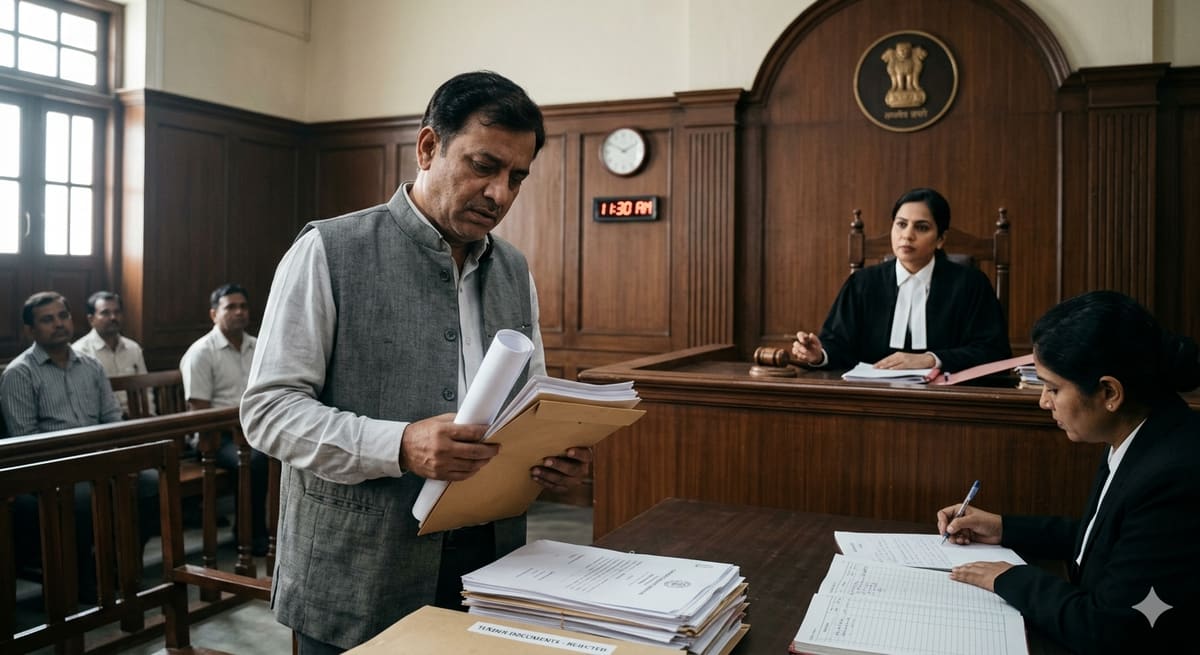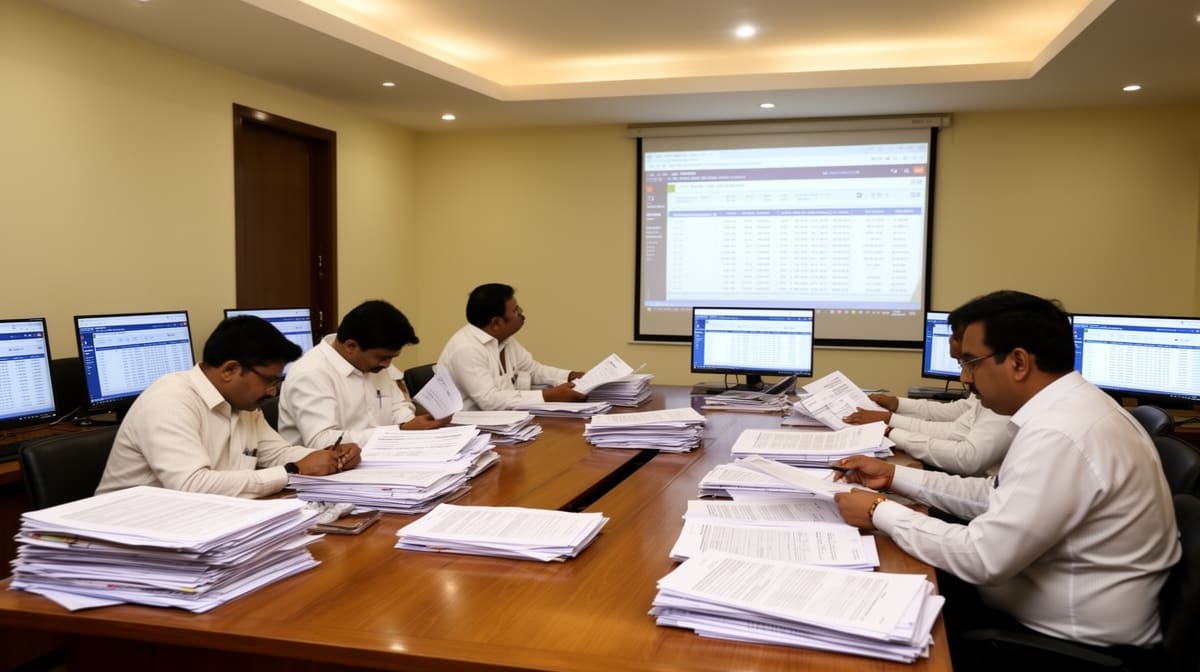
The Chhattisgarh High Court has reaffirmed that public authorities may disqualify bidders for failure to provide verifiable documentary evidence of compliance, even if the defect appears minor. This judgment underscores the limits of judicial intervention in tender processes and reinforces that procedural rigor, not subjective fairness, governs evaluation.
Background & Facts
The Dispute
The petitioner, Amar Karam Logistics LLP, participated in a tender issued by the Chhattisgarh State Civil Supplies Corporation for handling services related to food grains, sugar, and other commodities during the Kharif marketing years 2025 - 26 and 2026 - 27. The petitioner submitted bids for five locations: Kurud, Dhamtari, Akaltara, Basantpur, and Raigarh. While it was declared technically qualified for Akaltara, Basantpur, and Raigarh, it was disqualified for Kurud and Dhamtari on three grounds: (i) absence of signature on the photograph on page 19 of the tender form, (ii) absence of a receipt for the tender amount, and (iii) failure to upload a copy of the corrigendum.
Procedural History
- 07.10.2025: Notice Inviting Tender (NIT) issued by Respondent No. 2.
- 05.11.2025: Petitioner made RTGS payments of Rs. 1,00,000 each for Kurud and Dhamtari, with UTR numbers provided in documents.
- 04.12.2025: Technical bids opened; petitioner qualified for three locations but disqualified for two.
- 05.12.2025: Petitioner submitted clarifications and supporting bank statements via the online portal.
- No response received: No decision communicated by the Evaluation Committee.
- 19.02.2026: Writ petition filed under Article 226 before the Chhattisgarh High Court.
Relief Sought
The petitioner sought a writ directing the authorities to declare it qualified, award the tender for Kurud and Dhamtari, and direct adherence to statutory norms. It alleged arbitrariness, violation of Article 14, and denial of equal opportunity.
The Legal Issue
The central question was whether the disqualification of a bidder for failure to provide verifiable proof of Earnest Money Deposit (EMD) payment - despite asserting payment via RTGS - constitutes arbitrariness under Article 14, or whether such disqualification is lawful when tender conditions require objective documentation.
Arguments Presented
For the Petitioner
The petitioner argued that the disqualification was hyper-technical and discriminatory. It contended that the photograph bore the organization’s seal, authorized signature, and notarial verification, making a separate signature redundant. Regarding EMD, it submitted bank statements with UTR numbers, asserting that online transactions do not generate separate receipts. It relied on Banshidhar Construction Pvt. Ltd. v. Bharat Coking Coal Ltd. and Jagdish Mandal v. State of Orissa to argue that rejection based on trivial irregularities violates Article 14.
For the Respondent/State
The State countered that the tender conditions explicitly required complete transaction details - including UTR number, date, time, beneficiary account, and confirmation of credit - to verify EMD. The petitioner’s submission only referenced a cheque number, which created ambiguity about the mode and completion of payment. Other bidders had furnished complete documentation, enabling verification. The Evaluation Committee applied the same criteria uniformly across all bids, ensuring transparency. The State relied on Tata Cellular v. Union of India and Mihan India Ltd. v. GMR Airports Ltd. to assert that courts must not substitute their judgment for that of expert evaluation committees.
The Court's Analysis
The Court examined the tender conditions and the petitioner’s submissions in light of established principles of judicial review in government contracts. It emphasized that while courts do not sit as appellate bodies in tender matters, they may intervene only if the process is tainted by mala fide, arbitrariness, or violation of constitutional norms.
"The responsibility to provide complete transaction details rested with the bidder. The Petitioner’s claim that payment was made via RTGS is not substantiated by adequate documentary evidence, as required under the NIT, to enable verification by the Evaluation Committee. Mere assertion of payment or reference to a cheque number is insufficient to establish compliance."
The Court noted that the petitioner was accepted for three locations using the same set of documents, indicating that the evaluation was not inconsistent. The disqualification for Kurud and Dhamtari was based on a specific, objective criterion - lack of verifiable EMD proof - which was uniformly applied. The Court distinguished between procedural compliance and subjective fairness, holding that the latter cannot override the former in competitive bidding.
It further held that the alleged defects - such as the photograph signature and corrigendum - were ancillary and did not affect the substantive eligibility. Even if these were considered, they did not rise to the level of arbitrariness warranting judicial interference. The Court cited Jagdish Mandal to affirm that a decision is not arbitrary merely because it is unfavorable to a bidder, provided it is rational and grounded in the tender terms.
The Verdict
The petitioner’s writ petition was dismissed. The Court held that disqualification for failure to provide verifiable EMD documentation is lawful if applied uniformly, and courts cannot substitute their assessment for that of the tender evaluation committee absent mala fide or arbitrariness. No violation of Articles 14, 19(1)(g), 21, or 300A was established.
What This Means For Similar Cases
Documentary Evidence Must Be Complete and Verifiable
- Practitioners must ensure all EMD submissions include UTR numbers, exact dates, beneficiary account details, and confirmation of credit to the government account.
- Relying on bank statements alone without clear transaction identifiers is insufficient under tender conditions.
- Online payment screenshots must be annotated to show all required details; generic printouts will not suffice.
Judicial Review Is Limited to Process, Not Outcome
- Courts will not re-evaluate the technical merits of a bidder’s submission.
- Challenges based on "minor" technicalities - such as signature placement or missing corrigendum - will fail unless they demonstrate discriminatory application.
- Bidders must exhaust internal remedies before approaching courts; delay in seeking relief weakens the case.
Uniform Application of Criteria Is Key to Legality
- Authorities must apply the same standards to all bidders; inconsistency invites judicial intervention.
- If a term is deemed essential, deviations must be communicated to all bidders prospectively.
- Documentation requirements must be interpreted strictly; ambiguity in submissions is construed against the bidder.