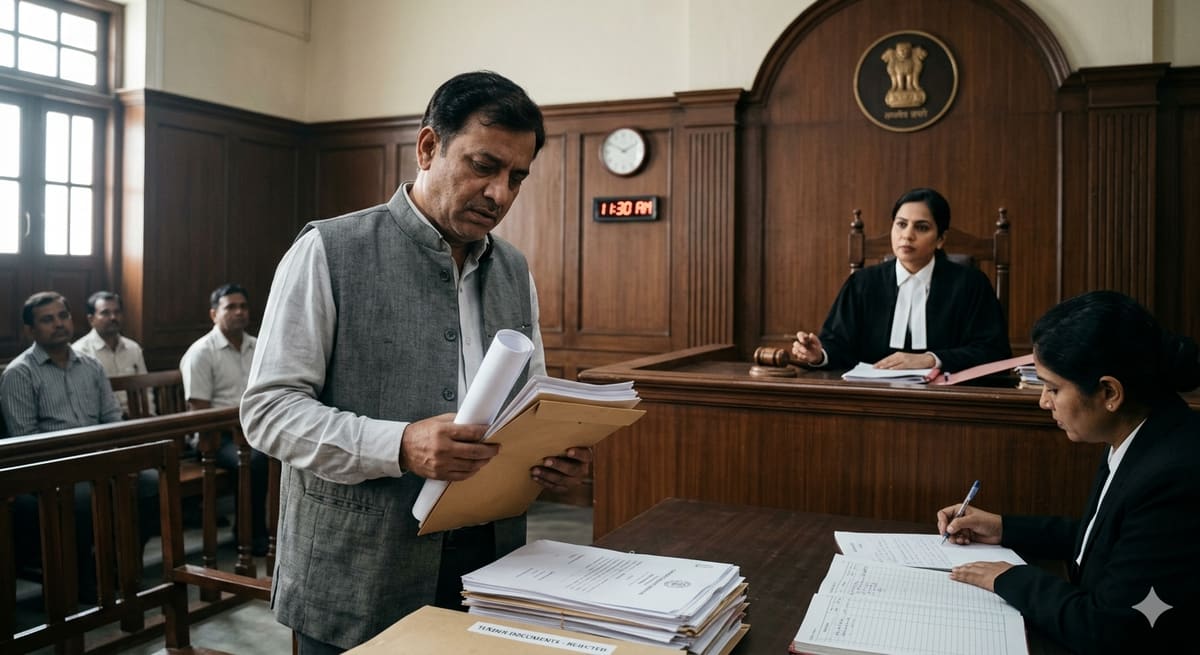
The Karnataka High Court recently addressed a challenge to tender conditions imposed by the Department of Horticulture for fee collection at Lalbagh Gardens. While the court found the requirement for experience certificates in both entry and parking fee collection to be arbitrary, it upheld the three-year experience stipulation as a valid policy decision. The judgment underscores the limited scope of judicial review in tender matters, while reinforcing the principle that unreasonable conditions violating Article 14 of the Constitution will not be permitted.
Background & Facts
The Dispute
The petitioner, Smartlens Parking Solutions Pvt Ltd, a company engaged in parking management services, challenged Tender No: KSHD/2026-27/SE0578 issued by the Deputy Director of Horticulture (Lalbagh Gardens) for the collection of entry and parking fees at Lalbagh Gardens, Bengaluru. The tender, dated 02.06.2026, included a clause requiring bidders to submit Satisfactory Performance Experience Certificates for three years in the past six years, specifically in the field of both entry fee and parking fee collection in government or government undertaking sectors.
Key Facts
- The tender was issued on 02.06.2026 for fee collection at Lalbagh Gardens
- Clause 6 of Section 3A of the Technical Proposal Submission Form required:
“6. Satisfactory Performance Experience Certificates in the field of Entry fee and Parking fee collection of any 3 Years in past 6 Years (i.e from the year 2020-21 to 2025-26 in Government/Government Undertaking Sectors.”
- The petitioner contended that:
- Most government departments issue experience certificates for parking fee collection only, not both entry and parking fee collection
- Lalbagh Gardens operates a composite fee system, distinct from other parking contracts
- The requirement of three years’ experience was onerous, as most government contracts are for two years
- The clause was introduced to favour select tenderers and was violative of Article 14 of the Constitution
Procedural History
- 02.06.2026: Tender issued by Respondent No. 2
- Pre-bid meeting: Grievances raised by prospective bidders
- 24.06.2026: Minutes of Meeting recorded, proposing amendment to Clause 6
- Filing of Writ Petition: The petitioner approached the High Court under Article 226 seeking:
- Quashing of the tender (Annexure-C)
- Alternatively, modification of Clause 6 to require experience in either entry fee or parking fee collection
- Other reliefs as deemed fit
Relief Sought
The petitioner prayed for:
- A writ of certiorari to quash the tender dated 02.06.2026
- Alternatively, a writ of mandamus to revise Clause 6 to require experience in either entry fee or parking fee collection
- Any other relief the court deemed appropriate
The Legal Issue
The central questions before the court were:
- Whether Clause 6 of Section 3A of the tender, requiring experience certificates in both entry fee and parking fee collection, was arbitrary and violative of Article 14 of the Constitution?
- Whether the stipulation of three years’ experience in the past six years was unreasonable or onerous, warranting judicial interference?
Arguments Presented
For the Petitioner
- Arbitrariness of Clause 6: The petitioner argued that the requirement for experience in both entry fee and parking fee collection was arbitrary, as most government departments issue certificates for parking fee collection only. Lalbagh Gardens’ composite fee system was distinct and not comparable to other parking contracts.
- Unreasonable Experience Requirement: The stipulation of three years’ experience was onerous, as most government contracts are for two years. The petitioner contended that this requirement was introduced to favour select tenderers and was violative of Article 14.
- Lack of Justification: No rationale was provided for the sudden introduction of this condition, which was absent in earlier tenders.
For the Respondents
- Policy Matter: The respondents, represented by the Additional Government Advocate (AGA), argued that the experience requirement was a policy decision aimed at assessing the capability and competence of bidders. Such decisions fall within the realm of tender conditions and should not be interfered with unless manifestly arbitrary or mala fide.
- Amendment Proposed: The AGA submitted that the grievances raised during the pre-bid meeting were considered, and it was resolved to amend Clause 6 to substitute “Entry Fee and Parking Fee” with “Entry Fee or Parking Fee”.
- Interpretation of Clause: The respondents contended that the clause did not require a single certificate for three years but allowed cumulative certificates to meet the requirement.
The Court's Analysis
The court examined the petitioner’s contentions in light of settled legal principles governing judicial review of tender conditions and the scope of Article 14 of the Constitution.
Arbitrariness of Clause 6
The court observed that the requirement for experience certificates in both entry fee and parking fee collection was arbitrary, as it placed an unreasonable burden on bidders. Most government departments issue certificates for parking fee collection only, and the composite fee system at Lalbagh Gardens was not comparable to other contracts. The court noted that the proposed amendment to substitute “and” with “or” would substantially address the petitioner’s grievance, as it would allow bidders to submit certificates for either entry fee or parking fee collection.
“The proposed amendment substantially addresses the grievance of the petitioner, inasmuch as the petitioner would now be entitled to submit certificates evidencing experience either in collection of Entry Fee or Parking Fee, which would be taken into consideration for the purpose of technical evaluation.”
Reasonableness of Three Years’ Experience Requirement
The court, however, rejected the petitioner’s contention that the three years’ experience requirement was unreasonable or onerous. It held that:
- Policy Decision: The stipulation of three years’ experience was a policy decision taken by the respondents to assess the capability and competence of bidders. Such decisions fall within the realm of tender conditions and are not ordinarily subject to judicial interference.
- Judicial Restraint: The court emphasized that it would not interfere with tender conditions unless they were manifestly arbitrary, irrational, or actuated by mala fides. No such material was placed on record in this case.
- Interpretation of Clause: The court clarified that the clause did not require a single certificate for three years. Instead, bidders could submit one or more certificates that, cumulatively, established the requisite experience of three years.
“Merely because the present tender is for a period of two years would not preclude the respondents from prescribing a higher threshold of experience for assessing the capability and competence of prospective bidders. The respondents, in their wisdom, have taken a policy decision requiring a minimum of three years' experience. Such prescription, being a matter falling within the realm of policy and tender conditions, cannot ordinarily be interfered with in exercise of writ jurisdiction unless it is shown to be manifestly arbitrary, irrational or actuated by mala fides.”
The Verdict
The court disposed of the writ petition with the following directions:
- Amendment of Clause 6: The respondents were directed to amend Clause 6 of Section 3A of the Technical Proposal Submission Form to substitute “Entry Fee and Parking Fee” with “Entry Fee or Parking Fee”, as proposed in the Minutes of the Meeting dated 24.06.2026.
- Upholding Three Years’ Experience Requirement: The court found no merit in the petitioner’s contention that the three years’ experience requirement was unreasonable or onerous. The stipulation was upheld as a valid policy decision.
- No Further Interference: The court declined to interfere with the tender conditions beyond the amendment of Clause 6, as no manifest arbitrariness or mala fides was established.
What This Means For Similar Cases
Judicial Review of Tender Conditions Is Limited
- Policy Decisions Are Respected: Courts will not ordinarily interfere with tender conditions unless they are manifestly arbitrary, irrational, or mala fide. Practitioners must establish clear evidence of arbitrariness to challenge such conditions.
- Burden of Proof: The burden lies on the petitioner to prove that a tender condition is unreasonable or discriminatory. Mere inconvenience or difficulty in compliance is insufficient.
Experience Requirements Must Be Reasonable
- Composite Requirements: Tender conditions requiring experience in multiple distinct fields (e.g., both entry and parking fee collection) may be struck down as arbitrary if they impose an unreasonable burden on bidders.
- Flexibility in Compliance: Courts may permit alternative compliance mechanisms, such as allowing experience in either of two fields, to address grievances.
- Cumulative Experience: Conditions requiring three years’ experience may be satisfied through multiple certificates cumulatively establishing the requisite period, rather than a single certificate.
Pre-Bid Meetings Can Resolve Disputes
- Amendments Based on Feedback: Government departments should consider feedback from prospective bidders during pre-bid meetings and amend tender conditions to address legitimate grievances.
- Judicial Notice of Amendments: Courts may take judicial notice of proposed amendments and dispose of petitions based on undertakings by the respondents to modify tender conditions.
Practitioners challenging tender conditions must focus on establishing arbitrariness or mala fides and should explore alternative compliance mechanisms to address grievances without resorting to litigation.