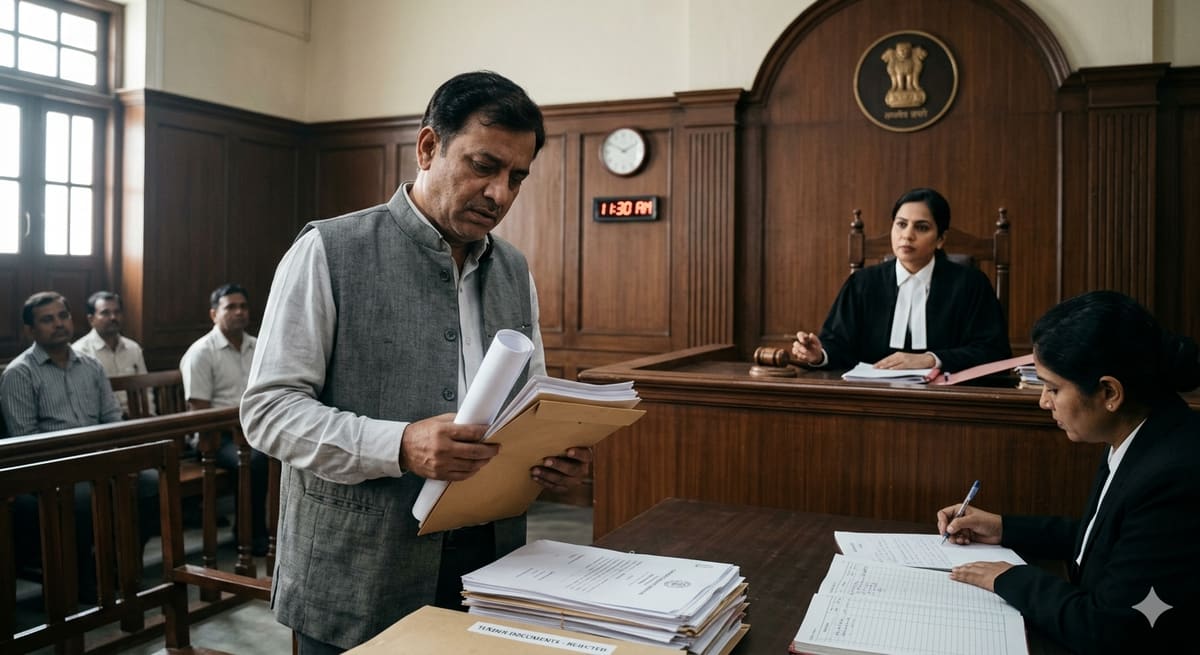
The Karnataka High Court has affirmed that excluding proprietorship firms from public tenders without a reasoned justification violates the foundational principles of open competition and transparency in public procurement. This ruling provides critical clarity for small businesses seeking equitable access to government contracts.
Background & Facts
The Dispute
The appellant, Ram Computers, a proprietorship firm owned by Shri Annasaheb Bhangare, participated in the public procurement process for manpower services including pharmacists, lab technicians, and staff nurses. The third respondent, the District Health and Family Welfare Officer, Belagavi, issued a Tender Notification dated 09.03.2026 restricting eligibility exclusively to Societies or Co-operative Societies. This marked a material change from the earlier Tender Notification dated 12.09.2025, which had permitted proprietorship firms to bid.
Key Facts
- The appellant had successfully bid under the earlier tender dated 12.09.2025, which allowed proprietorship firms.
- The new tender dated 09.03.2026 imposed a new eligibility criterion: only Societies or Co-operative Societies could participate.
- No reason was provided by the respondents for abandoning or cancelling the earlier tender process.
- The appellant filed a writ petition on 18.03.2026 seeking interim relief to submit its bid under the new tender, arguing that the change was arbitrary and violated Section 14 of the Karnataka Transparency in Public Procurements Act, 1999.
- The writ petition was pending before the Single Judge, who issued notice to respondents but declined interim relief.
- The deadline for bid submission under the impugned tender was 04:00 p.m. on 24.03.2026.
Procedural History
- 12.09.2025: First Tender Notification issued, permitting proprietorship firms to bid.
- 09.03.2026: Second Tender Notification issued, restricting participation to Societies/Co-operative Societies only.
- 18.03.2026: Writ Petition No. 102525/2026 filed before the High Court seeking interim relief and mandamus.
- 18.03.2026: Single Judge issued notice to respondents but refused interim order.
- 24.03.2026: Writ Appeal No. 100154/2026 filed under Section 4 of the Karnataka High Court Act, 1961, seeking urgent interim relief.
The Parties' Positions
Appellant (Ram Computers): Argued that the change in eligibility criteria was arbitrary, lacked transparency, and violated Section 14 of the Karnataka Transparency in Public Procurements Act, 1999, which mandates communication of reasons for cancellation or abandonment of a tender. The appellant was otherwise fully qualified and had previously participated lawfully under the earlier tender.
Respondents (State of Karnataka, District Health Department, District Health Officer): Did not file any written submission prior to hearing. The Additional Government Advocate conceded that the matter required judicial scrutiny but argued that the final decision on eligibility rested with the procuring authority.
Relief Sought
The appellant sought an interim order permitting it to submit its bid under the impugned tender dated 09.03.2026, without being disqualified on the ground of not being a Society or Co-operative Society, and to have its bid evaluated on merit.
The Legal Issue
Can a public authority unilaterally restrict tender participation to specific legal entities (e.g., Societies or Co-operative Societies) without providing a reasoned justification for abandoning the previous eligibility criteria, and without complying with the statutory requirement under Section 14 of the Karnataka Transparency in Public Procurements Act, 1999?
Arguments Presented
For the Appellant
The appellant relied on Section 14 of the Karnataka Transparency in Public Procurements Act, 1999, which requires that any cancellation or abandonment of a tender process must be accompanied by a reasoned communication. The appellant argued that the shift from permitting proprietorship firms to restricting participation to only Societies/Co-operative Societies constituted a de facto abandonment of the earlier tender without any explanation. The appellant further contended that such a restriction violated the principle of a level playing field and open competition, which are integral to public procurement under Article 14 of the Constitution. The appellant was otherwise fully compliant with technical, financial, and professional requirements.
For the Respondent
The Additional Government Advocate did not dispute the factual premise that no reason was communicated for the change in eligibility. However, he submitted that the procuring authority retained discretion to modify tender conditions for administrative convenience, and that the writ court would ultimately decide the legality of the change on merits. He did not oppose the grant of interim relief to preserve the status quo pending final adjudication.
The Court's Analysis
The Court observed that the change in eligibility criteria from permitting proprietorship firms to restricting participation to only Societies or Co-operative Societies was a substantial modification that effectively nullified the earlier tender framework. The absence of any reason communicated under Section 14 of the Karnataka Transparency in Public Procurements Act, 1999 rendered the change procedurally defective.
"The restriction imposed by the impugned tender notification, without any justification, operates as a barrier to competition and undermines the very purpose of transparency in public procurement."
The Court emphasized that public procurement must be conducted in a manner that ensures equal opportunity and non-discrimination. Excluding a class of eligible bidders - particularly small businesses like proprietorship firms - without a rational nexus to the object of the tender is arbitrary and violative of Article 14. The Court noted that the appellant had previously participated under the earlier tender and was otherwise fully qualified. The Court further held that allowing the tender to proceed without considering the appellant’s bid would render its legal challenge infructuous.
The Court balanced the interests of the appellant, the procuring authority, and the public interest. It recognized that if the appellant were barred from bidding and the contract awarded to another entity, the matter would become academic. Hence, an interim measure was necessary to preserve the status quo.
The Verdict
The writ appeal was allowed. The appellant is permitted to submit its bid under the impugned tender dated 09.03.2026 by 04:00 p.m. on 24.03.2026, online or physically if technical difficulties arise. The respondents are directed to receive and evaluate the appellant’s bid without disqualifying it on the ground of not being a Society or Co-operative Society. The evaluation shall be subject to the final decision of the writ court on the legality of the eligibility criteria. The appellant’s bid shall be considered on merit alongside other bids.
What This Means For Similar Cases
Reasoned Justification Is Mandatory for Tender Modifications
- Public authorities must provide written, substantive reasons for any material change in tender eligibility criteria, especially when excluding a class of bidders previously permitted.
- Failure to comply with Section 14 of the Karnataka Transparency in Public Procurements Act, 1999 renders such changes legally vulnerable.
- Courts will intervene where changes appear arbitrary or discriminatory, even if made before bid submission.
Proprietorship Firms Are Legally Competent Bidders Unless Excluded by Reasoned Policy
- Proprietorship firms are not inherently ineligible for public tenders.
- Any exclusion must be based on objective, documented criteria related to the nature of the service (e.g., scale, liability, continuity), not arbitrary categorization.
- Practitioners should challenge tender conditions that impose non-essential legal entity restrictions without justification.
Interim Relief Is Available to Prevent Irreversible Harm
- Where a tender deadline is imminent and exclusion would render a legal challenge infructuous, courts may grant interim relief permitting bid submission.
- This creates a precedent for urgent applications in time-sensitive procurement disputes.
- Practitioners should file interim applications with affidavits establishing: (a) prior eligibility, (b) absence of reason for change, and (c) imminent deadline.