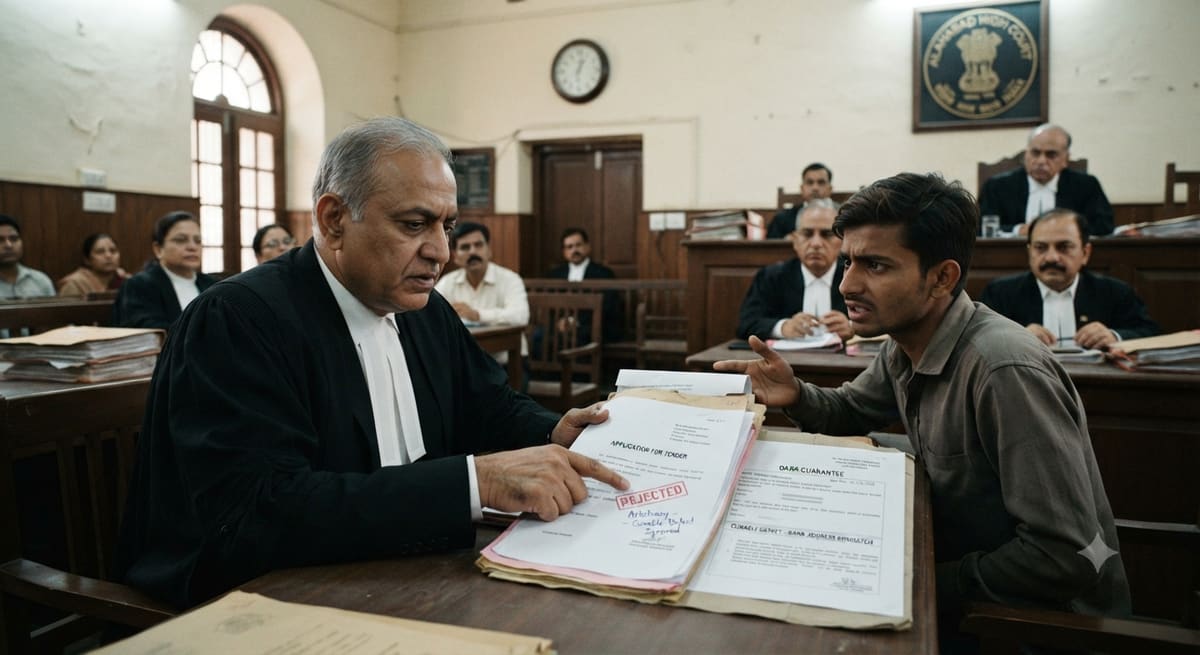
The Chhattisgarh High Court has affirmed that rejecting the lowest bidder in a public tender without objective, documented reasoning constitutes arbitrariness and violates the constitutional guarantee of equality under Article 14. This judgment reinforces the principle that discretion in public procurement must be exercised transparently and with rational justification, not mechanical or capricious decision-making.
Background & Facts
The Dispute
The petitioner, M/s. Vineet Singh Construction Company Pvt. Ltd., a duly registered A-5 Class Contractor under the State Government, participated in a public tender for the construction of the Gondaiya Anicut in Bilha Block, District Bilaspur. The tender was issued by the Water Resources Department via NIT dated 17.09.2025. The petitioner submitted all required documents and earnest money deposit within the stipulated time.
Key Facts
The petitioner was declared the lowest bidder (L-1) in the first call of the tender, quoting 18% above the Schedule of Rates
Other bidders quoted rates significantly higher, up to 29.07% above the estimated cost
The petitioner’s bid was technically qualified and recommended for approval by the Executive Engineer, Superintending Engineer, and Engineer-in-Chief
The Tender Evaluation Committee rejected the petitioner’s bid on 27.03.2026 without assigning any specific reasons
The tender was recalled and a second call (System Tender No. 183190) was issued on 06.01.2026
In the second call, the petitioner again submitted the lowest bid (18% above), and again received unanimous technical recommendations
The Tender Evaluation Committee again rejected the bid without justification
The petitioner submitted a representation under Clause 10 of the tender conditions seeking rate negotiation, which remained unconsidered
The petitioner alleged that in other similar works, tenders with rates exceeding 18% had been accepted by the same authorities
Procedural History
17.09.2025: First NIT issued for construction of Gondaiya Anicut
[Date unspecified]: First bid opening; petitioner declared L-1
27.03.2026: Tender Evaluation Committee rejects petitioner’s bid without reasons (Annexure P/1)
06.01.2026: Second NIT issued for same work (System Tender No. 183190)
[Date unspecified]: Second bid opening; petitioner again declared L-1
27.03.2026: Second rejection of petitioner’s bid by same Committee
28.03.2026: Writ Petition (WPC No. 2064 of 2026) filed before the High Court
30.04.2026: Hearing and judgment delivered
Relief Sought
The petitioner sought:
Quashing of the order dated 27.03.2026 rejecting its bid
Direction to the respondents to award the contract to the petitioner
Any other relief deemed fit by the Court
The Legal Issue
The central question was whether the rejection of a technically qualified, lowest bidder (L-1) in a public tender, without assigning objective reasons or considering comparative market data, constitutes arbitrariness and violates Article 14 of the Constitution.
Arguments Presented
For the Petitioner
The petitioner’s counsel argued that the repeated rejection of its bid, despite being L-1 in both rounds and receiving unanimous technical recommendations, was arbitrary and discriminatory. It was contended that no material or data was produced to substantiate the claim that the 18% markup was excessive. The failure to consider the representation under Clause 10 and the acceptance of higher bids in similar projects further demonstrated inconsistent and unfair treatment. Reliance was placed on M/s. M. R. Builders v. State of Karnataka and Union of India v. M/s. R. S. Dhami & Co. to establish that discretion must be exercised reasonably and transparently.
For the Respondent/State
The State counsel contended that the Tender Evaluation Committee acted within its discretion and after due application of mind. It was submitted that the Committee was not bound by the recommendations of technical authorities and had the authority to reject bids in the financial interest of the State. The 18% markup was allegedly inconsistent with prevailing market trends, and re-tendering was justified to ensure competitive pricing. No specific data was produced to substantiate this claim.
The Court's Analysis
The Court acknowledged the well-established principle that the State is not obligated to accept the lowest bid and retains discretion in public procurement. However, such discretion is not absolute and must be exercised in a fair, transparent, and reasoned manner consistent with Article 14.
"The rejection of the petitioner’s bid rests on a vague and generalized observation that the quoted rate of 18% above the estimated cost was on the higher side and not in consonance with prevailing trends. However, no comparative data, material particulars or objective criteria have been placed on record to justify such conclusion."
The Court noted that the petitioner’s bid was consistently recommended by all technical authorities, and the Committee offered no explanation for overriding these recommendations. The failure to address the petitioner’s claim that higher bids had been accepted in comparable projects rendered the decision susceptible to allegations of discrimination. The Court emphasized that administrative decisions affecting contractual rights must be accompanied by intelligible reasons to satisfy the test of reasonableness.
The Court further observed that the repeated rejection without justification indicated a lack of application of mind and amounted to procedural arbitrariness. While the Court declined to direct the award of the contract - respecting the State’s discretion - it found the process so flawed as to warrant compensation for the petitioner’s loss of opportunity and expenditure.
The Verdict
The petitioner’s petition was allowed in part. The Court set aside the impugned order dated 27.03.2026 and directed the State to pay Rs. 1,00,000 as compensation to the petitioner within three weeks from the date of receipt of a certified copy of this order. No costs were awarded. The Court did not direct the award of the contract, affirming the State’s discretion but condemning the arbitrary process.
What This Means For Similar Cases
Arbitrariness in Tender Rejection Is Judicially Reviewable
Practitioners must now argue that rejection of L-1 bids without documented justification invites judicial intervention under Article 14
Public authorities must maintain a written record of comparative market analysis, benchmark rates, or technical grounds for rejecting lowest bids
Failure to provide reasons, even if discretion exists, renders the decision vulnerable to writ petitions
Compensation for Procedural Injustice Is Now Recognized
Even when courts do not interfere with the award decision, compensation may be granted for procedural arbitrariness
Petitioners can now claim damages for expenses incurred in bidding, time lost, and reputational harm due to opaque processes
Rs. 1,00,000 in this case sets a precedent for modest but meaningful compensation in similar procurement disputes
Transparency Must Be Documented, Not Assumed
Recommendations from technical authorities cannot be ignored without reasoned explanation
Representations under tender clauses must be formally addressed and recorded
Re-tendering cannot be used as a pretext to circumvent obligations to a qualified L-1 bidder