Topic

police duty

Police duty in Indian law encompasses the obligation of law enforcement to proactively protect citizens' fundamental rights, including life, liberty, and personal security, especially in cases of domestic violence, honour threats, or obstruction of lawful activities.

22 articlesLatest July 2026
Section 154 CrPC | Cross-Complaints and Premature Trial Stage Bar Writ for Compensation Against Police : Bombay HC
Case Law Analysis
|Bombay High Court

Section 154 CrPC | Cross-Complaints and Premature Trial Stage Bar Writ for Compensation Against Police : Bombay HC

Bombay High Court rules that compensation and disciplinary action against police for delayed FIR registration under Section 154 CrPC cannot be granted via writ when cross-complaints exist and the trial is premature. The judgment underscores that judicial relief for police inaction is unsustainable without final adjudication of competing complaints.

Article 19(1)(g) & Article 21 | Police Must Provide Proactive Bandobast for Licensed Aquaculture Operations: Andhra Pradesh HC
Case Law Analysis
|Andhra Pradesh High Court

Article 19(1)(g) & Article 21 | Police Must Provide Proactive Bandobast for Licensed Aquaculture Operations: Andhra Pradesh HC

The Andhra Pradesh High Court has ruled that police cannot merely register complaints against interference with legally licensed aquaculture - they are constitutionally obligated to provide proactive security to safeguard livelihoods protected under Article 19(1)(g) and the right to life under Article 21. This sets a binding precedent for state authorities to treat lawful fishing and aquaculture as essential economic activity warranting preventive law enforcement.

Article 21 | Police Duty to Assess Threat Perception for Adult Couples in Inter-Faith/Inter-Caste Marriages : Rajasthan HC
Case Law Analysis
|Rajasthan High Court

Article 21 | Police Duty to Assess Threat Perception for Adult Couples in Inter-Faith/Inter-Caste Marriages : Rajasthan HC

Rajasthan High Court directs police to evaluate threat perceptions and provide protection to adult couples in inter-faith or inter-caste marriages, reinforcing that fundamental rights under Article 21 cannot be compromised. The ruling mandates law enforcement to prevent vigilante actions and ensure safety without adjudicating marital validity.

Section 173 BNSS | Police Must Decide on FIR Registration Within 90 Days of Cognizable Offence Complaint: MP HC
Case Law Analysis
|Madhya Pradesh High Court

Section 173 BNSS | Police Must Decide on FIR Registration Within 90 Days of Cognizable Offence Complaint: MP HC

Madhya Pradesh High Court mandates that police must conclude preliminary inquiry and decide on FIR registration within 90 days of receiving a complaint for cognizable offences under Bhartiya Nagrik Suraksha Sanhita, 2023. Failure to act within the stipulated period empowers complainants to seek judicial intervention under Article 226, reinforcing accountability in criminal investigations.

Article 21 | Rajasthan HC Directs Police to Assess Threat Perception for Live-in Couples Facing Family Opposition : Rajasthan HC
Case Law Analysis
|Rajasthan High Court

Article 21 | Rajasthan HC Directs Police to Assess Threat Perception for Live-in Couples Facing Family Opposition : Rajasthan HC

The Rajasthan High Court reaffirmed that the right to life and personal liberty under Article 21 prevails over societal norms, directing police to evaluate threats faced by live-in couples from family members. The ruling mandates state protection for consenting adults, regardless of the relationship's legal status, reinforcing constitutional safeguards against extra-legal coercion.

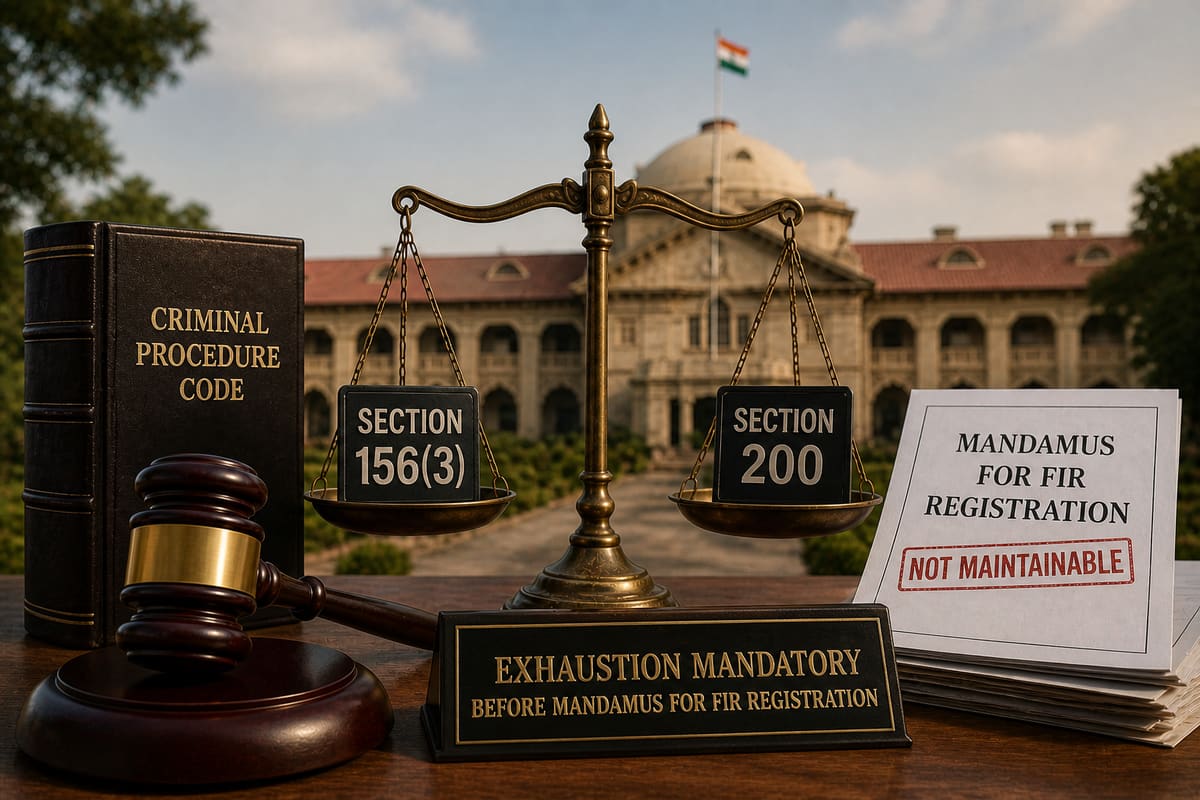
CrPC Sections 156(3) & 200 Exhaustion Mandatory Before Mandamus for FIR Registration : Allahabad HC
Case Law Analysis
|Allahabad High Court

CrPC Sections 156(3) & 200 Exhaustion Mandatory Before Mandamus for FIR Registration : Allahabad HC

Allahabad HC reaffirms that petitioners must first exhaust remedies under Sections 156(3) or 200 CrPC before approaching the High Court for mandamus to compel FIR registration, unless exceptional circumstances exist. The ruling reinforces the statutory duty of police to register FIRs for cognizable offences but mandates prior judicial remedies as a precondition for writ relief.

Article 21 | Police Must Proactively Assess Threats to Interfaith Couples Even Without FIR: Punjab & Haryana HC
Case Law Analysis
|Punjab and Haryana High Court

Article 21 | Police Must Proactively Assess Threats to Interfaith Couples Even Without FIR: Punjab & Haryana HC

The Punjab & Haryana High Court has ruled that state police must independently evaluate threat claims by interfaith couples under Article 21, regardless of whether an FIR has been filed. This sets a critical precedent for preventive state protection in cases of familial opposition, affirming that the right to life and liberty includes proactive safeguarding, not just reactive intervention.

Article 21 | Police Duty to Protect Adult Couples in Love Marriages Without Validating Legality : Punjab & Haryana HC
Case Law Analysis
|Punjab and Haryana High Court

Article 21 | Police Duty to Protect Adult Couples in Love Marriages Without Validating Legality : Punjab & Haryana HC

Punjab & Haryana HC directs police to act on threat reports from adult couples in love marriages, affirming their right to life and liberty under Article 21, irrespective of marriage validity. The ruling clarifies that police protection does not grant immunity from criminal liability but mandates state intervention to prevent harm.

Article 19(1)(g) & Police Duty | Fundamental Right to Lawful Business Includes Police Protection Against Obstruction: Madras HC Directs Mandamus for Quarry Operations
Case Law Analysis
|Madras High Court

Article 19(1)(g) & Police Duty | Fundamental Right to Lawful Business Includes Police Protection Against Obstruction: Madras HC Directs Mandamus for Quarry Operations

Madras High Court reinforces that licensed quarry operators with statutory clearances hold a fundamental right under Article 19(1)(g) to operate without unlawful obstruction. The Court directed police to act on protection requests within a reasonable time, emphasizing that failure to do so violates constitutional guarantees and enables lawful business disruptions.

Article 226 | Police Duty to Proactively Protect Lawful Infrastructure Projects from Unlawful Obstruction : Madras HC
Case Law Analysis
|Madras High Court

Article 226 | Police Duty to Proactively Protect Lawful Infrastructure Projects from Unlawful Obstruction : Madras HC

Madras High Court dismisses a writ petition after police confirm restoration of order at a 100 MW solar project, reinforcing that state authorities must proactively safeguard lawful infrastructure from unlawful disruptions. The ruling clarifies that police protection is not merely reactive but a mandatory duty under constitutional writ jurisdiction.

Article 226 Writ Jurisdiction | Police Must Register FIR and Issue Non-Traceable Certificate for Lost Registered Documents : Telangana High Court
Case Law Analysis
|Telangana High Court

Article 226 Writ Jurisdiction | Police Must Register FIR and Issue Non-Traceable Certificate for Lost Registered Documents : Telangana High Court

The Telangana High Court has held that police inaction in registering an FIR or issuing a Non-Traceable Certificate for lost registered documents violates constitutional duty and principles of natural justice. The ruling mandates police to act on complaints regarding missing legal documents, ensuring legal recourse for affected parties under Article 226.