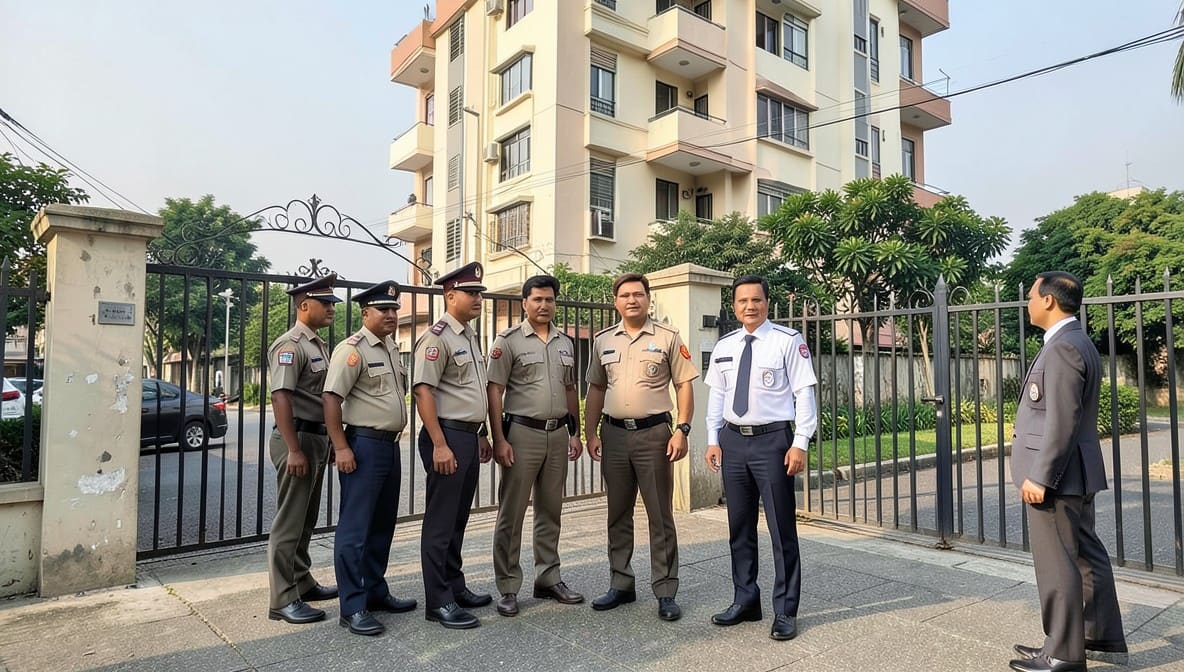
The Madhya Pradesh High Court has clarified that law enforcement authorities cannot remain passive when secured creditors report criminal trespass after lawful possession has been taken under the SARFAESI Act. This ruling reinforces the practical enforceability of asset recovery rights granted to banks and financial institutions under statutory frameworks.
Background & Facts
The Dispute
The petitioner, Canara Bank, is a secured creditor that initiated proceedings under the Securitisation and Reconstruction of Financial Assets and Enforcement of Security Interest Act, 2002 (SARFAESI Act) against a defaulting borrower. After obtaining an order under Section 14 of the SARFAESI Act, the bank was granted physical possession of the secured asset on 01.05.2025. Subsequently, the borrower unlawfully re-entered and retook possession of the property, constituting criminal trespass.
Key Facts
- The bank filed a complaint with the local police on 29.07.2025 regarding the unlawful re-entry
- A second complaint was submitted to respondent No. 2 (likely the District Magistrate or relevant authority) on 01.11.2025
- A third complaint was lodged at Police Station - Lasudiya on 23.01.2026
- Despite multiple complaints, no action was taken by any of the respondents
- The bank had lawfully obtained possession under a valid Section 14 order of the Assistant District Magistrate, Indore
Procedural History
- 01.05.2025: Physical possession of secured asset handed over to Canara Bank under Section 14 SARFAESI Act
- 29.07.2025: First complaint filed with local police
- 01.11.2025: Second complaint filed with respondent No. 2
- 23.01.2026: Third complaint filed at Police Station - Lasudiya
- 2026: Writ Petition No. 8631 of 2026 filed before the High Court of Madhya Pradesh, Indore
- 02.04.2026: Judgment delivered by Division Bench
Relief Sought
The petitioner sought a direction to the respondents to take immediate cognizance of the complaints of criminal trespass, initiate appropriate criminal proceedings against the trespassers, and ensure the bank’s lawful possession under the SARFAESI Act is protected.
The Legal Issue
The central question was whether the police and district authorities are obligated to act on complaints of criminal trespass after a secured creditor has lawfully taken possession under Section 14 of the SARFAESI Act, or whether such authorities may claim functus officio status and refuse intervention.
Arguments Presented
For the Petitioner
The petitioner relied on the precedent set by the Division Bench in AU Small Finance Bank Limited v. State of Madhya Pradesh (Writ Petition No. 5373/2025, decided on 14.02.2025), where the Court held that police inaction after lawful possession under SARFAESI Act violates the creditor’s statutory rights. It was argued that the SARFAESI Act creates a statutory mechanism for enforcement, and police inaction undermines its efficacy. The bank’s possession is not merely civil but protected by criminal law against trespass.
For the Respondent
The State contended that once possession is handed over under Section 14, the authorities become functus officio and have no further role. It was argued that the bank, as a private entity, must independently secure the property and that criminal complaints are outside the scope of the SARFAESI Act’s enforcement mechanism.
The Court's Analysis
The Court rejected the State’s argument that it becomes functus officio after issuing a possession order. It emphasized that the SARFAESI Act does not displace the ordinary criminal law regime. The Court observed that criminal trespass under Section 441 of the Indian Penal Code remains actionable even after possession is transferred under SARFAESI Act.
"The enforcement of security interest under the SARFAESI Act is not an alternative to criminal law but operates in tandem with it. When a secured creditor is deprived of possession obtained lawfully under Section 14, the remedy lies not only in civil proceedings but also in invoking the criminal jurisdiction of the State."
The Court further relied on its earlier decision in M/s Yes Bank Limited v. State of Madhya Pradesh & Others (Writ Petition No. 37182/2024, decided on 29.11.2024), which held that police authorities have a statutory duty to register and investigate complaints of unlawful re-entry by borrowers after lawful possession. The Court noted that the bank’s repeated complaints were ignored without any lawful justification, amounting to a failure of public duty.
The Verdict
The writ petition was allowed. The Court directed the Superintendent of Police, Indore; Town Inspector, Police Station - Lasudiya; District Magistrate, Indore to consider the petitioner’s complaints dated 29.07.2025, 01.11.2025, and 23.01.2026 in a prompt and lawful manner. The respondents were directed to take appropriate action under the Indian Penal Code, including registration of FIR if warranted, within 15 days of receipt of a certified copy of this order.
What This Means For Similar Cases
Police Cannot Ignore Trespass After SARFAESI Possession
- Banks and financial institutions can now file criminal complaints with absolute confidence that police are legally bound to act
- Inaction by police after lawful SARFAESI possession constitutes dereliction of duty
- Complaints must be registered and investigated under Section 441 IPC regardless of civil proceedings
SARFAESI and IPC Operate Concurrently
- The SARFAESI Act does not oust criminal jurisdiction
- Trespass after possession transfer is a standalone criminal offence
- Practitioners should file both SARFAESI enforcement applications and criminal complaints simultaneously
Procedural Imperative for Secured Creditors
- Maintain a documented trail of all complaints filed with police and district authorities
- Always seek certified copies of complaints and acknowledgment receipts
- File writ petitions promptly if no action is taken within 30 days of complaint