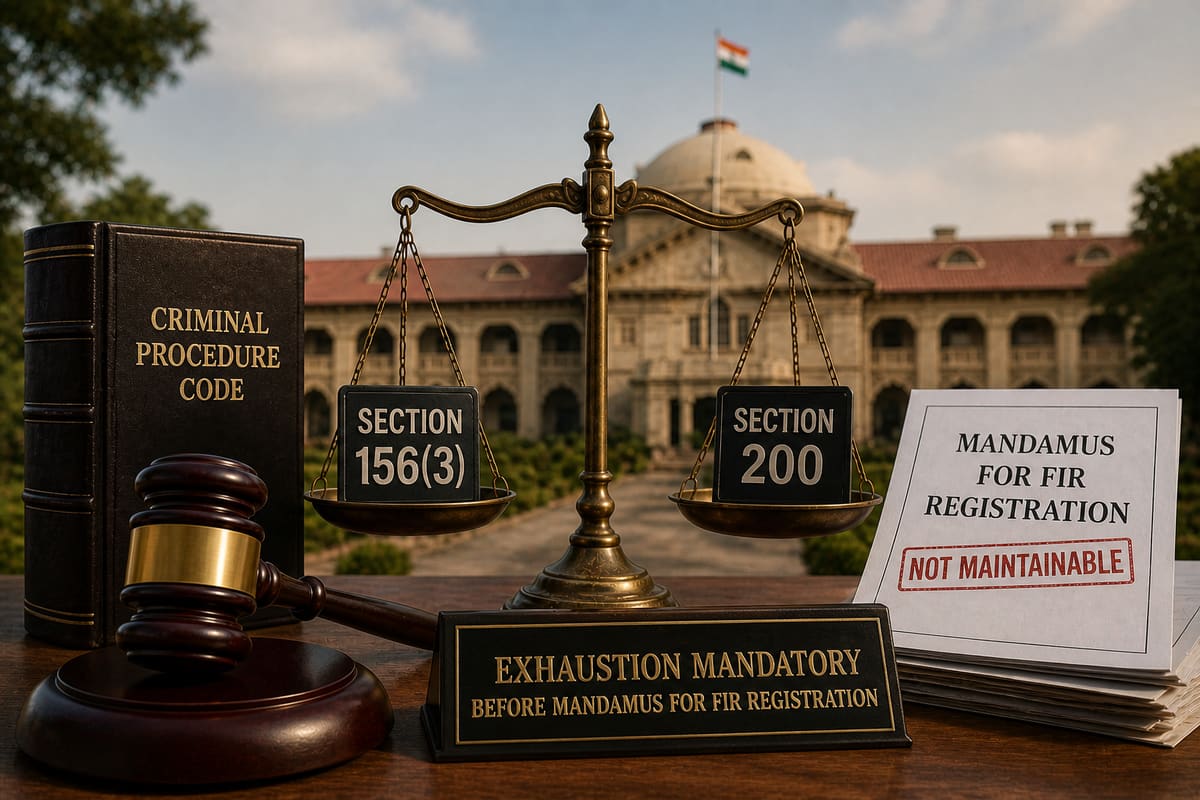
The Allahabad High Court has clarified that a writ of mandamus cannot be granted to compel police registration of an FIR if the petitioner has not first exhausted statutory remedies under the Code of Criminal Procedure. This ruling reinforces the principle that judicial intervention is not the first recourse when statutory alternatives exist.
Background & Facts
The Dispute
The petitioner, Nagendra Kumar Gupta, sought the registration of a First Information Report (FIR) concerning alleged criminal conduct by respondents, including public officials. Despite submitting multiple complaints and applications to the concerned authorities, no FIR was registered. The petitioner alleged that the failure to register the FIR amounted to a dereliction of statutory duty under Section 154 of the Code of Criminal Procedure, 1973.
Key Facts
The petitioner submitted an application dated 15.03.2026 to the competent authority seeking registration of an FIR
No FIR was lodged despite repeated requests and follow-ups
The petitioner did not file a complaint under Section 156(3) CrPC or approach a Magistrate under Section 200 CrPC
The alleged offence pertains to a cognizable offence, triggering mandatory police duty under Section 154 CrPC
The petitioner’s grievances were raised through administrative channels but not through judicial or quasi-judicial remedies provided under CrPC
Procedural History
15.03.2026: Petitioner submitted application for FIR registration to concerned authorities
Subsequent dates (unspecified): Multiple complaints and representations made to police and administrative officers; no response or action
2026: Writ Petition No. 3840 of 2026 filed before the Allahabad High Court (Lucknow Bench)
29.04.2026: Hearing conducted before Division Bench of Justices Abdul Moin and Pramod Kumar Srivastava
Relief Sought
The petitioner sought:
(i) A writ of mandamus directing respondents no. 2 to 4 to consider and decide the application dated 15.03.2026 forthwith;(ii) Any other writ, order, or direction the Court deemed fit.
The Parties' Positions
Petitioner’s Position: The police have a non-discretionary duty under Section 154 CrPC to register FIRs upon receipt of information disclosing a cognizable offence. Failure to do so constitutes a violation of the mandate laid down in Lalita Kumari v. Government of Uttar Pradesh. The petitioner argued that administrative inaction left no alternative but to approach the High Court.
Respondents’ Position: The petitioner had not availed of the statutory remedies available under Sections 156(3) or 200 CrPC, which are specifically designed to address refusal to register FIRs. The State contended that writ jurisdiction under Article 226 is not meant to circumvent these remedies.
Relief Sought
The petitioner sought a writ of mandamus to compel registration of the FIR and immediate adjudication of the pending application.
The Legal Issue
Can a writ of mandamus be granted under Article 226 of the Constitution to compel registration of an FIR under Section 154 CrPC when the petitioner has not first sought remedies under Sections 156(3) or 200 CrPC?
Arguments Presented
For the Petitioner
The petitioner relied on Lalita Kumari v. Government of Uttar Pradesh (2014) 2 SCC 1, which mandates that police must register an FIR whenever a cognizable offence is disclosed. It was argued that administrative inaction and delay amounted to a violation of fundamental rights under Article 21, and that the petitioner had no other effective remedy. The petitioner contended that the Lalita Kumari judgment removes any procedural bar to approaching the High Court directly.
For the Respondent
The State relied on Waseem Haider v. State of U.P. (2021) 2 ADJ 86, which held that writ jurisdiction under Article 226 cannot be invoked to compel FIR registration unless the petitioner has exhausted remedies under Sections 156(3), 200, 190, or 154(3) CrPC. The State emphasized that the Supreme Court in Lalita Kumari did not abolish these statutory alternatives but affirmed their existence. The State further cited Whirlpool Corporation v. Registrar of Trade Marks (1998) 8 SCC 1 to argue that exceptional circumstances must be shown to bypass alternative remedies.
The Court's Analysis
The Court undertook a detailed examination of the interplay between Lalita Kumari and the procedural framework of the CrPC. It noted that while Lalita Kumari established the mandatory nature of FIR registration, it did not eliminate the statutory remedies available to an aggrieved informant.
"The verdict of Apex Court in the case of Lalita Kumari Vs. Government of U.P. & Ors. reported in (2014) 2 SCC 1 does not pertain to issue of entitlement to writ of mandamus for compelling the police to perform statutory duty under Section 154 Cr.P.C without availing alternative remedy under Section 154(3), 156(3), 190 and 200 Cr.P.C."
The Court held that the existence of remedies under Section 156(3) CrPC - which empowers a Magistrate to direct police to investigate - and Section 200 CrPC - which allows a complainant to initiate proceedings before a Magistrate - are not mere technicalities but integral to the criminal justice architecture. To permit direct writ petitions without exhausting these remedies would undermine the legislative intent behind the CrPC’s layered structure.
The Court further clarified that while Lalita Kumari imposes a duty on police, it does not confer an absolute right to bypass statutory alternatives. The petitioner must demonstrate that the alternative remedies are either ineffective, unduly delayed, or that exceptional circumstances exist as enumerated in Whirlpool Corporation.
The Court rejected the petitioner’s argument that administrative inaction alone justifies direct judicial intervention. It emphasized that the High Court’s writ jurisdiction is discretionary and must be exercised with restraint where statutory remedies are available.
The Verdict
The writ petition was dismissed. The Court held that the petitioner failed to exhaust remedies under Section 156(3) CrPC (now Section 173(4) of the Bharatiya Nagarik Suraksha Sanhita, 2023) or Section 200 CrPC (now Section 223 of B.N.S.S., 2023). The petitioner is at liberty to file a complaint before the competent Magistrate under Section 156(3) CrPC or initiate proceedings under Section 200 CrPC. No costs were awarded.
What This Means For Similar Cases
Alternative Remedies Are Mandatory Before Writ Petitions
Practitioners must advise clients to file a complaint under Section 156(3) CrPC before approaching the High Court under Article 226
Failure to do so will result in dismissal of the writ petition unless exceptional circumstances are proven
The burden lies on the petitioner to show that the alternative remedy is futile, delayed, or unavailable
Police Inaction Alone Does Not Justify Mandamus
Merely alleging non-registration of FIR is insufficient to invoke writ jurisdiction
Courts will examine whether the petitioner attempted remedies under Sections 156(3), 200, or 190 CrPC
Administrative complaints to police superiors do not substitute for judicial remedies under CrPC
Statutory Framework Trumps Broad Rights-Based Arguments
The Lalita Kumari doctrine does not override the CrPC’s procedural hierarchy
The Supreme Court’s emphasis on mandatory FIR registration does not equate to a right to direct judicial intervention
Courts will continue to uphold the principle that writ jurisdiction is a remedy of last resort