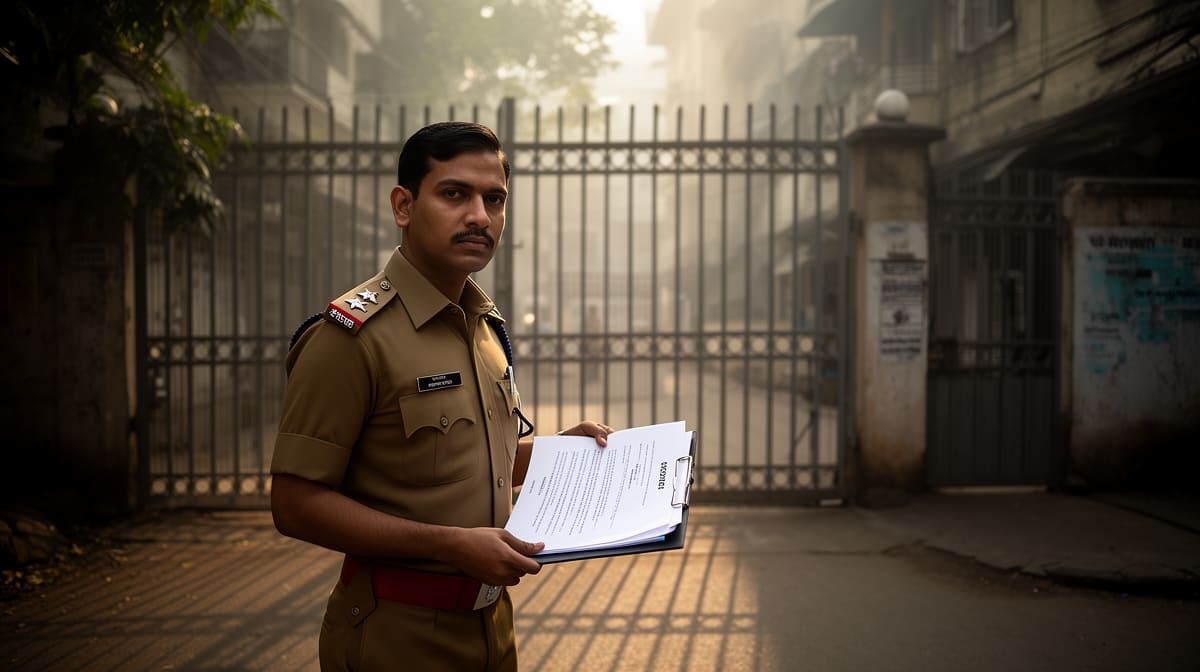
The Andhra Pradesh High Court has affirmed that police authorities cannot treat civil court orders protecting peaceful possession as mere advisory directives. When a civil court grants interim relief to safeguard property rights, the state’s law enforcement machinery has a constitutional obligation to enforce it - failure to do so amounts to arbitrary state action violating fundamental rights.
Background & Facts
The Dispute
The petitioner, Mulla Vijaya Chamundeswari, is the owner of agricultural land in East Godavari District. She alleged that respondents, including Thota Rambabu, were unlawfully encroaching upon her property and obstructing her peaceful possession. She filed a civil suit, O.S. No. 1096/2025, seeking injunction and damages. The trial court, by order dated 17.12.2025, granted an interim injunction restraining respondents from interfering with her possession.
Procedural History
- 17 December 2025: III Additional Civil Judge (Junior Division), Rajamahendravaram, passed an interim order in O.S. No. 1096/2025 directing respondents not to interfere with petitioner’s possession.
- 22 January 2026: Petitioner submitted a formal representation to the Superintendent of Police and Station House Officer, Bomuru, requesting enforcement of the civil court’s order.
- No action taken: Despite the order and representation, police did not provide any assistance or intervene to protect possession.
- Crime No. 401/2025: Police registered a case under the Bharatiya Nyaya Sanhita, 2023, but did not link it to the civil court’s injunction or take steps to enforce it.
Relief Sought
The petitioner sought a writ of mandamus directing the police to implement the civil court’s order and provide necessary protection to her property, arguing that inaction violated her rights under Articles 14 and 21 of the Constitution.
The Legal Issue
The central question was whether police authorities are legally bound to implement interim orders passed by civil courts protecting peaceful possession, and whether their failure to act constitutes a violation of Articles 14 and 21 of the Constitution.
Arguments Presented
For the Petitioner
Learned counsel argued that the civil court’s interim order was a binding judicial directive. Police, as agents of the state, have a duty to uphold court orders under Article 50 of the Constitution and the principle of rule of law. Reliance was placed on State of U.P. v. Mohd. Noor and State of M.P. v. Shyamsunder, where courts held that non-enforcement of civil injunctions by police amounts to abdication of constitutional duty. The petitioner emphasized that registration of a criminal case does not absolve police of their obligation to enforce civil court orders.
For the Respondent/State
The Assistant Government Pleader contended that since a criminal case had been registered under the Bharatiya Nyaya Sanhita, the police were already acting. They argued that civil court orders are not self-executing and require separate enforcement mechanisms. The state claimed that police cannot be compelled to act as private security for civil disputes, citing K. S. Puttaswamy v. Union of India on the limits of state intervention in private disputes.
The Court's Analysis
The Court rejected the state’s argument that registration of a criminal case substitutes for enforcement of a civil injunction. It held that the existence of a criminal complaint does not negate the obligation to implement a civil court order protecting possession. The Court emphasized that peaceful possession is a facet of personal liberty under Article 21, and state inaction in the face of a judicial order undermines the integrity of the judicial process.
"The civil court’s order is not a piece of paper; it is a judicial command that the state machinery is constitutionally bound to respect and enforce. To treat it as optional is to render the judicial process impotent."
The Court further noted that Article 14 requires equal protection of law, and denying police assistance to one law-abiding citizen while permitting unlawful interference by others creates an arbitrary classification. The Court distinguished K. S. Puttaswamy by clarifying that the case dealt with data privacy, not enforcement of judicial orders. The Court held that non-enforcement of a civil injunction by police, despite a clear representation, is arbitrary and violative of constitutional norms.
The Verdict
The petitioner succeeded. The Court held that police must implement civil court orders protecting peaceful possession, and their failure to act on the petitioner’s representation violated Articles 14 and 21. The Court directed the police to consider the representation dated 22.01.2026 in accordance with law and take necessary steps to enforce the civil court’s order.
What This Means For Similar Cases
Police Cannot Ignore Civil Court Injunctions
- Practitioners must immediately notify police in writing when civil court orders are issued protecting possession.
- A criminal case registration does not discharge police duty to enforce civil injunctions.
- Failure to act can be challenged via writ petition under Article 226.
Civil Injunctions Are Enforceable by Police
- Police are not mere bystanders in civil disputes involving possession.
- Interim injunctions under Order XXXIX CPC are binding on state authorities.
- Courts may hold police officers in contempt for willful non-compliance.
Documentation Is Critical
- Always obtain a certified copy of the civil court order.
- Submit representations via registered post or email with acknowledgment.
- Maintain a log of all communications with police for future litigation.