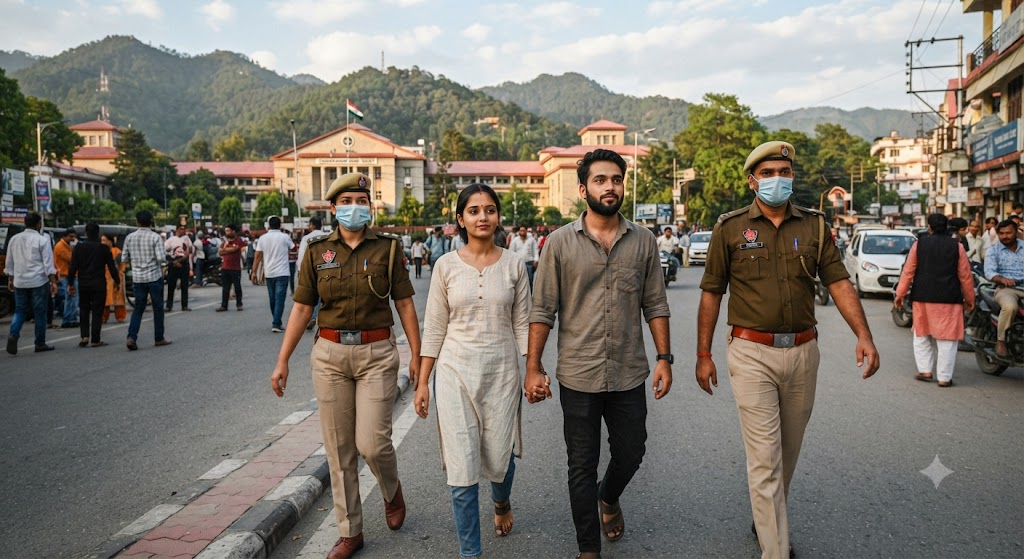
The Punjab and Haryana High Court has affirmed the state’s affirmative duty to protect the lives and liberty of individuals who marry against familial opposition, emphasizing that mere absence of immediate threat does not absolve authorities from proactive assessment. This order reinforces the constitutional guarantee under Article 21 in cases of interfaith unions facing social coercion.
Background & Facts
The Dispute
The petitioners, Rajni Kaur (23 years) and Tiger (29 years), are a couple who solemnized their marriage on 15.04.2026 under Sikh rites, against the wishes of their respective families, who are arrayed as private respondents. Both petitioners are in their first marriage. They allege that their families are threatening, harassing, and interfering in their marital life, creating a credible apprehension of harm to their life and personal liberty.
Key Facts
- The petitioners submitted a written representation dated 15.04.2026 (Exhibit P-5) to Respondent No. 2, the Senior Superintendent of Police, Moga, detailing their fears of violence and abduction by family members.
- The representation explicitly requested police protection to ensure the safety of their marital life.
- No FIR or criminal complaint had been registered at the time of filing the petition.
- The petitioners are not seeking annulment or validation of marriage, but only protection from intimidation.
Procedural History
- 15.04.2026: Marriage solemnized and representation (P-5) submitted to Senior Superintendent of Police, Moga.
- 16.04.2026: Writ petition (CRWP-4441-2026) filed under Articles 226 and 227 of the Constitution of India.
- 20.04.2026: Hearing before the High Court; notice issued only to official respondents (State of Punjab and police authorities).
The Parties' Positions
Petitioners: Argued that their right to life and personal liberty under Article 21 is under imminent threat due to familial opposition. They emphasized that the state has a positive obligation to prevent harm, even in the absence of a formal complaint or FIR. They cited Shakti Vahini v. Union of India to underscore the state’s duty to protect interfaith couples.
Respondents (State): Did not contest the petition’s maintainability. The Additional Advocate General accepted notice on behalf of the State and acknowledged the seriousness of the apprehension raised.
Relief Sought
The petitioners sought a direction to the police authorities to provide immediate protection to their lives and liberty, including surveillance, patrolling, and preventive measures against interference by private respondents.
The Legal Issue
Does the state have a constitutional obligation under Article 21 to proactively assess and respond to a credible representation of threat by an interfaith couple, even in the absence of a registered FIR or prior incident?
Arguments Presented
For the Petitioner
The petitioners’ counsel relied on Shakti Vahini v. Union of India, where the Supreme Court held that the state must take preventive steps to protect couples facing honor-based threats. He argued that the submission of a detailed representation (P-5) constituted sufficient notice to trigger the state’s duty. He further contended that delay in action, under the guise of waiting for a crime to occur, violates the principle of preventive justice under Article 21.
For the Respondent
The State did not oppose the petition in substance. The Additional Advocate General accepted notice and acknowledged the petitioners’ apprehensions. He did not dispute the legal obligation but noted that the status report filed by the Moga police indicated no overt threat at the time.
The Court's Analysis
The Court observed that the right to life and personal liberty under Article 21 encompasses the right to choose one’s partner and to live free from coercion or threat, regardless of societal or familial disapproval. The Court emphasized that the state’s duty is not merely reactive but preventive.
"The mere fact that no threat perception has been recorded in the status report does not absolve the police of the obligation to examine the representation with due diligence. The absence of a formal complaint or FIR cannot be a shield against the state’s constitutional duty to protect.
The Court distinguished between a threat that is already manifest and one that is reasonably apprehended. It held that where a couple, particularly in interfaith marriages, voluntarily brings their fears to the attention of the police through a written representation, the state must treat it as a potential risk requiring investigation.
The Court further clarified that the examination of the petitioners’ credentials - such as age, consent, and marital status - is not an inquiry into the validity of the marriage, but a necessary step to assess the credibility of the threat and the vulnerability of the petitioners.
The Verdict
The petition was disposed of with a direction to Respondent No. 2, the Senior Superintendent of Police, Moga, to examine the representation dated 15.04.2026 (P-5) with due diligence. If any substance is found in the apprehensions raised, the police must take necessary measures under law to ensure the protection of the petitioners’ lives and liberty. The Court explicitly clarified that this direction does not validate the marriage, nor does it preclude any civil or criminal proceedings that may be initiated in accordance with law.
What This Means For Similar Cases
Police Must Proactively Assess Threats, Not Wait for Crimes
- Practitioners representing interfaith couples must file written representations with police, even without an FIR, to trigger state duty.
- Status reports stating "no threat" are insufficient if a credible representation exists - police must conduct a substantive inquiry.
- Failure to act may expose authorities to writ jurisdiction under Article 226.
Article 21 Protects Against Coercion, Not Just Violence
- The right to life includes freedom from psychological and social coercion by family members.
- Courts will not require proof of physical violence to grant protection; reasonable apprehension suffices.
- This judgment strengthens the legal position of couples in interfaith, inter-caste, or inter-religious marriages facing familial opposition.
Validation of Marriage Is Irrelevant to Protection
- Courts will not adjudicate the validity of marriage when the relief sought is protection of life and liberty.
- Any civil or criminal proceedings regarding marriage validity remain unaffected and must be pursued separately.
- Protection orders are independent remedies under constitutional law.