Tribunals and Commissions judgments

1770 Tribunals and Commissions judgments explained in plain English: what was decided, the law applied and why it matters. Page 37 of 74.

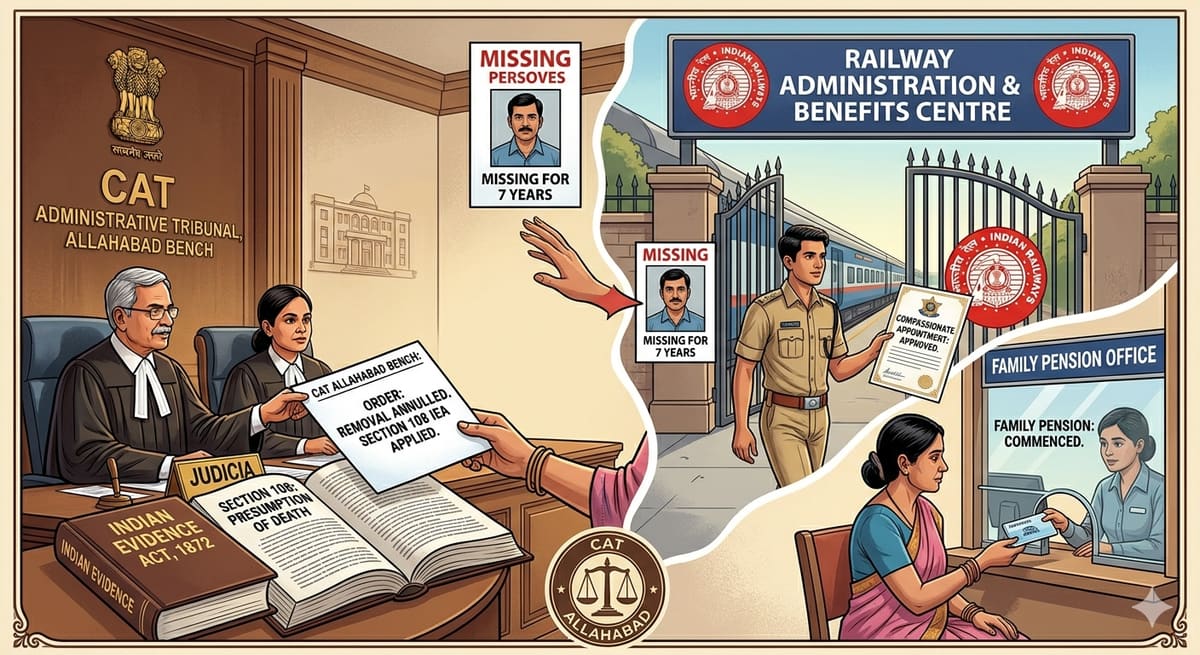
Section 108 IEA | Presumption of Death Must Precede Compassionate Appointment & Family Pension : CAT Allahabad Annuls Railway Employee Removal
Case Law Analysis
|Central Administrative Tribunal

Section 108 IEA | Presumption of Death Must Precede Compassionate Appointment & Family Pension : CAT Allahabad Annuls Railway Employee Removal

CAT Allahabad set aside the removal of a railway employee presumed dead under Section 108 of the Indian Evidence Act, directing payment of family pension, arrears, and reconsideration of compassionate appointment for the son. The ruling underscores that disciplinary actions cannot proceed without first establishing legal presumption of death, ensuring due process for dependents.


Criminal Acquittal by Compromise in Mutual Dispute Does Not Automatically Disqualify Police Recruitment: CAT Principal Bench
Case Law Analysis
|Central Administrative Tribunal

Criminal Acquittal by Compromise in Mutual Dispute Does Not Automatically Disqualify Police Recruitment: CAT Principal Bench

The Central Administrative Tribunal ruled that an acquittal by compromise in a mutual dispute involving cross-FIRs cannot lead to automatic disqualification for Delhi Police recruitment. The Screening Committee must conduct a holistic assessment of the candidate's character and the nature of the dispute before rejecting candidature.

Section 421 Companies Act | NCLAT Has Exclusive Jurisdiction Over Condonation of Delay; Writ Courts Barred : NCLAT Chennai
Case Law Analysis
|National Company Law Appellate Tribunal

Section 421 Companies Act | NCLAT Has Exclusive Jurisdiction Over Condonation of Delay; Writ Courts Barred : NCLAT Chennai

NCLAT Chennai reaffirms that High Courts cannot condone delays under Section 421 of the Companies Act, 2013, as the statute vests this power exclusively with the appellate tribunal. The ruling underscores the mandatory exhaustion of statutory remedies and bars writ jurisdiction for procedural lapses, impacting corporate litigants and insolvency practitioners.

Section 249(3) Income Tax Act | Condonation of Delay Requires Proof of 'Sufficient Cause' : ITAT Hyderabad Remands Case for Merits Hearing
Case Law Analysis
|Income Tax Appellate Tribunal

Section 249(3) Income Tax Act | Condonation of Delay Requires Proof of 'Sufficient Cause' : ITAT Hyderabad Remands Case for Merits Hearing

ITAT Hyderabad condoned a 419-day delay in filing an income tax appeal, holding that assessees must establish 'sufficient cause' with evidence under Section 249(3) of the Income Tax Act. The tribunal remanded the case to CIT(A) for merits consideration, emphasizing procedural compliance in faceless assessments and the assessee's duty to maintain updated contact details.

SRO 14/1996 | Qualifying Service for Time-Bound Promotion Counts from Promotion Date, Not Joining Date : CAT Jammu
Case Law Analysis
|Central Administrative Tribunal

SRO 14/1996 | Qualifying Service for Time-Bound Promotion Counts from Promotion Date, Not Joining Date : CAT Jammu

CAT Jammu rules that the second Time-Bound Promotion (TBP) under SRO 14/1996 accrues from the first day of the month following nine years from the promotion order date, not the physical joining date. The tribunal sets aside erroneous pay fixation, ensuring notional benefits align with the promotion timeline, impacting service law calculations for government employees.

Section 151(ii) IT Act | Incorrect Approval Authority Voids Reassessment Beyond 3 Years : ITAT Mumbai Quashes Proceedings
Case Law Analysis
|Income Tax Appellate Tribunal

Section 151(ii) IT Act | Incorrect Approval Authority Voids Reassessment Beyond 3 Years : ITAT Mumbai Quashes Proceedings

ITAT Mumbai ruled that reassessment proceedings initiated beyond three years from the relevant assessment year are invalid if approved by an incorrect authority under Section 151(ii) of the Income Tax Act. The tribunal held that only the 'specified authority' as amended in 2021 could grant approval, rendering the notice and subsequent proceedings null and void. This decision reinforces jurisdictional compliance in tax reassessment cases, impacting taxpayers and revenue authorities alike.

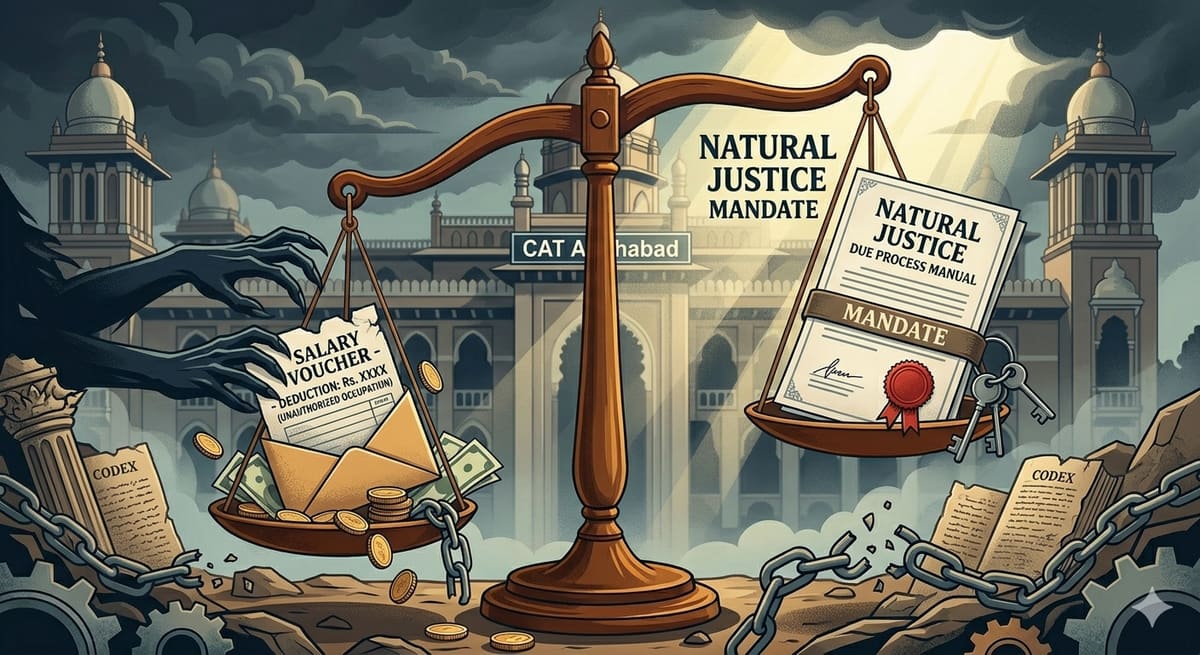
Natural Justice Mandate | Salary Deduction for Unauthorized Quarter Occupation Requires Due Process: CAT Allahabad
Case Law Analysis
|Central Administrative Tribunal

Natural Justice Mandate | Salary Deduction for Unauthorized Quarter Occupation Requires Due Process: CAT Allahabad

CAT Allahabad quashes Rs. 39,000/month recovery from a government employee's salary for unauthorized quarter occupation, ruling that due process and opportunity of hearing are mandatory under FR 45-A. The judgment reinforces that recovery proceedings must comply with principles of natural justice, impacting government accommodation rules and service law.

Section 69C IT Act | Only Profit Margin, Not Full Bogus Purchase Amount, Addable Where Assessee Voluntarily Discloses Portion : ITAT Mumbai
Case Law Analysis
|Income Tax Appellate Tribunal

Section 69C IT Act | Only Profit Margin, Not Full Bogus Purchase Amount, Addable Where Assessee Voluntarily Discloses Portion : ITAT Mumbai

ITAT Mumbai rules that when an assessee voluntarily discloses a portion of bogus purchases, only 12.5% profit margin-not the entire purchase amount-can be added under Section 69C. The decision aligns with jurisdictional High Court precedent, offering relief to taxpayers facing reassessment for non-genuine expenditures where partial disclosure is made.

CENVAT Credit Rules 2004 | Outward Freight Under FOR Sales Qualifies as Input Service if Buyer's Premises is Place of Removal : CESTAT Hyderabad
Case Law Analysis
|Custom, Excise & Service Tax Tribunal

CENVAT Credit Rules 2004 | Outward Freight Under FOR Sales Qualifies as Input Service if Buyer's Premises is Place of Removal : CESTAT Hyderabad

CESTAT Hyderabad ruled that where goods are sold on FOR basis with freight included in assessable value and risk retained till delivery, outward transportation up to the buyer's premises qualifies as 'input service' under Rule 2(l) of CENVAT Credit Rules 2004. This clarifies that the 'place of removal' can extend beyond the factory gate for FOR sales, allowing manufacturers to claim CENVAT credit on outward freight charges.

Service Tax Valuation | Reimbursable Expenses Excluded from Taxable Value Under Pure Agent Rule: CESTAT Chennai
Case Law Analysis
|Custom, Excise & Service Tax Tribunal

Service Tax Valuation | Reimbursable Expenses Excluded from Taxable Value Under Pure Agent Rule: CESTAT Chennai

CESTAT Chennai reaffirms that reimbursable expenses collected by service providers do not form part of taxable value under the Service Tax Valuation Rules, provided the 'Pure Agent' conditions are met. The ruling shields businesses from retrospective tax demands on expenses like freight, warehousing, and survey charges, reinforcing the Supreme Court's precedent invalidating Rule 5(1).

Section 19 Designs Act 2000 | Prior Publication Must Be Proven by Documentary Evidence, Not Ocular Impression: Calcutta HC Remands for Fresh Adjudication
Case Law Analysis
|Intellectual Property Appellate Board

Section 19 Designs Act 2000 | Prior Publication Must Be Proven by Documentary Evidence, Not Ocular Impression: Calcutta HC Remands for Fresh Adjudication

Calcutta High Court sets aside a design registration order, ruling that novelty and prior publication under the Designs Act 2000 must be established through strict documentary proof and comparative analysis, not mere visual inspection. The case is remanded for re-adjudication, emphasizing the need for rigorous evidentiary standards in design cancellation proceedings.

Section 37(1) IT Act | Double Taxation Barred Even If Same Amount Offered to Tax in Subsequent Year : ITAT Mumbai
Case Law Analysis
|Income Tax Appellate Tribunal

Section 37(1) IT Act | Double Taxation Barred Even If Same Amount Offered to Tax in Subsequent Year : ITAT Mumbai

ITAT Mumbai rules that while disallowance of commission expenditure under Section 37(1) of the IT Act is valid on merits, the same amount cannot be taxed again in a subsequent assessment year, reinforcing the bar on double taxation. This holding protects taxpayers from punitive reassessments where income was already disclosed and taxed.

Section 68 IT Act | Partner Capital Contributions Exempt from Income Addition If Identity & Creditworthiness Proven : ITAT Ahmedabad
Case Law Analysis
|Income Tax Appellate Tribunal

Section 68 IT Act | Partner Capital Contributions Exempt from Income Addition If Identity & Creditworthiness Proven : ITAT Ahmedabad

ITAT Ahmedabad rules that capital introduced by partners cannot be treated as unexplained income under Section 68 of the Income Tax Act if the partner's identity and creditworthiness are established. The decision reinforces that tax authorities must accept documented partner contributions unless material discrepancies exist, offering relief to partnership firms under tax scrutiny.

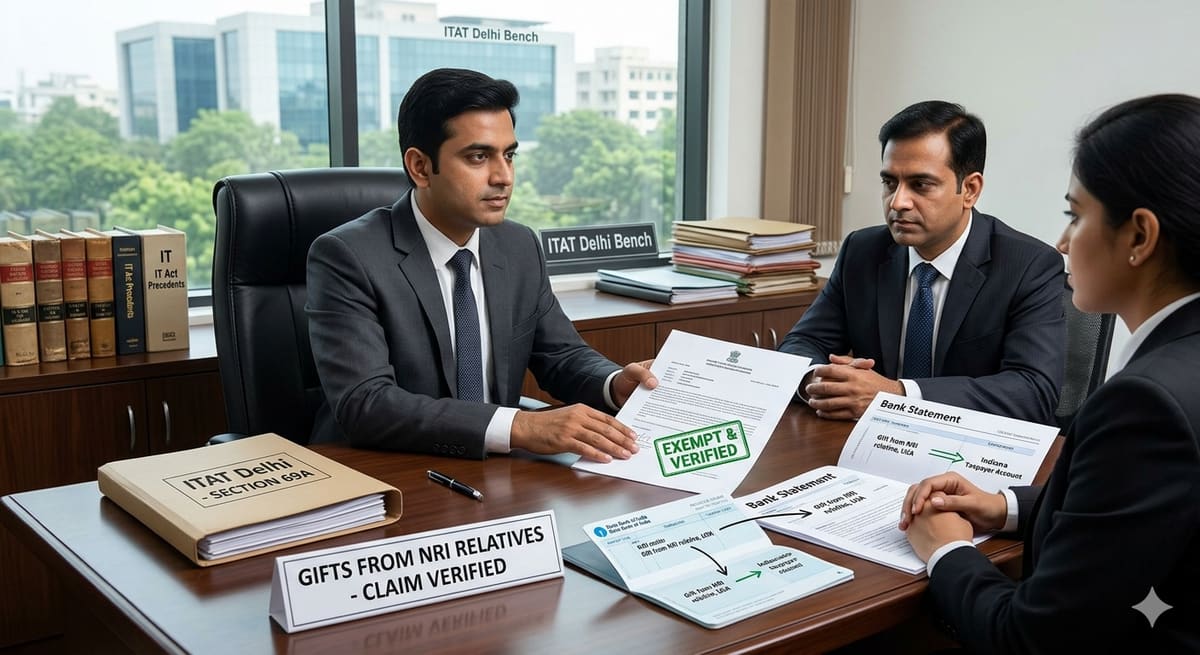
Section 69A IT Act | Gifts from NRI Relatives Exempt from Unexplained Income Addition If Source and Bank Trail Verified : ITAT Delhi
Case Law Analysis
|Income Tax Appellate Tribunal

Section 69A IT Act | Gifts from NRI Relatives Exempt from Unexplained Income Addition If Source and Bank Trail Verified : ITAT Delhi

ITAT Delhi rules that gifts from NRI relatives cannot be taxed as unexplained income under Section 69A if the assessee proves the source, identity, and bank trail. The ruling clarifies that mere suspicion without evidence of cash circulation is insufficient for addition, protecting taxpayers from arbitrary tax demands on legitimate family transfers.

Section 69A IT Act | Cash Deposits from Prior Withdrawals Not 'Unexplained Income' Without Proof of Diversion : ITAT Delhi
Case Law Analysis
|Income Tax Appellate Tribunal

Section 69A IT Act | Cash Deposits from Prior Withdrawals Not 'Unexplained Income' Without Proof of Diversion : ITAT Delhi

ITAT Delhi rules that cash deposits during demonetization, sourced from prior bank withdrawals (e.g., salary income), cannot be taxed as unexplained income under Section 69A without evidence of diversion or unaccounted utilization. The ruling shifts the burden of proof to the tax authorities to establish diversion, reinforcing taxpayer rights in banking transactions.

Central Excise Valuation | Consolidated Evidence Suffices for Trade Discount Abatement; One-to-One Correlation Not Required : CESTAT Chennai
Case Law Analysis
|Custom, Excise & Service Tax Tribunal

Central Excise Valuation | Consolidated Evidence Suffices for Trade Discount Abatement; One-to-One Correlation Not Required : CESTAT Chennai

CESTAT Chennai rules that abatement for trade discounts in jewellery trade can be granted based on consolidated sales data and Chartered Accountant certificates, without requiring transaction-wise correlation. This eases compliance burdens for manufacturers adopting provisional assessments under Rule 7 of Central Excise Rules, particularly in industries with fluctuating prices and indirect sales channels.

Service Tax Not Applicable on Placement Fees Collected from Students Under 'Manpower Recruitment' Definition : CESTAT Mumbai
|Custom, Excise & Service Tax Tribunal

Service Tax Not Applicable on Placement Fees Collected from Students Under 'Manpower Recruitment' Definition : CESTAT Mumbai

CESTAT Mumbai rules that placement fees charged by educational institutions to students-not employers-do not constitute 'manpower recruitment or supply agency service' under Section 65(105)(k) of the Finance Act, 1994. The decision clarifies that service tax liability arises only when institutions act as intermediaries for employers, shielding academic bodies from retrospective tax demands.

Transfer Pricing | ITAT Delhi Upholds Cost-Plus Remuneration for Limited Risk Service Providers Under Consistency Principle : ITAT Delhi
Case Law Analysis
|Income Tax Appellate Tribunal

Transfer Pricing | ITAT Delhi Upholds Cost-Plus Remuneration for Limited Risk Service Providers Under Consistency Principle : ITAT Delhi

ITAT Delhi ruled that a limited risk service provider is entitled to cost-plus remuneration, rejecting transfer pricing adjustments where benchmarking was inconsistent and DRP directions were ignored. The decision reinforces the consistency principle in transfer pricing, impacting multinational enterprises and tax compliance strategies.

Natural Justice in CCI Proceedings | Mandatory Notice Before Deviating from DG's Findings Under Competition Act : NCLAT
Competition Law
|National Company Law Appellate Tribunal

Natural Justice in CCI Proceedings | Mandatory Notice Before Deviating from DG's Findings Under Competition Act : NCLAT

NCLAT quashes CCI's penalty order for violating principles of natural justice by imposing Rs. 301.61 crore penalty without notifying the appellant of its intent to differ from the Director General's report. The ruling reinforces that regulatory bodies must afford parties a fair hearing before departing from investigative findings, impacting all competition law proceedings.

Service Tax Exemption for Visa Facilitation | Direct Traveler Assistance Not 'Business Auxiliary Service' Under Finance Act, 1994 : CESTAT Chennai
Case Law Analysis
|Custom, Excise & Service Tax Tribunal

Service Tax Exemption for Visa Facilitation | Direct Traveler Assistance Not 'Business Auxiliary Service' Under Finance Act, 1994 : CESTAT Chennai

CESTAT Chennai rules that visa facilitation services provided directly to travelers do not qualify as 'business auxiliary services' under Section 65(19) of the Finance Act, 1994, exempting travel agencies from service tax liability. The ruling clarifies the scope of taxable services, impacting travel agencies and tax practitioners dealing with similar disputes.

EIA Notification 2006 | SEIAA Must Provide Reasoned Dissent to Override SEAC Recommendations : NGT Central Zone
Case Law Analysis
|National Green Tribunal

EIA Notification 2006 | SEIAA Must Provide Reasoned Dissent to Override SEAC Recommendations : NGT Central Zone

NGT Central Zone sets aside SEIAA's arbitrary rejection of environmental clearance for a dolomite mine, ruling that statutory authorities must either follow expert committee recommendations or provide detailed reasons for dissent. The judgment reinforces natural justice principles in environmental governance, impacting all project proponents seeking environmental clearance under the EIA Notification 2006.