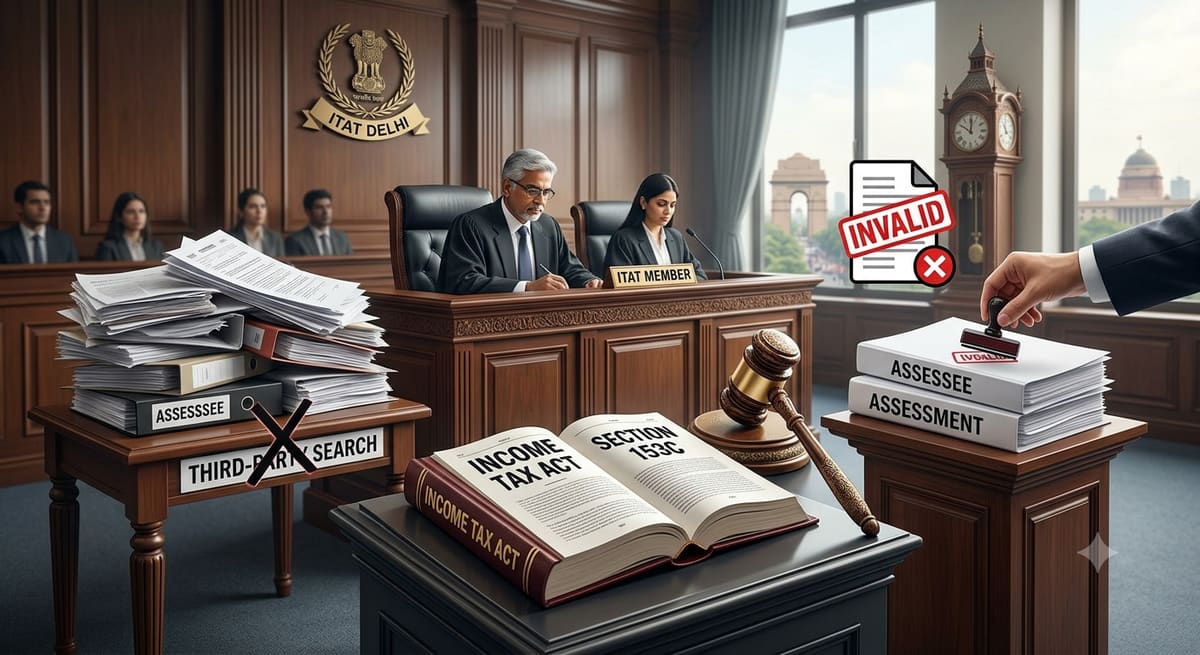
The ITAT Guwahati has reaffirmed a foundational principle of tax jurisprudence: an assessee cannot be penalized on the basis of undisclosed third-party evidence without being granted a meaningful opportunity to rebut it. This judgment clarifies procedural safeguards under the Income Tax Act when assessments rely on materials seized from unrelated persons.
Background & Facts
The Dispute
The dispute arose from an assessment order issued for Assessment Year 2019-20 against the assessee, Krishna Kumar Mintri, following a search and seizure operation conducted on the Babul Nath Group on 29.01.2021. During the search, a document was recovered indicating that the assessee had received Rs. 50,00,000 in cash from one Shri Ashit Ghosh. The Assessing Officer treated this amount as undisclosed income and initiated proceedings under Section 68 of the Income Tax Act, 1961.
Key Facts
- Search operation conducted on 29.01.2021 on Babul Nath Group
- Document recovered from third party (Babul Nath Group) showing cash receipt of Rs. 50,00,000 by assessee from Shri Ashit Ghosh
- Assessing Officer recorded satisfaction under Section 132(4) on 05.02.2021 (implied from proceedings)
- Show-cause notice issued to assessee on 15.07.2021
- Assessee submitted a written reply on 20.08.2021, explaining the transaction as a personal loan
- No copy of Shri Ashit Ghosh’s statement under Section 132(4) was provided to the assessee
- CIT(A) upheld the addition on 19.09.2025
- Appeal filed before ITAT Guwahati on 10.11.2025
- Hearing held on 30.04.2025; order pronounced on 30.04.2026
Procedural History
- 29.01.2021: Search conducted on Babul Nath Group
- 05.02.2021: Assessing Officer records satisfaction under Section 132(4)
- 15.07.2021: Show-cause notice issued to assessee
- 20.08.2021: Assessee submits reply explaining transaction
- 19.09.2025: CIT(A) upholds addition of Rs. 50,00,000
- 10.11.2025: Appeal filed before ITAT Guwahati (ITA No. 349/Gau/2025)
- 30.04.2025: Hearing conducted
- 30.04.2026: Order pronounced
The Parties' Positions
For the Assessee
- Argued that satisfaction under Section 132(4) must be recorded by both the Assessing Officer of the searched person and the assessee, unless they are the same officer
- Contended that the statement of Shri Ashit Ghosh was not disclosed to the assessee
- Asserted violation of natural justice and right to cross-examination
- Relied on CIT v. Calcutta Knitwears (2014) 362 ITR 673 (SC) and CBDT Circular No. 24/2015
For the Revenue
- Relied on Super Malls (P.) Ltd. v. PCIT (2020) 423 ITR 281 (SC)
- Argued that since the Assessing Officer of the searched person and the assessee were identical, single satisfaction was sufficient
- Stated that the assessee had opportunity to explain but failed to substantiate the transaction
- Claimed statement under Section 132(4) was recorded and thus admissible
Relief Sought
The assessee sought:
- Quashing of the addition of Rs. 50,00,000 as undisclosed income
- Setting aside of the CIT(A) order dated 19.09.2025
- Restoration of the case to the Assessing Officer with directions to provide all evidence for rebuttal
The Legal Issue
The central question was whether an assessment based on evidence recovered from a third party during a search operation violates natural justice when the assessee is not provided access to the statement of the third party or the documentary evidence relied upon.
Arguments Presented
For the Appellant
The ld. AR contended that the statement of Shri Ashit Ghosh, recorded under Section 132(4), constituted the sole basis for the addition. Since the assessee was not furnished with a copy of this statement, he was denied the opportunity to cross-examine or rebut the allegations. The AR emphasized that CIT v. Calcutta Knitwears requires dual satisfaction unless the Assessing Officers are the same, and even then, disclosure of evidence is mandatory. The AR further argued that the assessee had submitted a plausible explanation, and the burden shifted to the revenue to substantiate its claim.
For the Respondent
The ld. Sr. DR relied on Super Malls (P.) Ltd. v. PCIT, arguing that when the Assessing Officer of the searched person and the assessee are identical, a single satisfaction under Section 132(4) suffices. The revenue contended that the assessee had ample opportunity to explain the transaction but failed to provide corroborative documents such as bank statements or loan agreements. The revenue maintained that the statement under Section 132(4) was validly recorded and did not require disclosure as it was not a formal witness statement under the Evidence Act.
The Court's Analysis
The Tribunal acknowledged the precedent in Super Malls (P.) Ltd., holding that where the Assessing Officer of the searched person and the assessee are the same, the satisfaction recorded by that officer is sufficient. Thus, the first ground of appeal regarding satisfaction was rejected.
However, the Tribunal turned decisively to the core procedural flaw: the non-disclosure of evidence. The Court observed:
"When evidence is found in the course of search on a third party is being used against the assessee, obviously the evidence available with the revenue has to be provided to the assessee to rebut, which has not been done in the impugned case."
The Tribunal emphasized that natural justice is not a technicality but a constitutional imperative under Article 14 and Section 133A of the Income Tax Act. The assessee’s right to know the case against him and to respond meaningfully cannot be circumvented by invoking the secrecy of search proceedings. The statement of Shri Ashit Ghosh, even if recorded under Section 132(4), became the foundation of the addition and therefore had to be disclosed.
The Court further noted that the assessee had submitted a reply explaining the transaction, and the revenue’s failure to provide the evidentiary basis rendered the assessment arbitrary. The Tribunal rejected the revenue’s argument that Section 132(4) statements are exempt from disclosure, holding that such an interpretation would nullify the right to a fair hearing.
The Verdict
The appeal was partly allowed. The Tribunal set aside the CIT(A) order dated 19.09.2025 and restored the matter to the file of the Assessing Officer for re-adjudication. The Assessing Officer is directed to provide the assessee with a copy of the statement recorded from Shri Ashit Ghosh under Section 132(4) and all other documents intended to be used against him. The assessee shall be granted a reasonable opportunity to rebut the evidence, including the right to submit documents and cross-examine if necessary. The re-assessment shall be completed within 12 weeks from the date of receipt of this order.
What This Means For Similar Cases
Disclosure of Third-Party Evidence Is Mandatory
- Practitioners must now insist on disclosure of all statements and documents seized from third parties that form the basis of additions under Section 68 or Section 69
- Failure to provide such evidence renders the assessment void ab initio, regardless of the validity of satisfaction under Section 132(4)
- The burden of proving non-disclosure lies with the assessee; once raised, the revenue must produce the material
Natural Justice Trumps Administrative Convenience
- The Tribunal has firmly rejected the notion that search proceedings can be used as a shield to deny procedural rights
- Even if the Assessing Officer is the same, the right to rebut remains inviolable
- Practitioners should cite this judgment to challenge assessments based on undisclosed third-party statements
Strategic Implications for Tax Litigation
- In cases involving cash credits from third parties, file applications under Section 133A for production of evidence
- If denied, raise the issue at the CIT(A) stage and preserve it for ITAT appeal
- Always request a list of documents relied upon during assessment proceedings