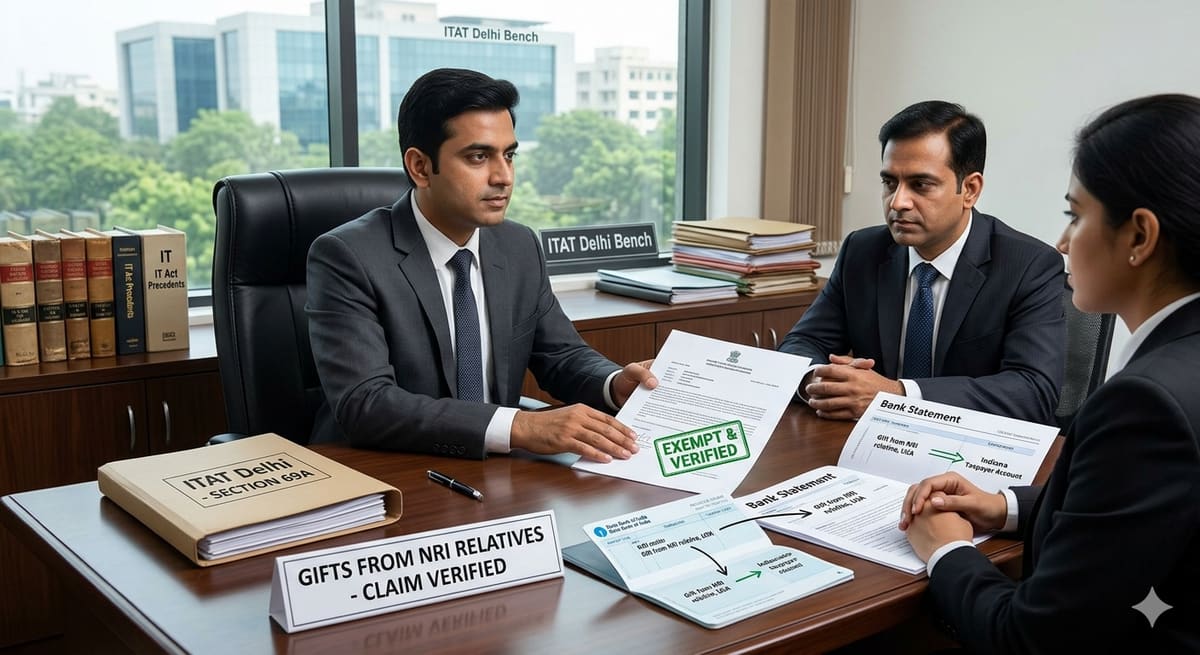
The Income Tax Appellate Tribunal, Delhi, has clarified that gifts received from non-resident relatives, when duly credited to the assessee’s bank accounts and supported by verifiable source documentation, cannot be treated as unexplained income under Section 69A of the Income Tax Act. This ruling reinforces the principle that mere suspicion based on WhatsApp chats or circumstantial assumptions is insufficient to invoke deeming provisions.
Background & Facts
The Dispute
The appellant, Parvinder Singh Taneja, an individual engaged in the retail sale of luxury watches through Kapoor Watch Company Pvt. Ltd., faced reassessment proceedings initiated under Section 147 of the Income Tax Act, 1961, following a search operation conducted on 31.10.2022 at his residence in Gurugram and the business premises of Kapoor Watch Company. The Assessing Officer (AO) alleged that certain financial transactions, including gifts received from his father-in-law residing in Dubai and cash payments for property construction, constituted unexplained income.
Key Facts
The appellant filed original returns for Assessment Years (AY) 2019-20, 2021-22, and 2023-24, declaring income of INR 31,32,020, INR 39,50,020, and INR 39,50,020 respectively.
During the search on 31.10.2022, WhatsApp chats were seized suggesting cash transfers from the appellant to his father-in-law in Dubai, followed by receipt of funds as "gifts" into the appellant’s and his wife’s bank accounts.
For AY 2019-20: Gifts of INR 89,50,000 received from father-in-law were treated as unexplained income by the AO.
For AY 2021-22: Gifts of INR 1,28,61,452 received from father-in-law were similarly treated.
For AY 2023-24: Gifts of INR 1,28,61,452 received from father-in-law were treated as unexplained income.
The appellant provided bank statements of the donor (father-in-law), affidavits, and proof of his NRI status.
No evidence was produced by the Revenue to show that the donor had received unaccounted cash prior to remitting the gifts.
In all three years, the appellant received "on money" (additional cash consideration) from property sales: INR 67,00,000 (jointly with co-owners) in AY 2019-20; INR 36,66,666 and INR 61,50,000 in AY 2023-24.
Cash of INR 17,00,000 was seized from the appellant’s residence.
Jewellery worth INR 1,09,26,387 was seized from the appellant’s residence and lockers.
Cash payments of INR 16,18,460 for property construction were alleged based on Excel sheets from M/s ENN V ENN Designs Pvt. Ltd., a contractor.
Procedural History
19.08.2019: Original return filed for AY 2019-20.
20.12.2023: Original return filed for AY 2023-24.
31.10.2022: Search and seizure conducted at appellant’s residence and Kapoor Watch Company premises.
12.03.2024: Notice under Section 148 issued for AY 2019-20 and 2023-24.
13.04.2024: Revised return filed for AY 2019-20, declaring same income.
07.02.2025: AO’s order for AY 2019-20 under Section 147 r.w.s. 143(3).
31.03.2025: AO’s order for AY 2023-24 under Section 143(3).
13.08.2025: Order of Commissioner of Income Tax (Appeals)-27 passed for all three AYs.
18.05.2021: Review petition dismissed by CIT(A) for AY 2019-20 (not applicable; likely typo; actual review not cited).
18.03.2026: Hearing before ITAT Delhi.
06.05.2026: Judgment pronounced.
Relief Sought
The appellant sought deletion of additions under Section 69A and 69B relating to:
Gifts from father-in-law (INR 89,50,000 for AY 2019-20; INR 1,28,61,452 for AY 2023-24)
On money from property sales (INR 33,50,000 for AY 2019-20; INR 36,66,666 and INR 61,50,000 for AY 2023-24)
Cash seized (INR 17,00,000)
Jewellery seized (INR 1,09,26,387)
Cash payments for construction (INR 16,18,460)
The Revenue sought restoration of these additions.
The Legal Issue
The central question was whether Section 69A of the Income Tax Act can be invoked to treat gifts received from an NRI relative as unexplained income when the funds are duly credited to the assessee’s bank accounts, the donor’s source is established, and no evidence of unaccounted cash remittance exists.
Arguments Presented
For the Appellant
The appellant contended that:
The gifts were received through legitimate banking channels and were reflected in the books of accounts.
The father-in-law was a long-standing NRI with a verifiable source of income abroad.
The WhatsApp chats were speculative, lacked timestamps, and did not prove the origin of funds.
The Revenue failed to establish that the donor had received unaccounted cash prior to remittance.
The on money received from property sales was part of the sale consideration and should be taxed as capital gains, not under Section 69A.
The jewellery was received over time as family gifts, supported by social context and CBDT Instruction No. 1994.
The Excel sheets used to allege cash payments for construction were mere estimates, lacked dates, and were not corroborated.
The benefit of telescoping should be allowed to offset unexplained income with legitimate on money received.
For the Respondent
The Revenue argued that:
The WhatsApp chats indicated a circular flow of funds, suggesting the gifts were a cover for unaccounted money.
The appellant had undisclosed income from luxury watch sales and property transactions.
The gifts were not recorded as gifts in the books, and their source was not satisfactorily explained.
The Excel sheets from the contractor’s system provided reliable evidence of cash payments.
The seized cash and jewellery were unexplained assets under Section 69A and 69B.
The on money was not disclosed in the sale deed and therefore constituted unexplained income.
The Court's Analysis
The Tribunal conducted a meticulous review of the statutory requirements under Section 69A, which mandates three cumulative conditions for invocation: (i) ownership of unrecorded money, (ii) absence of satisfactory explanation, and (iii) non-recording in books of account.
"The provisions of section 69A could be invoked when the assessee is found to be the owner of any money... and same is not recorded in the books of accounts maintained and the source thereof is not satisfactorily explained in the opinion of the AO."
The Tribunal held that the gifts were recorded in the appellant’s bank accounts, which formed part of his regular books of account. The source - an NRI father-in-law - was established through affidavits and bank statements of the donor. The Revenue failed to produce any evidence that the donor had received unaccounted cash prior to remitting the gifts. The WhatsApp chats were deemed insufficient to rebut this, especially since they contained no dates, amounts, or explicit references to illicit transfers.
The Tribunal further relied on its own earlier decision in Kapoor Watch Company Pvt. Ltd. v. DCIT (ITA No. 6825/Del/2025), which held that no cash sales were routed through dummy buyers, thereby undermining the AO’s theory of unaccounted income generation.
Regarding the on money received from property sales, the Tribunal emphasized:
"Once the source is established, provision of section 69A cannot be invoked for making addition of sale consideration received over and above the declared sale consideration in cash."
It held that on money received from identifiable buyers, as disclosed in the sale deed, forms part of the sale consideration and must be taxed under the head "Capital Gains," not as unexplained income.
On the issue of cash seized (INR 17,00,000) and jewellery (INR 1,09,26,387), the Tribunal upheld the CIT(A)’s deletion of INR 83,28,912 in jewellery on the basis of family gift history and CBDT Instruction No. 1994, but sustained INR 25,97,479 where no proof was submitted. Crucially, the Tribunal allowed telescoping - permitting the appellant to offset the unexplained cash and jewellery with the legitimate on money received, since the Revenue had not claimed its application elsewhere.
The Excel sheets used to allege cash payments for construction were dismissed as speculative, lacking dates, signatures, or payment modes. The Tribunal noted that the AO had not referred the matter to the District Valuation Officer, as required under the law.
The Verdict
The appellant succeeded in part. The Tribunal:
Deleted the addition of INR 25,00,000 for AY 2019-20 and INR 38,80,000 for AY 2023-24 under Section 69A relating to gifts from the father-in-law.
Allowed the inclusion of on money of INR 33,50,000 (AY 2019-20), INR 36,66,666 and INR 61,50,000 (AY 2023-24) as part of sale consideration for computing Long Term Capital Gains.
Upheld the addition of INR 25,97,479 for unexplained jewellery where no proof was submitted.
Allowed telescoping and set-off of INR 25,97,479 (jewellery) and INR 17,00,000 (cash) against the on money received, since the Revenue did not claim its application elsewhere.
Deleted the addition of INR 16,18,460 for cash construction payments.
Deleted the addition of INR 8,16,000 for the luxury watch, as ownership was established by the buyer’s documents.
Dismissed all Revenue appeals.
What This Means For Similar Cases
Gifts from NRIs Are Not Automatically Unexplained
Practitioners must argue that bank credits from NRI relatives, supported by donor affidavits and source documentation, satisfy the "satisfactory explanation" requirement under Section 69A.
WhatsApp chats alone, without corroborative evidence of cash flow or timing, cannot justify additions.
On Money Must Be Taxed as Capital Gains
Any additional cash consideration received in property sales, even if not reflected in the registered deed, must be treated as part of sale consideration and taxed under "Capital Gains."
AO cannot invoke Section 69A merely because the amount exceeds the declared consideration.
Telescoping Is Permissible When Revenue Is Silent
Where unexplained income is established but the assessee has legitimate unutilized funds from disclosed sources (e.g., on money), the benefit of telescoping may be granted if the Revenue has not claimed application of those funds elsewhere.
This creates a new procedural lever for taxpayers in reassessment cases.
Estimations Cannot Replace Evidence
Excel sheets with round figures, no dates, and no payment modes are insufficient to prove cash expenditure.
The burden remains on the Revenue to substantiate allegations - mere suspicion is not enough.
Documentary Evidence Trumps Assumptions
The Tribunal consistently prioritized bank records, affidavits, and sale deeds over speculative inferences.
Practitioners should emphasize the primacy of documentary proof over oral or digital circumstantial evidence in tax litigation.