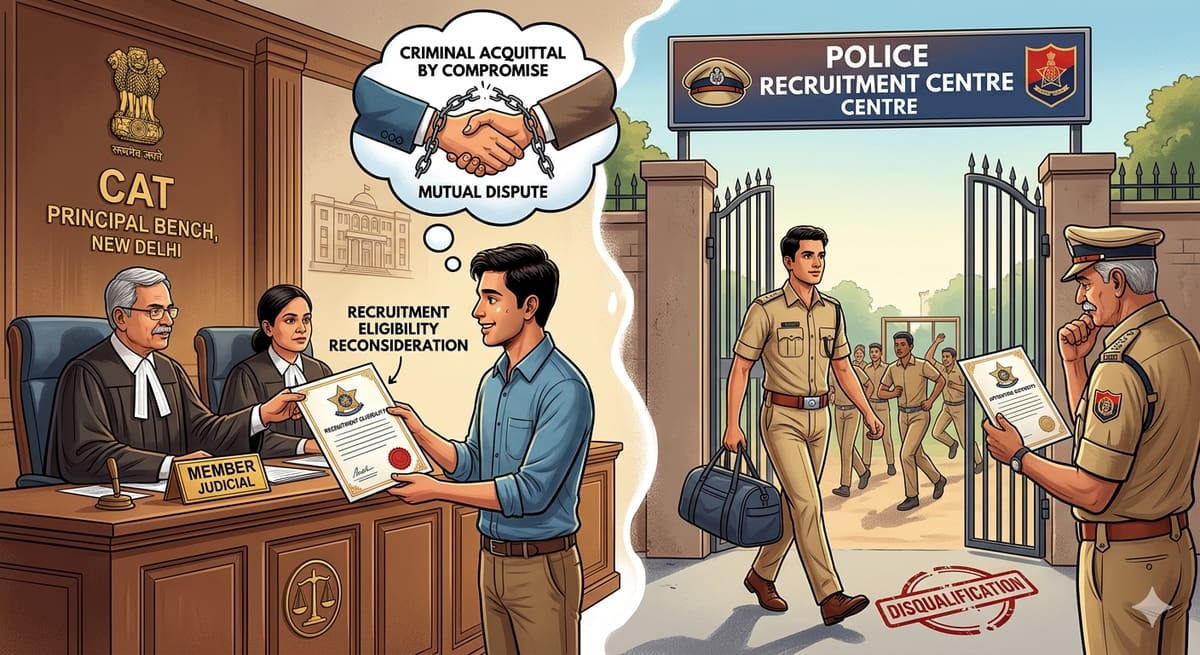
The Central Administrative Tribunal has clarified that acquittal in a criminal case arising from a mutual altercation, especially where a cross FIR exists, cannot be grounds for automatic disqualification in police recruitment without a balanced, fact-specific evaluation. This ruling reinforces that employers must assess suitability contextually, not mechanically, even when candidates are acquitted on compromise.
Background & Facts
The Dispute
The applicant, Sachin S/o Sh. Vijay Singh, applied for the post of Constable (Driver) in Delhi Police under the 2022 recruitment cycle. His candidature was cancelled on 06.12.2024 on the ground of prior involvement in a criminal case registered under Sections 294, 323, and 506 IPC at PS Kohefija, Bhopal. The Screening Committee concluded that his conduct demonstrated a "premeditated tendency to indulge in crime" and rendered him unsuitable for a disciplined force, despite his acquittal.
Key Facts
The applicant disclosed his involvement in the criminal case in his attestation form, without suppression.
FIR No. 624/2016 was registered on 16.09.2016 against the applicant at PS Kohefija, Bhopal, based on a complaint by Shri Shailender, a teacher.
The incident allegedly occurred when the applicant, an alumnus of a coaching centre, was asked to show ID and allegedly abused and assaulted the complainant, causing injury to the left eye.
A charge sheet was filed on 29.12.2016.
The applicant was acquitted on 12.11.2016 by the Judicial Magistrate, Bhopal, through a compromise recorded before the National Lok Adalat.
The compromise order explicitly noted that the dispute was settled voluntarily, without coercion, and that the matter was no longer controversial.
A cross FIR, No. 625/2016, was registered on the same date (16.09.2016) against the complainant and others under Sections 294, 323, 506, and 34 IPC, indicating a mutual confrontation.
The Screening Committee did not consider the cross FIR in its assessment.
The applicant received a show cause notice dated 21.03.2024, to which he replied with full documentation, including the acquittal order.
The respondents cancelled his candidature on 06.12.2024, citing the nature of the offence and his "active role" in the incident.
Procedural History
16.09.2016: FIR No. 624/2016 registered at PS Kohefija, Bhopal.
29.12.2016: Charge sheet filed under Sections 294, 323, 506 IPC.
12.11.2016: Acquittal granted by Judicial Magistrate, Bhopal, via National Lok Adalat compromise.
21.03.2024: Show cause notice issued by Delhi Police Recruitment Cell.
06.12.2024: Candidature cancelled by respondents based on Screening Committee’s recommendation.
17.01.2025: Original Application (O.A. No. 174/2025) filed before Central Administrative Tribunal, Principal Bench, New Delhi.
28.04.2026: Case reserved for judgment.
30.04.2026: Judgment pronounced.
The Parties' Positions
Applicant’s Position: The applicant argued that the incident was a trivial, mutual altercation, not a premeditated crime. He truthfully disclosed the case, was acquitted by a court of law, and the compromise was lawful and voluntary. The Screening Committee ignored the cross FIR and misapplied the concept of moral turpitude. Reliance was placed on Mahendra Solanki v. Commissioner of Police and Standing Order HRD/12/2022.
Respondents’ Position: The respondents contended that the nature of the allegations - assault and criminal intimidation - rendered the applicant unsuitable for Delhi Police. They relied on State of M.P. v. Parvez Khan and Commissioner of Police v. Mehar Singh, asserting that acquittal by compromise does not confer automatic eligibility and that the employer has the right to assess character and antecedents.
Relief Sought
The applicant sought:
Quashing of the order cancelling his candidature dated 06.12.2024;
Direction to appoint him to the post of Constable (Driver) with all consequential benefits;
Notional seniority from the date of appointment of his immediate junior;
Costs of litigation.
The Legal Issue
The central question was whether the cancellation of a candidate’s candidature for Delhi Police, based on a criminal case acquitted by compromise, is lawful when the Screening Committee ignores a cross FIR and fails to assess the incident’s trivial nature under Standing Order HRD/12/2022.
Arguments Presented
For the Appellant/Petitioner
The applicant’s counsel argued that Sections 294, 323, and 506 IPC do not fall under the list of offences involving moral turpitude in Annexure A of Standing Order HRD/12/2022. The incident was a localized, mutual dispute evidenced by the cross FIR, which the Screening Committee deliberately omitted. The applicant disclosed the case truthfully, and the acquittal was judicially recorded as a voluntary compromise. Reliance was placed on Mahendra Solanki v. Commissioner of Police and Avtar Singh v. Union of India, which hold that trivial disputes cannot disqualify candidates. The Screening Committee acted arbitrarily by sitting in appeal over the court’s acquittal order.
For the Respondent/State
The respondents relied on State of M.P. v. Parvez Khan and Commissioner of Police v. Mehar Singh, asserting that acquittal by compromise does not equate to innocence and that the employer retains discretion to assess suitability. They argued that the nature of the allegations - assault causing injury and criminal intimidation - indicated a propensity for violence, making the applicant unfit for a law enforcement role. The Screening Committee’s decision, they claimed, was a legitimate exercise of administrative discretion under the guidelines.
The Court's Analysis
The Tribunal emphasized that while acquittal does not automatically entitle a candidate to appointment, the assessment of suitability must be contextual, objective, and grounded in the complete factual matrix. The Standing Order HRD/12/2022 mandates that the Screening Committee evaluate the nature of the allegations, the manner of acquittal, and the surrounding circumstances - including whether the case was trivial or involved mutual confrontation.
"The omission to consider the existence of the cross FIR, in our considered view, has materially vitiated the decision-making process, inasmuch as the Screening Committee was obligated to evaluate the entire factual background before arriving at any conclusion regarding suitability."
The Tribunal noted that Section 323 IPC (voluntarily causing hurt) and Section 506 IPC (criminal intimidation) are not listed in Annexure A as offences involving moral turpitude. Section 294 IPC (obscene acts) is listed, but its application here was incidental to a personal dispute, not a public decency violation. The presence of a cross FIR demonstrated that the incident was not one-sided but a mutual altercation, a fact critical to determining whether the conduct was premeditated or reactive.
The Screening Committee’s conclusion that the applicant exhibited a "premeditated tendency to indulge in crime" was found to be unsupported by evidence and contradicted by the compromise order, which described the settlement as voluntary and aimed at restoring goodwill. The Tribunal held that the Committee’s reliance on the FIR alone, without examining the acquittal’s basis or the reciprocal allegations, amounted to a mechanical and arbitrary application of guidelines.
The Tribunal further observed that the applicant’s truthful disclosure in the attestation form entitled him to the benefit of the Standing Order’s provisions for trivial cases, as clarified in Avtar Singh. The Committee’s failure to engage with the full record violated principles of natural justice and the spirit of the guidelines.
The Verdict
The applicant succeeded. The Tribunal quashed the order dated 06.12.2024 cancelling his candidature. The respondents are directed to reconsider the applicant’s suitability afresh, taking into account the cross FIR No. 625/2016, the nature of the dispute, the judicial acquittal, and the provisions of Standing Order HRD/12/2022. If found suitable and otherwise eligible, the applicant shall be issued an offer of appointment with notional seniority from the date of appointment of his immediate junior; actual monetary benefits shall accrue only from the date of joining.
What This Means For Similar Cases
Cross FIRs Cannot Be Ignored in Recruitment Assessments
Practitioners must now argue that any screening decision based on a single FIR is legally defective if a reciprocal FIR exists.
Screening Committees are obligated to obtain and evaluate all related criminal records, not just those incriminating the candidate.
Failure to consider cross allegations renders the assessment incomplete and arbitrary under principles of natural justice.
Trivial Disputes Do Not Equate to Moral Turpitude
Cases arising from personal altercations, even if involving Sections 323 or 506 IPC, cannot be automatically classified as involving moral turpitude.
The burden is on the employer to demonstrate that the conduct reflects a pattern of criminality or character defect, not merely the existence of a charge.
Acquittal by compromise in a mutual dispute, especially where no grievous injury or organized violence occurred, must be weighed as a mitigating factor.
Disclosure Mitigates Disqualification Risk
Candidates who truthfully disclose criminal involvement in attestation forms are entitled to the benefit of procedural safeguards under Standing Order HRD/12/2022.
Non-disclosure remains a ground for disqualification, but truthful disclosure triggers the requirement for a reasoned, contextual evaluation.
Employers cannot use post-facto scrutiny to penalize applicants for disclosures they were legally required to make.