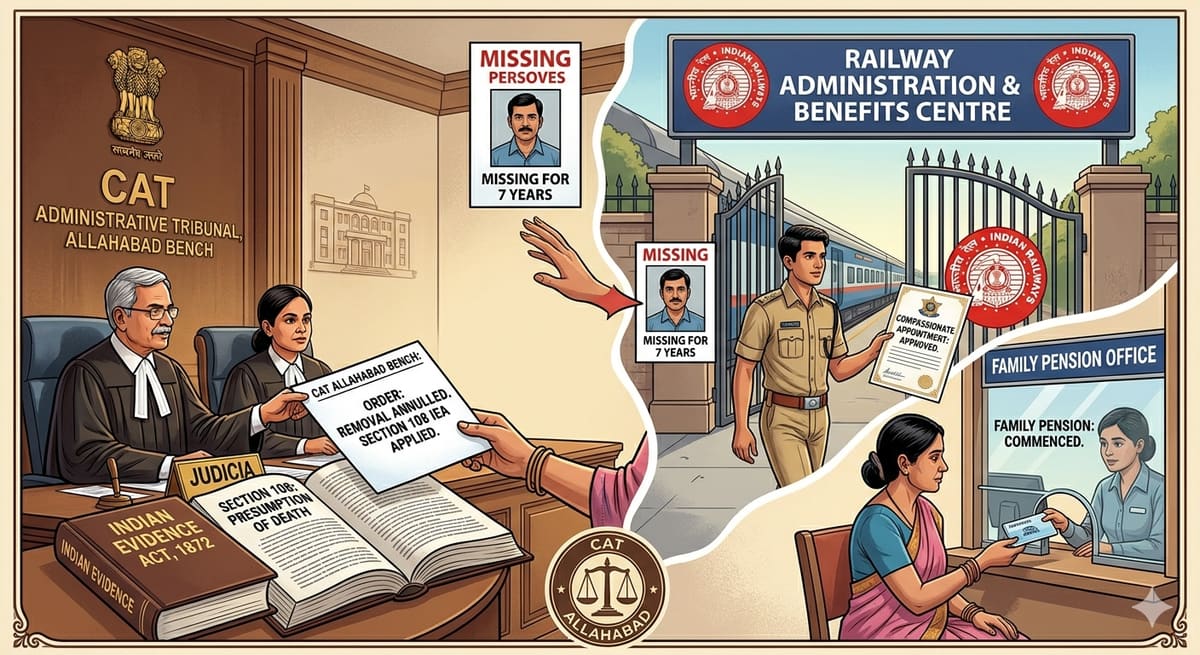
The Central Administrative Tribunal, Allahabad, has set a significant precedent by annulling the removal from service of a Railway employee declared missing for over nine years, holding that disciplinary action based on unauthorized absence is invalid when the employee is genuinely missing and presumed dead under Section 108 of the Indian Evidence Act. The judgment mandates reinstatement of all service benefits and compels reconsideration of compassionate appointment for the dependent child.
Background & Facts
The Dispute
The applicants, Smt. Susheela Devi (widow) and Sudheer (son), sought annulment of the removal order passed against her husband, Late Prem Narayan, a Railway employee appointed on 28.04.1977. He went missing from duty on 16.01.1998. Despite repeated attempts by the family to locate him, he remained untraceable. The Railway authorities initiated disciplinary proceedings under the Disciplinary and Appeal Rules (D&AR) for unauthorized absence from 22.06.1998 to 12.11.1998. An ex-parte inquiry was conducted, and he was removed from service by order dated 19.01.2001. The applicants contended that the employee was not absconding but genuinely missing, and the disciplinary action was based on a false premise.
Key Facts
The employee was appointed on 28.04.1977 as MSM-III (S&T) at Mathura Jn.
He went missing from duty on 16.01.1998.
The applicant, his wife, approached the police station on 16.11.1998 to report his disappearance.
A formal FIR was lodged on 13.06.2007.
The police submitted a final closure report on 22.04.2008, confirming the employee had not been traced for over nine years.
Disciplinary proceedings were initiated on 30.01.1999 with service of SF-5.
The enquiry concluded on 19.01.2001, resulting in removal from service.
The applicant submitted representations for family pension and compassionate appointment on 26.06.2007, 19.03.2009, and repeatedly between 2015 - 2017.
Family pension and DCRG of Rs. 18,809/- were sanctioned via PPO dated 04.07.2011 under Rule 65 of the Railway Services (Pension) Rules, 1993.
Compassionate appointment for the son was rejected on 23.11.2017 on the ground that the employee had been removed from service.
Procedural History
16.01.1998: Employee goes missing from duty.
16.11.1998: Wife reports disappearance to local police.
30.01.1999: SF-5 issued for unauthorized absence.
19.01.2001: Removal order passed by Railway authorities.
22.04.2008: Police closure report issued confirming employee untraceable for 9 years 5 months.
11.12.2007: First rejection of compassionate appointment claim.
04.07.2011: Family pension and DCRG sanctioned.
23.11.2017: Final rejection of compassionate appointment for son.
12.01.2018: Original Application No. 53/2018 filed before CAT Allahabad.
21.04.2026: Judgment reserved.
30.04.2026: Judgment pronounced.
The Parties' Positions
Applicants: Argued that the employee was genuinely missing, not absconding. Relied on Railway Board Circulars RBE 150/1991 and RBE 164/1998, which mandate annulment of removal orders in cases of genuine missing employees and allow reconsideration of compassionate appointments. Contended that Section 108 of the Indian Evidence Act applies, presuming death after seven years of unexplained absence.
Respondents: Maintained that the employee was removed for unauthorized absence, and the FIR was lodged only in 2007 - after removal. Argued that compassionate appointment is not available to dependents of employees removed from service, regardless of subsequent discovery of missing status.
Relief Sought
Annulment of removal order dated 19.01.2001.
Grant of all post-retiral and family pension benefits with arrears.
Compassionate appointment for the son, Sudheer, in accordance with Railway Board instructions.
Payment of interest on delayed settlement dues.
Costs of the application.
The Legal Issue
The central question was whether disciplinary proceedings and removal from service against a Railway employee who is later established as genuinely missing, with no evidence of absconding, can stand under Section 108 of the Indian Evidence Act, and whether the dependents are entitled to family pension and compassionate appointment under Railway Board Circulars RBE 150/1991 and RBE 164/1998.
Arguments Presented
For the Appellant
The applicant’s counsel relied on RBE 150/1991, which explicitly states that disciplinary action against a railway employee who is genuinely missing - despite exhaustive police efforts - is based on invalid premises and must be annulled. The circular mandates that such cases be treated as one of presumed death under Section 108 of the Indian Evidence Act, and all consequential benefits - including family pension, leave encashment, and compassionate appointment - must be extended. The counsel emphasized that the police closure report dated 22.04.2008 conclusively established the employee’s missing status after nine years, rendering the earlier charge of unauthorized absence legally untenable. Further, RBE 164/1998 permits compassionate appointment after two years of disappearance, provided an FIR is lodged and the case is deemed genuine.
For the Respondent
The respondents contended that the removal order dated 19.01.2001 was validly passed under D&AR, based on the employee’s unexplained absence during his tenure. They argued that the FIR was lodged in 2007, long after the removal, and therefore could not invalidate a prior disciplinary action. They relied on the principle that once an employee is removed, no further service benefits can be claimed, and compassionate appointment is only available to dependents of employees who die in service or retire. The respondents also pointed out the absence of any FIR or documentation from 1998, questioning the timeliness of the claim.
The Court's Analysis
The Tribunal undertook a detailed examination of the Railway Board Circulars and the evidentiary record. It noted that RBE 150/1991 is not a mere guideline but a binding administrative instruction issued to correct manifest injustice. The circular explicitly states: "The disciplinary action should be treated as initiated on invalid premises and the punishment order should be annulled."
"In cases of the aforesaid type where it is established that the railway employee was really missing and not unauthorizedly absent, the disciplinary action should be treated as initiated on invalid premises and the on going disciplinary action or the punishment order should be annulled."
The Court held that the police closure report dated 22.04.2008, issued after nine years and five months of untraceability, conclusively established the employee’s status as genuinely missing. The absence of an early FIR did not negate the subsequent conclusive finding by the police. The Tribunal emphasized that Section 108 of the Indian Evidence Act permits presumption of death after seven years of unexplained absence, and the Railway Board’s circulars explicitly incorporate this legal principle.
The Court further rejected the respondents’ argument that removal precludes compassionate appointment. RBE 164/1998 clearly states that compassionate appointment is not barred merely because settlement dues are pending, and the decision must be based on the genuineness of the missing case, not the outcome of prior disciplinary proceedings. The Tribunal held that the applicant’s son, having attained majority, was eligible for consideration under the circular’s criteria, particularly since the FIR was lodged and the police confirmed non-traceability.
The Court observed that the Railway authorities had already recognized the employee’s death for pension purposes by sanctioning family pension with effect from 19.01.2001. To continue treating him as removed for compassionate appointment purposes was inconsistent and arbitrary.
The Verdict
The applicants succeeded. The Tribunal annulled the removal order dated 19.01.2001. The respondents are directed to release all post-retiral and family pension benefits with arrears from 19.01.2001. Arrears must be paid within four months of receipt of a certified copy of the order; failure to comply will attract interest at six percent per annum. The respondents are further directed to consider the son’s application for compassionate appointment in accordance with RBE 164/1998, taking into account the police closure report and the genuineness of the case.
What This Means For Similar Cases
Disciplinary Action Based on Absconding Is Invalid If Genuinely Missing
Practitioners must now argue that removal for unauthorized absence is void ab initio if subsequent evidence (e.g., police closure report) proves the employee was genuinely missing.
The burden shifts to the employer to prove absconding; mere non-appearance during proceedings is insufficient.
RBE 150/1991 is binding on all Railway authorities and overrides rigid interpretations of D&AR.
Compassionate Appointment Is Not Tied to Service Status at Time of Death
Compassionate appointment eligibility is determined by the genuineness of the missing status, not the outcome of disciplinary proceedings.
Even if an employee was removed, the dependents retain the right to claim compassionate appointment if the missing status is established under RBE 164/1998.
The requirement of an FIR and a minimum two-year gap remains, but the police closure report is conclusive evidence.
Administrative Inaction Cannot Prejudice Dependents
Delay in filing FIR or submitting documents cannot be used to deny benefits if the missing status is later conclusively established.
Pension adalats and administrative bodies must proactively apply Railway Board circulars, not wait for litigation.
Interest at six percent per annum on delayed payments sets a precedent for compensation in similar service law cases.