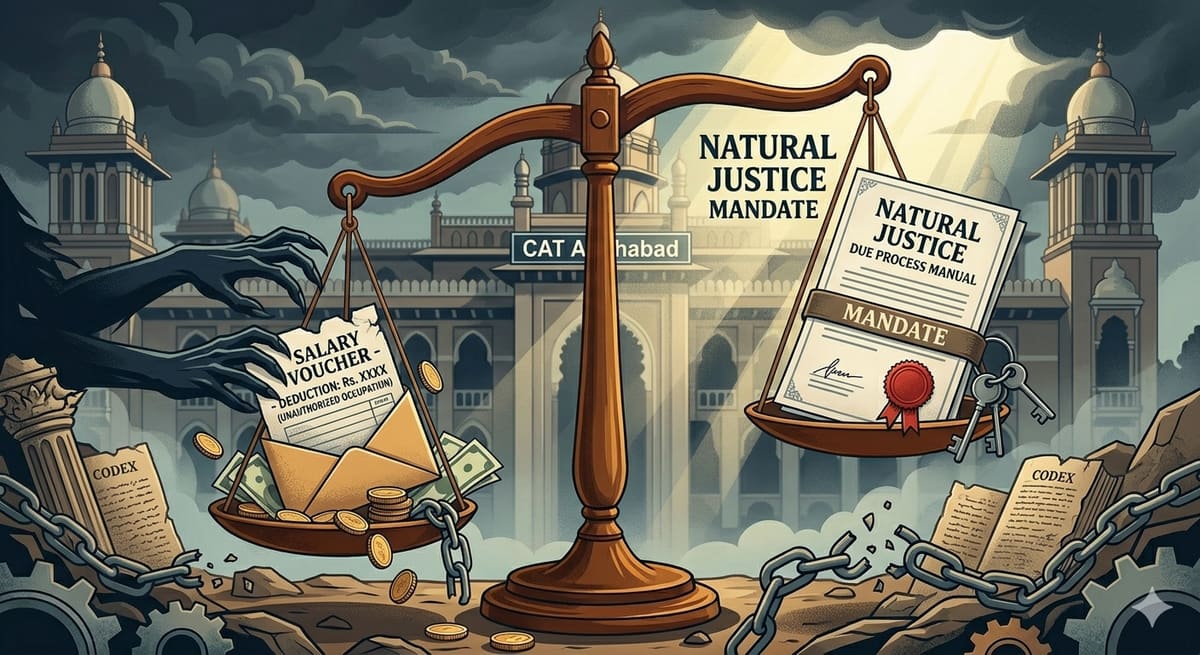
The Central Administrative Tribunal, Allahabad Bench has underscored the necessity of adhering to due process before effecting recovery of damage rent from a government employee's salary. In a significant ruling, the Tribunal set aside the recovery of Rs. 39,000 per month from the applicant's salary, holding that the respondents failed to afford an opportunity of hearing and disclose the basis of calculation, thereby violating principles of natural justice.
Background & Facts
The Dispute
The applicant, Shankar Lal, a retired Railway Mail Service employee, was aggrieved by the recovery of Rs. 39,000 per month from his salary towards penal/damage rent for continued occupation of a government quarter at Prayagraj after his transfer to Mughalsarai on 01.12.2008. The applicant contended that the recovery was effected without following prescribed procedures, affording him an opportunity of hearing, or disclosing the basis of calculation.
Key Facts
The applicant was transferred from Prayagraj to Mughalsarai on 01.12.2008 but continued occupying the government quarter at Prayagraj.
The allotment of the quarter was cancelled on 18.06.2014, rendering his subsequent occupation unauthorized.
The applicant cited compelling family circumstances, including his children's education and his wife's medical treatment, for retaining the quarter.
The respondents issued multiple notices directing vacation of the quarter, including communications dated 18.07.2013, 01.07.2016, 25.01.2017, and 09.09.2019, but no formal eviction proceedings were initiated.
The impugned recovery order was passed on 06/08.10.2021, directing recovery of Rs. 39,000 per month from the applicant's salary.
Procedural History
01.12.2008: Applicant transferred from Prayagraj to Mughalsarai.
18.06.2014: Allotment of quarter cancelled.
18.07.2013 to 09.09.2019: Multiple notices issued directing vacation of the quarter.
06/08.10.2021: Impugned recovery order passed.
30.04.2026: Present Original Application (OA No. 813/2023) decided by CAT Allahabad.
The Parties' Positions
For the Applicant:
The retention of the quarter was due to compelling family circumstances and not mala fide intent.
No formal order rejecting his request for retention was communicated.
The respondents failed to initiate statutory eviction proceedings.
Notices issued were mere directions to vacate and not valid legal proceedings for imposition of damage rent.
No enquiry was conducted to determine the damage rent, including identification of accommodation, measurement of area, fixation of rate, or period of unauthorized occupation.
The recovery was effected without issuing a show cause notice or affording an opportunity of hearing.
The recovery was arbitrary, lacking clarity on whether it pertained to normal rent, penal rent, or damage rent.
The provisions of FR 45-A were invoked without following prescribed procedures.
Recovery from retiral dues was impermissible, relying on State of Punjab v. Rafiq Masih.
For the Respondents:
The applicant's occupation became unauthorized after the permissible retention period expired and the allotment was cancelled.
The applicant failed to comply with multiple notices directing vacation of the quarter.
The recovery was calculated strictly in accordance with FR Rule 40 and FR 45-A, read with Government of India Office Memorandums dated 22.07.2016 and 07.09.2016.
The damage rent was assessed by the competent authority (HRO Prayagraj) based on applicable license fee, increased telescopically as per prescribed limits.
The applicant was aware of the consequences of non-vacation, as warnings were issued.
Repeated notices constituted sufficient compliance with principles of natural justice.
The applicant's conduct disentitled him from challenging the recovery.
Recovery from salary and retiral dues was lawful and based on determined liability.
Relief Sought
The applicant sought:
Quashing of the impugned order dated 06/08.10.2021.
Refund of the recovered amount with market rate of interest within a stipulated period.
The Legal Issue
The central question was whether the recovery of Rs. 39,000 per month from the applicant's salary towards damage rent for unauthorized occupation of a government quarter was sustainable in law, given the absence of a show cause notice, opportunity of hearing, and disclosure of the basis of calculation.
Arguments Presented
For the Applicant
The recovery was effected without following due process, violating principles of natural justice.
No show cause notice was issued, and no opportunity of hearing was afforded before recovery.
The basis of calculation of damage rent was not disclosed, rendering the recovery arbitrary.
Recovery from retiral dues of a Group 'C'/'D' employee was impermissible, relying on State of Punjab v. Rafiq Masih.
The notices issued were mere directions to vacate and not valid legal proceedings for imposition of damage rent.
For the Respondents
The recovery was calculated strictly in accordance with FR 45-A and relevant Office Memorandums.
The applicant was aware of the consequences of non-vacation, as warnings were issued.
Repeated notices constituted sufficient compliance with principles of natural justice.
The applicant's conduct disentitled him from challenging the recovery.
Recovery from salary and retiral dues was lawful and based on determined liability.
The Court's Analysis
The Tribunal examined the rival contentions and held that the recovery effected by the respondents was procedurally defective and unsustainable in law. Key observations included:
Unauthorized Occupation Admitted: The applicant's occupation of the quarter after cancellation of allotment on 18.06.2014 was unauthorized. While family circumstances may explain his conduct, they did not confer a legal right to continue occupation in derogation of applicable rules.
Due Process Mandatory: The Tribunal emphasized that any determination having civil consequences must be preceded by disclosure of the basis thereof and an opportunity of hearing. Relying on State of Orissa v. Dr. Binapani Dei, the Tribunal held that an order involving civil consequences must comply with principles of natural justice. The requirement of transparency and recording of reasons was underscored, citing Kranti Associates Pvt. Ltd. v. Masood Ahmed Khan, which held that reasons are the heartbeat of every conclusion.
Show Cause Notice Essential: The Tribunal distinguished between notices directing vacation of accommodation and notices proposing recovery of a quantified amount. The latter requires a specific show cause notice, as held in Oryx Fisheries Pvt. Ltd. v. Union of India. The absence of such notice rendered the recovery arbitrary.
Recovery from Retiral Dues Impermissible: The Tribunal relied on State of Punjab v. Rafiq Masih to hold that recovery from retiral dues of Group 'C'/'D' employees is impermissible. Additionally, Thomas Daniel v. State of Kerala was cited to emphasize that recovery after a long lapse of time, particularly where the employee is not at fault, is inequitable.
Liability Must Be Determined Lawfully: While the applicant's prolonged unauthorized occupation could not absolve him of liability, such liability must be determined strictly in accordance with law and procedural safeguards. The Tribunal granted liberty to the respondents to re-determine the liability after affording due process.
"It is a settled principle of administrative law that any determination having civil consequences must be preceded by disclosure of the basis thereof and an opportunity of hearing to the affected person."
"The requirement of transparency and recording of reasons is also an essential component of fair administrative action, as observed by the Hon'ble Supreme Court in Kranti Associates Pvt. Ltd. v. Masood Ahmed Khan, wherein it has been held that reasons are the heartbeat of every conclusion."
The Verdict
The Tribunal set aside the impugned recovery order dated 06/08.10.2021 and consequential recoveries made pursuant thereto. The respondents were granted liberty to re-determine the applicant's liability towards damage/penal rent strictly in accordance with law. Before passing any fresh order, the respondents were directed to:
Issue a detailed show cause notice to the applicant.
Disclose the basis of calculation of damage/penal rent.
Afford a reasonable opportunity of hearing.
Pass a reasoned and speaking order.
The applicant was directed to vacate the quarter within three weeks from the date of receipt of the order, failing which he would be liable to pay costs of ₹10,000 to the concerned department. No order as to costs was passed in the present application.
What This Means For Similar Cases
Due Process Non-Negotiable in Recovery Proceedings
Show Cause Notice Mandatory: Any recovery from an employee's salary or retiral dues must be preceded by a specific show cause notice, disclosing the proposed liability and basis of calculation. Mere issuance of notices directing vacation of accommodation does not suffice.
Opportunity of Hearing: The affected employee must be afforded a reasonable opportunity of hearing before recovery is effected. Failure to do so renders the recovery arbitrary and unsustainable.
Recovery from Retiral Dues of Group 'C'/'D' Employees Impermissible
The judgment reaffirms the principle laid down in State of Punjab v. Rafiq Masih that recovery from retiral dues of Group 'C'/'D' employees is impermissible in law. Practitioners must challenge such recoveries on this ground.
Even where recovery is otherwise lawful, recovery after a long lapse of time, particularly where the employee is not at fault, may be inequitable, as held in Thomas Daniel v. State of Kerala.
Transparency and Reasoned Orders Essential
Disclosure of Basis: Administrative authorities must disclose the basis of calculation of liability, including identification of accommodation, measurement of area, fixation of rate, and period of unauthorized occupation.
Speaking Orders: Any order imposing liability must be a reasoned and speaking order, failing which it may be challenged for non-compliance with principles of natural justice.