Bombay High Court judgments

2128 Bombay High Court judgments explained in plain English: what was decided, the law applied and why it matters. Page 19 of 89.

Government Welfare Scheme Mandatory | Bombay HC Directs Co-operative Loan Restructuring for Flood-Affected Farmers to Prevent NPA Classification : Bombay HC
Case Law Analysis
|Bombay High Court

Government Welfare Scheme Mandatory | Bombay HC Directs Co-operative Loan Restructuring for Flood-Affected Farmers to Prevent NPA Classification : Bombay HC

Bombay High Court rules that non-implementation of Government Resolution (GR) for restructuring crop loans of flood-affected farmers violates welfare benefits, risking NPA classification and CIBIL score damage. The Court mandates immediate compliance to protect farmers from irreversible financial harm.


Article 300A & Right to Livelihood | Government Pipeline Work Destroying Farming Livelihood Triggers Prima Facie Compensation Obligation: Bombay HC
Case Law Analysis
|Bombay High Court

Article 300A & Right to Livelihood | Government Pipeline Work Destroying Farming Livelihood Triggers Prima Facie Compensation Obligation: Bombay HC

The Bombay High Court found that the state’s unauthorized pipeline construction, which obliterated over 550 pomegranate trees-the petitioner’s sole livelihood-constitutes a prima facie violation of the right to livelihood under Article 21 and property rights under Article 300A. Notice has been issued to government agencies to justify their failure to assess or compensate for this irreversible economic harm, setting a critical precedent for infrastructure projects impacting agrarian communities.

Old Pension Scheme Eligibility | Appointment and Approval Before 01.11.2005 in Grant-in-Aid Schools Mandatory: Bombay HC
|Bombay High Court

Old Pension Scheme Eligibility | Appointment and Approval Before 01.11.2005 in Grant-in-Aid Schools Mandatory: Bombay HC

Bombay High Court rules that assistant teachers in 100% grant-in-aid schools, appointed and approved before 1 November 2005, are entitled to the Old Pension Scheme under Maharashtra Civil Services (Pension) Rules, 1982. The Court quashed rejection orders, reinforcing the cut-off date for pension benefits and setting a precedent for similarly placed employees.

Section 149 Motor Vehicles Act | Insurer Liable for Fake Cover Note Unless Proven by Investigative Evidence: Bombay HC
Case Law Analysis
|Bombay High Court

Section 149 Motor Vehicles Act | Insurer Liable for Fake Cover Note Unless Proven by Investigative Evidence: Bombay HC

Bombay HC rules that an insurance company cannot deny liability based on allegations of a fake cover note without leading substantive evidence, including an FIR or investigator testimony. The court emphasized that mere administrative officer testimony from a different division is insufficient to disprove policy authenticity, reinforcing the insurer’s burden of proof in claims disputes.

Article 300A | Excess Land Taken Without Compensation Must Be Paid: Bombay HC
Case Law Analysis
|Bombay High Court

Article 300A | Excess Land Taken Without Compensation Must Be Paid: Bombay HC

The Bombay High Court has ruled that taking possession of land beyond the area specified in the acquisition award violates Article 300A of the Constitution, entitling landowners to a supplementary compensation award. This sets a binding precedent for all government projects in Maharashtra, requiring strict adherence to awarded land boundaries and immediate redress for unauthorized takings.

Service Law | Courts May Cure Administrative Deficiencies in Teacher Appointments by Directing Compliance: Bombay HC
Case Law Analysis
|Bombay High Court

Service Law | Courts May Cure Administrative Deficiencies in Teacher Appointments by Directing Compliance: Bombay HC

The Bombay High Court has ruled that when a government authority identifies procedural deficiencies in a teacher's appointment proposal but the candidate has substantially complied with all legal requirements, the court may directly direct compliance rather than remanding the matter. This empowers judicial intervention to prevent undue delay in public service appointments and protects candidates from bureaucratic inertia, setting a precedent for similar cases involving government recruitment processes.

Section 39 Maharashtra Village Panchayat Act | Mere FIR Under PC Act Insufficient for Disqualification Without Trial Progress : Bombay HC Aurangabad Bench
Case Law Analysis
|Bombay High Court

Section 39 Maharashtra Village Panchayat Act | Mere FIR Under PC Act Insufficient for Disqualification Without Trial Progress : Bombay HC Aurangabad Bench

Bombay High Court Aurangabad Bench rules that disqualification of a panchayat member under Section 39 of the Maharashtra Village Panchayat Act cannot be based solely on the registration of an offence under the Prevention of Corruption Act. The Court emphasized that trial progress, including charge sheet filing, is essential to uphold natural justice and prevent arbitrary disqualifications.

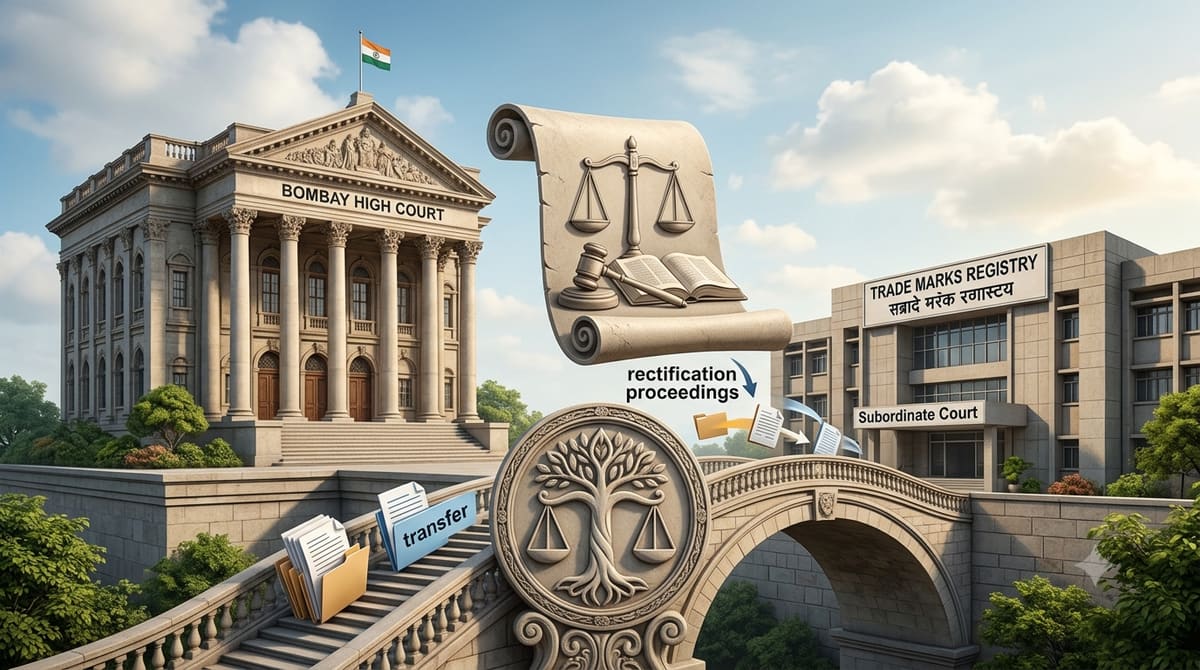
Section 24 CPC | Registrar of Trade Marks is a 'Subordinate Court' for Transfer of Rectification Proceedings : Bombay HC
Case Law Analysis
|Bombay High Court

Section 24 CPC | Registrar of Trade Marks is a 'Subordinate Court' for Transfer of Rectification Proceedings : Bombay HC

Bombay High Court holds that the Registrar of Trade Marks qualifies as a 'Court' under Section 24 CPC, enabling transfer of rectification proceedings to be consolidated with infringement suits. This ruling streamlines adjudication by preventing parallel litigation and reinforces the contextual interpretation of 'Court' under procedural laws, impacting trademark litigants and IP practitioners.

Watan Abolition Act 1950 | Cessation of Watan Land Character Upon Full Assessment & Dispensing Hereditary Services : Bombay HC
Case Law Analysis
|Bombay High Court

Watan Abolition Act 1950 | Cessation of Watan Land Character Upon Full Assessment & Dispensing Hereditary Services : Bombay HC

Bombay High Court rules that watan land loses its statutory character under the Watan Abolition Act 1950 once hereditary services are discontinued and full assessment is levied, even without an express settlement. The judgment reinforces Civil Court jurisdiction over revenue disputes and upholds private title against State claims, setting a precedent for similar land disputes in Maharashtra.

Fraudulent Marriage & Suppression of Material Facts Void Guardianship Appointment Under Guardians and Wards Act 1890 : Bombay HC
Case Law Analysis
|Bombay High Court

Fraudulent Marriage & Suppression of Material Facts Void Guardianship Appointment Under Guardians and Wards Act 1890 : Bombay HC

Bombay High Court rules that a guardianship appointment under the Guardians and Wards Act 1890 is void if obtained through fraudulent marriage or suppression of material facts, such as the ward's mental incapacity. The judgment reinforces the duty of utmost good faith in guardianship proceedings, impacting family law and property disputes involving vulnerable adults.

Section 126 Electricity Act | Civil Assessment for Unauthorized Use Valid Without Lab Testing: Bombay HC
Case Law Analysis
|Bombay High Court

Section 126 Electricity Act | Civil Assessment for Unauthorized Use Valid Without Lab Testing: Bombay HC

Bombay High Court rules that civil liability under Section 126 of the Electricity Act, 2003, for unauthorized electricity use can be established through inspection reports and load discrepancies, without mandatory lab testing of meters. The judgment clarifies that criminal standards of proof do not apply to civil assessments, impacting energy providers and consumers facing tampering allegations.

Group of Companies Doctrine Applies to Family Settlement Agreements | Single Arbitration Clause Governs Composite Transactions: Bombay HC Grants Section 9 Interim Relief
Case Law Analysis
|Bombay High Court

Group of Companies Doctrine Applies to Family Settlement Agreements | Single Arbitration Clause Governs Composite Transactions: Bombay HC Grants Section 9 Interim Relief

Bombay High Court extends the Group of Companies Doctrine to family settlement agreements, holding that interconnected agreements executed as part of a single transaction may be governed by a single arbitration clause-even if some agreements lack independent arbitration provisions. The ruling clarifies that Section 9 interim relief is available where the composite nature of the transaction and the parties' intent justify arbitration, offering critical protection for commercial disputes arising from family settlements.

Scheme of Arrangement for Liquor Licence Transfer Attracts Statutory Privilege Fees, Not Excessive Demands: Bombay HC
Case Law Analysis
|Bombay High Court

Scheme of Arrangement for Liquor Licence Transfer Attracts Statutory Privilege Fees, Not Excessive Demands: Bombay HC

Bombay High Court rules that privilege fees under excise laws apply to liquor licence transfers via Scheme of Arrangement, but authorities cannot impose charges beyond statutory authorization. The judgment clarifies compliance requirements for corporate restructuring involving regulated licences, impacting distilleries and liquor manufacturers.

Section 34 Arbitration Act | Judicial Review Limited to Patent Illegality; Arbitrator’s Contract Interpretation Binding Unless Perverse: Bombay HC
Case Law Analysis
|Bombay High Court

Section 34 Arbitration Act | Judicial Review Limited to Patent Illegality; Arbitrator’s Contract Interpretation Binding Unless Perverse: Bombay HC

Bombay High Court dismisses a Section 34 challenge, reinforcing that courts cannot re-examine arbitral awards unless the arbitrator’s interpretation is patently illegal or arbitrary. The ruling underscores the narrow scope of judicial review, protecting finality in commercial disputes and limiting interference to violations of public policy or fundamental legal errors.

Fraud Allegations Remain Arbitrable Unless Meeting Ayyasamy & Vidya Drolia Non-Arbitrability Tests : Bombay HC
Case Law Analysis
|Bombay High Court

Fraud Allegations Remain Arbitrable Unless Meeting Ayyasamy & Vidya Drolia Non-Arbitrability Tests : Bombay HC

Bombay High Court reaffirms that commercial disputes involving fraud and third-party rights are arbitrable unless they satisfy the strict non-arbitrability thresholds established in A. Ayyasamy and Vidya Drolia. The Court set aside the arbitrator’s order, restoring arbitration proceedings and reinforcing the pro-arbitration stance under Section 16 of the Arbitration and Conciliation Act 1996.

Senior Citizens Act 2007 | OCI Cardholders Entitled to Protection; Eviction Orders Must Balance DV Act Rights : Bombay HC
Case Law Analysis
|Bombay High Court

Senior Citizens Act 2007 | OCI Cardholders Entitled to Protection; Eviction Orders Must Balance DV Act Rights : Bombay HC

Bombay High Court rules that Overseas Citizen of India (OCI) cardholders are protected under the Senior Citizens Act 2007, even when the property is a shared household under the Domestic Violence Act. The Court held that eviction orders must balance the rights of senior citizens with those of daughter-in-law occupants, restoring the Maintenance Tribunal’s order for unrestricted access without eviction.

Section 9 Arbitration Act | Composite Family Settlement Agreements Governed by Single Arbitration Clause: Bombay HC Grants Interim Relief Under Group of Companies Doctrine
Case Law Analysis
|Bombay High Court

Section 9 Arbitration Act | Composite Family Settlement Agreements Governed by Single Arbitration Clause: Bombay HC Grants Interim Relief Under Group of Companies Doctrine

Bombay High Court rules that interconnected family settlement documents are governed by a single arbitration clause in the parent agreement, extending interim protection under Section 9 to preserve brand rights during arbitral proceedings. The judgment reinforces the Group of Companies Doctrine in composite agreements, impacting family business disputes and arbitration strategy.

Natural Justice in Departmental Enquiries | Oral Evidence Mandatory for Punishment Under Service Law: Bombay HC
|Bombay High Court

Natural Justice in Departmental Enquiries | Oral Evidence Mandatory for Punishment Under Service Law: Bombay HC

Bombay High Court quashed MSEDCL’s punishment order, ruling that documentary evidence alone is insufficient in departmental enquiries without examining witnesses or allowing cross-examination. The judgment reinforces that natural justice principles require oral proof for disciplinary actions, impacting service law proceedings across public sector employment.

Section 29 Indian Forests Act, 1927 | Private Land Cannot Be Declared Protected Forest Without Government Ownership: Bombay HC
Case Law Analysis
|Bombay High Court

Section 29 Indian Forests Act, 1927 | Private Land Cannot Be Declared Protected Forest Without Government Ownership: Bombay HC

Bombay High Court rules that private lands cannot be notified as 'protected forests' under Section 29 of the Indian Forests Act, 1927, unless they are government-owned or subject to government proprietary rights. The judgment quashes notifications issued without prior inquiry into ownership, reinforcing landowners' rights against arbitrary state declarations.

RTE Act Section 12(1)(c) | Proof of Residence Must Be Substantive, Not Technical: Bombay HC
Case Law Analysis
|Bombay High Court

RTE Act Section 12(1)(c) | Proof of Residence Must Be Substantive, Not Technical: Bombay HC

The Bombay High Court has ruled that under the RTE Act, mere address discrepancies or digital mapping errors cannot invalidate a child’s admission claim - proof of residence must be substantive, grounded in actual habitation and documented evidence. This sets a critical precedent for low-income families navigating bureaucratic hurdles in school admissions, reinforcing that procedural technicalities must not override the fundamental right to education.

Email Reminder of Premium Due Does Not Revive Lapsed Life Insurance Policy | Unjust Enrichment Mandates Premium Refund : Maharashtra State Consumer Commission
Case Law Analysis
|Bombay High Court

Email Reminder of Premium Due Does Not Revive Lapsed Life Insurance Policy | Unjust Enrichment Mandates Premium Refund : Maharashtra State Consumer Commission

The Maharashtra State Consumer Commission ruled that an insurer's email reminder about a pending premium does not constitute revival of a lapsed life insurance policy, but holding onto premiums after denial of claim constitutes unjust enrichment, requiring full refund to the policyholder's estate. This sets a critical precedent for insurers: administrative communication cannot create contractual obligations, yet financial retention without coverage violates consumer rights under the Consumer Protection Act.