The Bombay High Court has underscored the state's potential liability for destroying a farmer's sole livelihood source - over 553 pomegranate trees - while laying a pipeline beneath his land. Though declining to grant immediate relief under Article 226, the Court issued notice to respondents, emphasizing the need for evidentiary proof while acknowledging the petitioner's prima facie entitlement to compensation.
Background & Facts
The Dispute
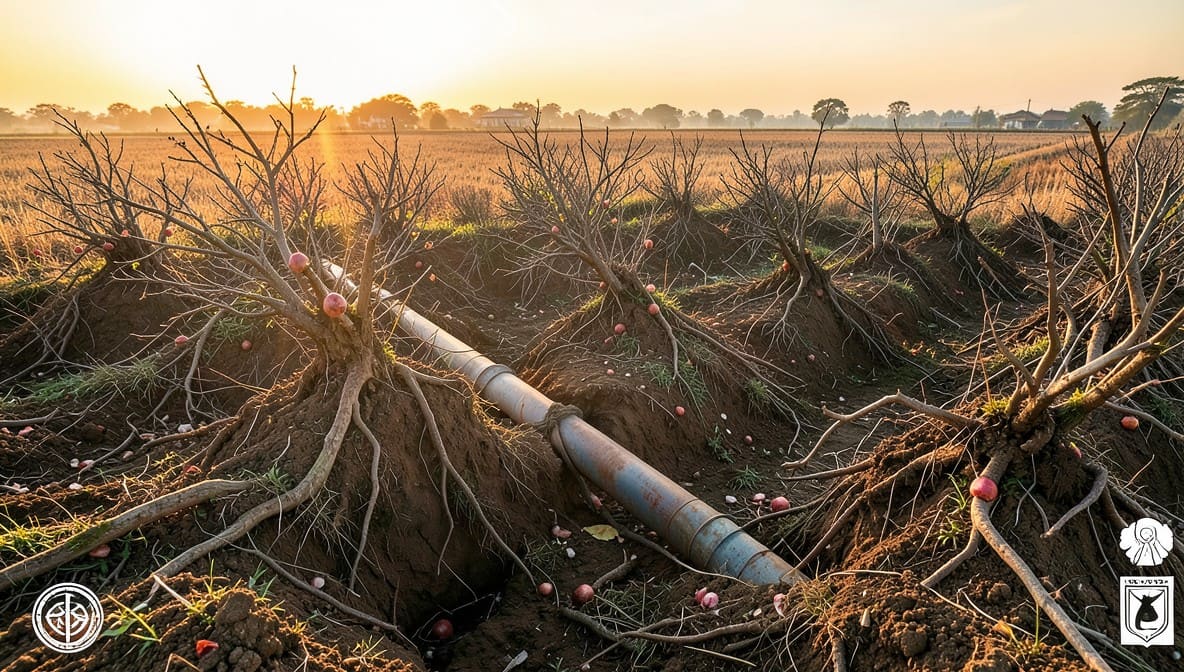
The petitioner, Sitaram Ganapati Babar, a farmer from Maharashtra, filed a writ petition seeking compensation for damages caused by the state government and its agencies. While laying a pipeline beneath his land, the respondents allegedly destroyed his pomegranate farm, which was his only source of livelihood. The petitioner claimed that the destruction of 553 pomegranate trees left him and his family without any means of sustenance.
Key Facts
- The petitioner owned agricultural land in Maharashtra, where he cultivated 553 pomegranate trees
- The respondents, while executing a pipeline project beneath the petitioner's land, completely destroyed the pomegranate trees
- The petitioner's sole source of livelihood was dependent on the farm
- A Sub-Divisional Officer addressed a letter dated 01.08.2019 to Respondent No. 4, directing an inspection of the damage, but no action was taken
- The petitioner filed Writ Petition No. 1080 of 2026 under Article 226 of the Constitution of India seeking compensation for damages and injurious affection
Procedural History
- Date of Incident: Destruction of pomegranate trees during pipeline laying (exact date not specified)
- 01.08.2019: Sub-Divisional Officer directs inspection of damage to Respondent No. 4
- 2026: Petitioner files Writ Petition No. 1080 of 2026 before the Bombay High Court, Circuit Bench at Kolhapur
- 30.06.2026: The Court hears the matter and issues notice to respondents
The Parties' Positions
Petitioner's Contention
The petitioner argued that the respondents' actions were high-handed and resulted in the complete destruction of his pomegranate farm, which was his only source of livelihood. He sought compensation for the damages caused, relying on the principle that the state is liable for actions that deprive citizens of their means of sustenance.
Respondents' Position
The respondents, represented by the Assistant Government Pleader (AGP), did not present a substantive counter-argument during the hearing. However, the Court noted that the respondents had failed to act on the Sub-Divisional Officer's directive dated 01.08.2019 to inspect the damage.
Relief Sought
The petitioner sought:
- Compensation for the destruction of 553 pomegranate trees
- Damages for injurious affection caused by the pipeline project
- Interest on the compensation amount
- Any other relief deemed appropriate by the Court
The Legal Issue
The central question before the Court was whether the petitioner was prima facie entitled to compensation under Article 226 of the Constitution of India for the destruction of his livelihood by state agencies, and if so, whether the Court could grant such relief without evidentiary proof in writ proceedings.
Arguments Presented
For the Petitioner
The petitioner's counsel, Mr. Ramdas A. Shelke, argued:
- The respondents' actions were arbitrary and high-handed, resulting in the complete destruction of the petitioner's livelihood
- The Sub-Divisional Officer's letter dated 01.08.2019 acknowledged the damage, yet no action was taken by the respondents
- The petitioner was left without any compensation or alternative means of sustenance, justifying the Court's intervention under Article 226
For the Respondents
The AGP, Mr. Atul P. Vanarase, did not present a substantive argument against the petitioner's claims. However, the Court observed that the respondents had failed to comply with the Sub-Divisional Officer's directive to inspect the damage.
The Court's Analysis
The Court acknowledged the prima facie merit of the petitioner's grievance but noted the limitations of writ proceedings under Article 226 for granting compensation. The Court observed:
"A litigant who comes to the Court with grievances is entitled to appropriate redressal. Though in the present Writ proceedings under Article 226 of the Constitution of India, we are unable to pass any orders considering that the facts which are stated by Petitioner would prima facie be required to be proved on evidence for the purpose of enabling the Petitioner to be entitled to damages and compensation as also interest, we cannot leave the Petitioner in the lurch."
The Court emphasized that the petitioner had suffered undeniable consequences due to the respondents' actions, including the destruction of 553 pomegranate trees, which was his sole livelihood source. While the Court could not grant compensation without evidentiary proof, it issued notice to the respondents, particularly Respondent Nos. 3 to 5, to answer why the petitioner should not be compensated for their high-handed actions.
The Court also directed the petitioner to serve notice on the private respondents and file an affidavit of service with proof. The private respondents were directed to file their Affidavit-in-Reply within two weeks and remain present on the next hearing date.
The Verdict
The Court issued the following directions:
- Notice issued to Respondent Nos. 3 to 5 to answer why the petitioner should not be compensated for the destruction of his pomegranate farm
- The AGP waived service on behalf of the state respondents
- The petitioner was permitted to serve notice on private respondents and file an affidavit of service with proof
- The private respondents were directed to file their Affidavit-in-Reply within two weeks from the date of the order (30.06.2026) and remain present on the next hearing date (14.07.2026)
- The Court warned that if the private respondents failed to appear, appropriate orders would be passed to ensure their presence
- All parties were directed to act on a server copy of the order downloaded from the High Court's website
What This Means For Similar Cases
Government Liability for Livelihood Destruction
This judgment reinforces the principle that the state and its agencies cannot escape liability for actions that destroy a citizen's livelihood. Practitioners should note:
- The Court acknowledged the prima facie entitlement to compensation, even if it could not grant relief under Article 226 without evidentiary proof
- The Sub-Divisional Officer's letter dated 01.08.2019 was treated as an acknowledgment of damage, which can be used as evidence in subsequent proceedings
Procedural Safeguards in Writ Proceedings
- Notice and Affidavit Requirements: The Court directed strict compliance with procedural requirements, including filing an Affidavit-in-Reply within a specified timeline
- Consequences of Non-Compliance: The Court warned that failure to appear or file replies would result in appropriate orders to ensure compliance
- Service of Notice: Petitioners must ensure proper service of notice and file affidavits of service with tangible proof
Evidentiary Proof in Compensation Claims
While the Court could not grant compensation under Article 226 without evidence, it set the stage for further proceedings:
- Practitioners should gather documentary evidence (e.g., inspection reports, photographs, witness statements) to substantiate claims of livelihood destruction
- The quantified damage (e.g., 553 pomegranate trees) strengthens the case for compensation in subsequent civil suits or tribunals
- The Court's observations can be cited in civil suits to establish the prima facie liability of the state